







There is no single “best” peel-and-stick tile brand for every wall. The useful comparison is whether a specific product matches your surface, room exposure, layout, installation tolerance and removal plan. A brand name can tell you where to look for instructions, but the exact SKU, material and installation guide decide whether the product belongs behind a sink, near a cooktop, on existing tile, in a rental, or only on a dry decorative wall.
This buyer guide compares Stickwoll with several well-known peel-and-stick wall-tile brands without turning the comparison into a scorecard. The goal is to show what to verify before ordering: material construction, sheet dimensions, substrate requirements, heat and water limits, seam design, cutting method, replacement availability, removal guidance and the quality of the manufacturer documentation. If two products cannot answer the same questions, a ranking based only on price or appearance is not very meaningful.
Start with the wall, not the brand name
Before comparing brands, define the actual wall. Is it painted drywall, existing glazed tile, glass, laminate, metal, sealed wood, unfinished drywall or a textured surface? Is the paint fully cured and firmly bonded? Are there grease, dust, loose coating, deep grout lines, active leaks or recurring condensation? Peel-and-stick products depend on broad adhesive contact, so a smooth-looking wall that is greasy or weak can be a worse substrate than an older wall that is clean, stable and properly prepared.
Surface preparation is not unique to one brand. Adhesive manufacturers such as 3M emphasize clean surfaces, compatible cleaners and pressure when applying pressure-sensitive adhesive products. That does not mean every backsplash uses 3M VHB tape; it is a useful reminder that “self-adhesive” does not mean “surface-independent.” The tile manufacturer’s own instructions still control the final installation.
Compare product construction before comparing style
Peel-and-stick “tile” is not one material category. Products may use vinyl, gel-faced constructions, composite panels, thin metal-faced sheets, PVC-based panels or other layered assemblies. Those constructions differ in thickness, flexibility, cutting method, seam design and how they react to heat, cleaning products and substrate movement. A marble print on two different constructions can look similar online while requiring different installation and care.
That is why a useful brand comparison starts with the product page and installation documentation. Smart Tiles’ FAQ, for example, describes its own self-adhesive wall-tile construction and publishes brand-specific guidance for stoves, countertop appliances and shower exposure. Art3d’s installation page separates instructions by product family, including vinyl peel-and-stick tile, metal tile and other wall-panel constructions. Tic Tac Tiles describes its Original line as self-adhesive vinyl with a raised texture. Those are manufacturer statements about their own products; they should not be transferred to another brand or even to every SKU within the same brand.
A practical brand-comparison checklist
| Question | Why it matters | What to verify |
|---|---|---|
| What is the tile made from? | Construction affects flexibility, cutting, finish and care. | Exact material or layered construction on the SKU page. |
| What surface is approved? | Adhesive needs stable contact with the substrate. | Paint, ceramic tile, glass, laminate, metal, sealed wood, texture limits. |
| What is the sheet or tile size? | Size affects layout, seams, cuts and true project coverage. | Usable dimensions, overlap, interlocking edges and pack quantity. |
| How are seams handled? | Printed grout, overlap and butt joints behave differently. | Manufacturer seam and corner instructions. |
| What are the heat limits? | “Heat resistant” is not the same as safe beside every appliance. | Required clearances, direct-flame restrictions and appliance-specific guidance. |
| What are the water limits? | A wipe-clean face does not make the whole wall assembly waterproof. | Sink splash guidance, bathroom limits, shower exclusions and exposed-edge details. |
| How is removal handled? | Paint and drywall can react differently after months or years. | Removal method, test-area guidance and whether the brand promises clean removal. |
| Can you buy matching replacements later? | Repairs are easier when the design remains available. | SKU continuity, lot variation and spare-material planning. |
How to read Stickwoll product information
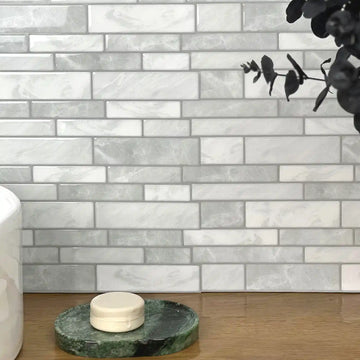
Stickwoll’s wall-tile range is organized around named patterns, color options, shape families and pack sizes. On a product page, the most useful details are the exact tile dimensions, the pattern or shape, the color option, the installation and care guidance, and any room-specific placement limits. That is more actionable than assuming every Stickwoll design behaves identically because the products share a peel-and-stick format.
If you are comparing several Stickwoll designs, start with the visual pattern and dimensions, then check whether the page is positioned for a backsplash, bathroom wall, rental project or general accent wall. A shopper choosing between two products with the same listed color and sheet size should use the product gallery to compare the actual artwork rather than expecting the specification table to create a difference that is not there. You can browse the current range in the Stickwoll peel-and-stick tile collection and use the Peel-and-Stick Tile Guide for broader planning.
How Smart Tiles documents product limits
Smart Tiles is useful as a comparison example because the company publishes unusually specific FAQ guidance. Its FAQ describes the brand’s self-adhesive wall tiles and gives product-specific recommendations for installation behind stoves and cooktops, around countertop appliances, and in bathrooms. It also states that its tiles are not recommended directly inside a shower or bathtub where they would receive large amounts of water. That kind of boundary is more useful than a single “waterproof” or “heat-resistant” badge because it tells the shopper where the manufacturer draws the line.
The lesson is not that every Smart Tiles product should be treated as interchangeable or that the same clearances apply to another brand. The lesson is to look for the same level of specificity from whichever product you buy. If a listing says only “heat resistant” but never explains direct flame, appliance distance, steam or maximum-use conditions, you still have an unanswered installation question.
How Art3d separates instructions by product family
Art3d’s customer-service installation page links different guides for vinyl peel-and-stick tile, peel-and-stick metal tile, reclaimed wood and other panel categories. That separation matters because “Art3d” is a brand, not a single material. A metal-faced backsplash and a flexible vinyl sheet may require different cutting tools, edge handling and placement decisions even when both appear under the same brand umbrella.
When comparing Art3d with another brand, match construction to construction. Do not compare one company’s flexible vinyl product with another company’s thicker composite or metal product and then attribute the difference to “brand quality.” First decide which construction you actually want, then compare the relevant SKU instructions, dimensions, surface requirements and care limits.
How Tic Tac Tiles presents its Original line
Tic Tac Tiles’ Original collection describes self-adhesive vinyl sheets with raised texture and offers multiple visual families, including subway, square, stone-look and terrazzo-style designs. The company also publishes its own resistance claims for that line. Those claims belong to the products and conditions described by Tic Tac Tiles; they are not a universal specification for every self-adhesive wall tile.
For a buyer, the useful comparison is therefore not “Tic Tac Tiles says X, so every vinyl tile does X.” Instead, note which properties are explicitly documented, then ask whether the exact Stickwoll, Smart Tiles, Art3d or other SKU you are considering publishes an equivalent instruction. If one manufacturer gives a room restriction and another gives no room guidance at all, the missing information is part of the purchasing decision.
Do not compare price before normalizing coverage
Sticker price is one of the easiest ways to make a misleading brand comparison. A pack can contain different numbers of sheets, and sheets can have different dimensions. Some designs use overlaps or interlocking edges that reduce usable coverage. A lower pack price can therefore cost more for the same wall once you convert both products to usable area.
Measure the wall first, subtract only openings that the manufacturer’s planning method allows you to subtract, and calculate the usable area of one tile or sheet. Then add an allowance for cuts, alignment and future repairs. The correct allowance depends on the pattern and room; a straight wall with forgiving seams may waste less material than a layout with many outlets, corners and directional pattern matching. The comparison should be “total material required for this wall,” not “price of one pack.”
A simple worksheet can use four fields: wall width × wall height, usable coverage per piece, number of pieces per pack, and a waste or spare-material allowance. Once those are equalized, you can compare delivered product cost, tools and any surface-preparation materials. Taxes, shipping and replacement policies belong in the same calculation because they affect the real project cost.
Surface preparation is a brand-comparison category
Some product pages make surface requirements prominent; others bury them in installation instructions. Read both. A tile may look ideal in a product photo but be a poor choice for a wall with peeling paint, heavy texture, powdery drywall, wax, kitchen grease or unresolved moisture. If the surface is weak, changing brands does not fix the substrate.
Look for instructions covering cleaning, drying, new paint, glossy surfaces, existing tile and grout lines. If a brand recommends sanding, priming or another surface treatment, check whether that treatment is permitted in your rental or compatible with the wall. When older paint may contain lead, surface disturbance becomes a safety issue rather than an adhesion trick. The U.S. EPA’s lead-safe renovation guidance for DIYers explains why sanding, scraping, drilling and other work on pre-1978 painted surfaces can create hazardous lead dust.
Water resistance needs a room-level question
A water-resistant face, sealed-looking seam or vinyl construction does not automatically make a wall assembly suitable for direct shower exposure. Water can enter through edges, penetrations, failed seams or the substrate behind the decorative layer. The correct question is not “Is this tile waterproof?” but “Is this exact product approved for this exact location, and what does the manufacturer require at seams and edges?”
The EPA’s guidance on mold and moisture emphasizes controlling moisture sources rather than covering them. If a sink leak, plumbing leak, condensation problem or damp wall exists, solve that condition before installing a decorative finish. A new backsplash should not be used to hide an active moisture problem.
Heat resistance needs an appliance-level question
“Heat resistant” is also incomplete without placement guidance. A backsplash behind a range, a wall beside a toaster oven and a decorative wall across the room do not experience the same heat. Direct flame, concentrated radiant heat and hot exhaust are different from normal room temperature. Brand documentation is most useful when it explains the relevant appliance clearances rather than relying on a general heat icon.
Smart Tiles, for example, publishes stove and countertop-appliance guidance for its own products. Use those instructions only for Smart Tiles. For any other brand, follow that brand’s exact guidance and the appliance manufacturer’s required clearances. If the product page does not answer the question, contact the seller or choose a placement that avoids the uncertain heat zone rather than assuming that a competitor’s number transfers.
Renter-friendly is a removal question, not a slogan
A renter can install a product that is marketed as removable and still damage paint if the wall coating is weak, uncured, poorly bonded or already failing. Conversely, a well-prepared stable surface may tolerate a temporary installation better. That is why “renter-friendly” should trigger a test plan rather than a promise about a security deposit.
Before buying, ask whether the manufacturer publishes a removal method, whether heat is recommended, whether extra adhesive is prohibited, and whether the instructions tell you to test the surface. Keep the packaging and installation documentation. In a rental, also check the lease or ask the landlord before altering the wall. The product manufacturer cannot override a lease agreement, and a marketing phrase cannot guarantee the condition of the paint months later.
Compare installation complexity honestly
Peel-and-stick products are usually simpler than mortar-set tile because they remove mixing, troweling and grout from the basic workflow, but “easy” does not mean zero planning. The time still includes cleaning, drying, measuring, dry layout, reference lines, cuts, outlets, corners, seam alignment, final pressure and cleanup. A small uninterrupted backsplash and a full wall with outlets and window returns are different projects.
Ask which tools the exact construction requires. Some thin vinyl products can be cut with a utility knife or scissors; thicker composites or metal-faced products may require different tools. Never assume the cutting method from a product photo. Art3d’s separate installation guides illustrate why construction-specific instructions matter. If a seller groups many materials under one generic instruction page, verify the guide that actually matches the SKU.
Compare the seam system before you compare photos
Product photography can hide the detail that often determines the final look: the seam. Some products overlap, some interlock, some butt together, and some simulate grout within a printed or molded surface. Directional patterns may require a specific orientation. A product can look convincing in one isolated sample and repetitive or visibly seamed across a larger wall.
Order or inspect enough material to understand the repeat. Place several pieces together before removing backing. Look at the wall from normal viewing distance and from the side under the room’s actual lighting. Glossy surfaces may emphasize relief and seams, while low-contrast patterns may hide them. A brand comparison that ignores repeat scale and seam design misses one of the biggest real-world differences between products.
Check dimensions and pack structure on every SKU
Within one brand, two designs may use different tile sizes or sheet formats. Within one product, pack choices may also differ. If you are replacing only one damaged piece later, the ability to match the exact size and pattern can matter more than saving a few dollars on the first order.
For that reason, record the handle or SKU, tile dimensions, pack size and order date. Keep one or two spare pieces when practical. If the brand changes its assortment later, a saved spare can make a local repair much easier than trying to match a discontinued pattern from a photo.
Use manufacturer claims as inputs, not shortcuts
Brand pages often use words such as waterproof, heat resistant, renter-friendly, durable, antimicrobial or mold resistant. Those terms can be useful starting points, but they are not interchangeable and they do not all describe the same test. Ask what part of the product the claim applies to, whether a standard or certificate is named, what installation conditions are required, and what exclusions appear in the instructions.
For example, a waterproof face does not necessarily describe the seams, wall penetrations or substrate. A “mold resistant” surface claim does not solve moisture behind the wall. A heat-resistance claim does not mean direct-flame exposure is acceptable. A removable adhesive does not guarantee intact paint. A strong buying guide separates the product attribute from the complete installed system.
How to compare environmental claims
If sustainability matters to you, compare specific declarations instead of broad green language. Recycled content, low-emitting material certification, product environmental declarations and packaging choices answer different questions. One does not prove the others. Ask whether the claim applies to the whole tile, one layer, a percentage of material, the packaging or only a manufacturing process.
A useful rule is to look for the document behind the claim. If a listing says “eco-friendly” but provides no defined attribute, certification, percentage, scope or disposal information, treat the phrase as incomplete. This same discipline helps across brands because it prevents a vague slogan from outweighing more concrete product information.
Do reviews prove that one brand is better?
Reviews can reveal recurring installation problems, confusing instructions, color differences or packaging issues, but star ratings are not controlled product tests. Review populations differ, incentives may differ, and people install products on different surfaces under different conditions. Use reviews to generate questions for the product page, not to turn small rating differences into a technical ranking.
Look for repeated themes: Did several reviewers mention difficult seam alignment? Did multiple buyers say the color changed under warm light? Are complaints concentrated around textured walls or wet areas that the manufacturer does not recommend? Then return to the manufacturer instructions and see whether the reported issue matches a known limitation.
A better way to shortlist brands
- Define the room and wall. Write down substrate, texture, paint condition, moisture exposure, heat sources and whether the project is temporary.
- Pick the construction. Decide whether you want flexible vinyl, a thicker composite look, metal-faced material or another product family before comparing decorative patterns.
- Collect exact instructions. Save the installation and care page for each candidate SKU or product family.
- Normalize coverage. Convert pack price to the quantity required for your wall, including cuts and spares.
- Compare placement limits. Check sink, shower, cooktop and small-appliance guidance separately.
- Dry-test the appearance. Compare multiple pieces together under the room’s actual lighting.
- Test the surface. For a temporary installation, test a hidden area before committing to the entire wall.
- Keep a repair plan. Save spare pieces and the exact product identifier if future matching matters.
What should a sample order answer?
A sample is most useful when it answers questions you cannot resolve from a listing. Does the color work next to your cabinets and countertop? Does the relief cast strong shadows? Do seams disappear at normal viewing distance? Can you cut the material cleanly with the recommended tool? Does the adhesive make broad contact with your prepared wall? Those observations are more valuable than using one sample to predict years of service life.
If the product is being considered for a rental, the sample can also support a hidden-area removal test after the manufacturer’s recommended dwell time. Do not treat a short test as proof that removal will be identical after a much longer installation, because paint age, adhesive dwell time and environmental exposure can change the outcome. The purpose is to catch an obviously incompatible surface before covering the whole wall.
When should you choose traditional tile instead?
Peel-and-stick wall tile is not the answer to every project. A properly designed traditional tile assembly may be the more appropriate choice when the location requires a full wet-area waterproofing system, when the wall needs structural repair, when high heat or direct flame is involved, or when a long-term installation justifies mortar, grout, backer and waterproofing work. The decorative surface should not be used to solve a building-envelope or moisture problem.
Traditional tile also offers different repair and finish options. Grout color, joint width, trim profiles and substrate systems can be selected as part of a permanent assembly. That usually requires more tools, skill, time and demolition than a self-adhesive wall tile, but those trade-offs may be appropriate for an owner planning a long service life in a demanding location.
When is peel-and-stick wall tile a strong fit?
Peel-and-stick products are especially useful when the wall is already smooth and stable, the location is within the product’s documented limits, the project benefits from lower installation complexity, and the shopper values pattern changes or a lighter-weight decorative layer. Kitchens outside direct-flame zones, dry accent walls, some vanity areas and other interior wall projects are common use cases, subject to the exact product instructions.
The strongest fit is not “everyone who wants an easy renovation.” It is a wall that does not need hidden repairs, a product with instructions that match the room, and a shopper willing to measure, prepare and test rather than relying on the adhesive to correct the substrate.
Questions to ask before buying any brand
- What material and thickness is this exact design?
- What surfaces are approved, and which surfaces are excluded?
- How long should new paint cure before installation?
- Are deep grout lines or textured walls acceptable?
- How does the seam or overlap work?
- Which tools are recommended for cuts and final pressure?
- What does the manufacturer say about sinks, bathrooms, showers and humidity?
- What clearance is required near ranges and countertop appliances?
- Does the product require acclimation or a minimum installation temperature?
- What cleaners are compatible with the finish?
- How should the product be removed, and is a test area recommended?
- Can matching replacement pieces be ordered later?
Frequently asked questions
Which peel-and-stick tile brand is the best?
There is no universal winner. The best fit depends on your wall, room exposure, preferred construction, design, dimensions, installation method and removal plan. Compare exact SKUs using the same checklist rather than ranking entire brands from a single product or star rating.
Are more expensive peel-and-stick tiles automatically better?
No. Price can reflect material, manufacturing, distribution, design, pack size or brand positioning, but price alone does not prove better adhesion or room suitability. Normalize usable coverage and compare the product instructions before deciding whether a price difference buys something relevant to your wall.
Can I compare heat-resistance claims across brands?
Only if the claims define comparable conditions. One manufacturer may publish a stove clearance, another may restrict direct flame, and another may give only a general heat-resistance statement. Follow the exact manufacturer and appliance guidance for the product you install rather than borrowing a competitor’s clearance.
Is a water-resistant peel-and-stick tile safe in a shower?
Not automatically. Direct shower exposure is a different condition from routine sink splashes or bathroom humidity. Check whether the exact product is approved for the location and whether the full wall assembly has the required waterproofing. If the manufacturer excludes shower or bathtub use, do not treat a water-resistant face as permission to install there.
Which brand is best for renters?
Start with the lease and the wall, not the logo. Look for clear removal instructions, test a hidden area, avoid adding unapproved permanent adhesive, and remember that no manufacturer can guarantee how unknown paint or drywall will respond months later. A product can be convenient for temporary projects without guaranteeing zero restoration work.
Should I trust “mold resistant” or “antimicrobial” marketing?
Read the exact scope and evidence. A surface treatment does not correct a leak or hidden wall moisture. The EPA’s moisture guidance is clear that controlling the water source is central to mold prevention. Treat surface claims as product attributes, not substitutes for moisture control.
Do I need to buy samples from every brand?
Not necessarily, but a sample can be valuable when color, relief, repeat scale, seam visibility or wall compatibility is uncertain. If two products look very similar online, testing them in the actual room can resolve more than another hour of comparing marketing copy.
Bottom line
A useful peel-and-stick tile comparison does not declare one brand the winner. It narrows the field by asking the same questions of every product: what it is made from, where it can be installed, how the wall must be prepared, how seams and cuts work, what heat and water limits apply, how removal is handled and how much usable coverage you are actually buying.
Stickwoll, Smart Tiles, Art3d and Tic Tac Tiles each publish different levels and types of product information. Use those documents as evidence for their own products, then verify the exact SKU you intend to install. When the wall, room and instructions line up, the brand comparison becomes much easier—and much more useful than a “top 10” list.



Leave a comment
This site is protected by hCaptcha and the hCaptcha Privacy Policy and Terms of Service apply.