





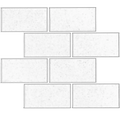




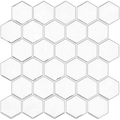
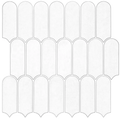
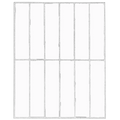
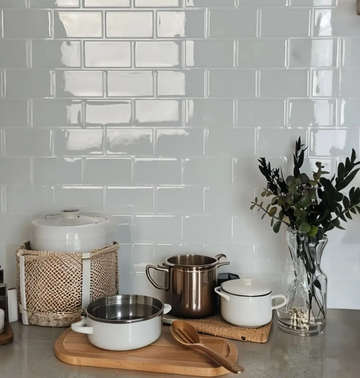
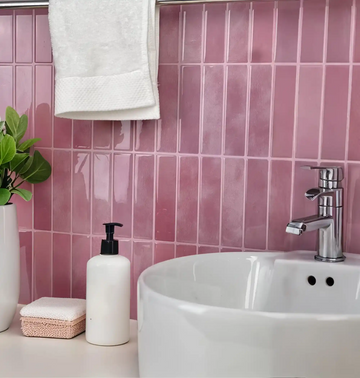



A peel-and-stick backsplash may be appropriate for a kitchen wall, but “installed near food” is not the same as “approved for direct food contact.” Before buying, confirm that the exact product and its instructions support your wall location, indoor-air priorities, heat exposure, moisture conditions, and cleaning routine.
Explore this guide
That distinction matters because a backsplash is a layered building product. The visible surface may sit over a printed layer, coating, substrate, and pressure-sensitive adhesive. A broad claim about one layer does not automatically describe the finished tile or sheet. Terms such as “food-safe,” “non-toxic,” “low-VOC,” “certified,” and “heat-resistant” are useful only when the manufacturer explains their scope.
This guide uses a four-check decision process:
- Contact: Will food merely be prepared nearby, will splashes reach the wall, or is food expected to touch the surface directly?
- Emissions: Is a VOC claim about chemical content, finished-product emissions, a defined test method, or only a marketing label?
- Heat: Do the backsplash instructions and the appliance manual support the actual location?
- Care: Can the installed surface, including seams and edges, tolerate the cleaning and moisture it will receive?
This article applies a United States regulatory and public-health framework and uses U.S. English. Requirements and terminology may differ in other countries. It also evaluates peel-and-stick backsplashes as decorative wall coverings, not as cutting boards, food-preparation counters, or surfaces for storing unwrapped food.

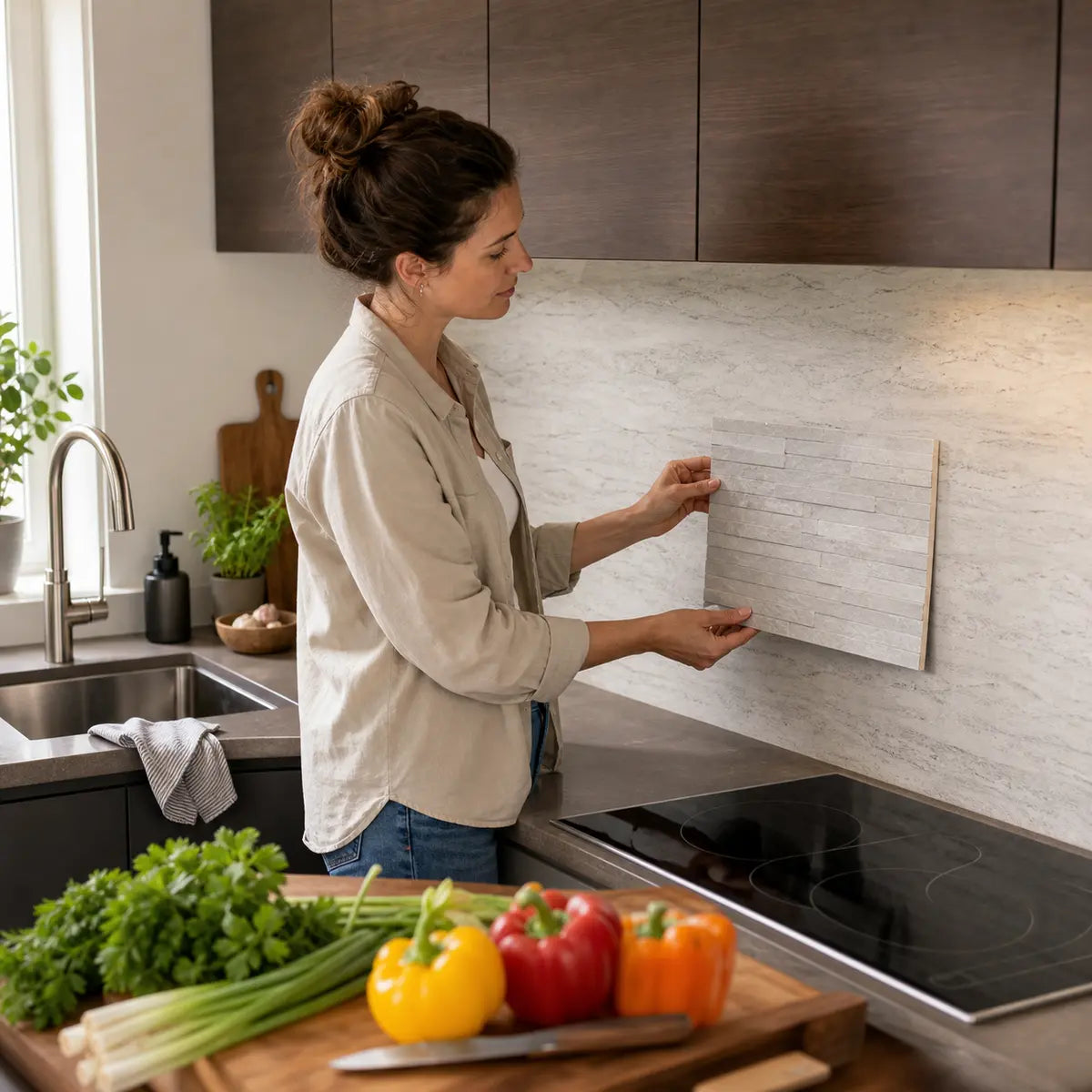
Kitchen-care illustration. The board and wall have different food-contact roles.
Are peel-and-stick backsplashes food-safe?
Some peel-and-stick backsplashes may be suitable for installation on a kitchen wall, but no universal food-safety verdict applies to the category. Suitability depends on the exact product, its intended use, where it will be installed, what will touch it, and whether the available documentation covers those conditions.
The practical answer is usually one of three outcomes:
- Pass: The exact product is intended for the proposed kitchen wall, and its documentation covers the expected contact, emissions, heat, installation, moisture, and cleaning conditions.
- Verify: The product may be a reasonable candidate, but a key claim is vague, unsupported, or missing important conditions.
- Avoid: The intended use conflicts with the instructions, requires direct food contact that has not been documented, or exposes the product to unsupported heat, moisture, or cleaning methods.
This is why “food-safe” can be the wrong opening question. It compresses several different decisions into one phrase.
A material can present a hazard, meaning it has the capacity to cause harm under some conditions, without creating the same level of exposure in every use. Exposure concerns how, how much, and how often a person comes into contact with something. Intended-use suitability asks a more practical question: does the product documentation support this exact installation and the conditions it will face?
A decorative backsplash several inches above a dry coffee station has a different use profile from a wall directly behind a gas cooktop. A smooth sheet beside a counter has different cleaning demands from a deeply textured tile behind a sink. A product that is suitable in one location may be a poor choice in another kitchen zone.
Which kitchen zone are you evaluating?
Define the installation zone before evaluating any safety claim. Product documentation cannot answer your question if the proposed location is still described only as “in the kitchen.”
Use the controls below to record the conditions that apply. There is no score. Every checked condition points to a question that needs a product-specific answer.
The number of checks matters less than their type. One unresolved direct-contact or heat question can outweigh several favorable features.
| Proposed location | Main questions to resolve | Typical decision direction |
|---|---|---|
| Dry decorative wall away from cooking and water | Is the substrate approved? Are indoor-use and cleaning instructions available? | Often lower complexity, but still product-specific |
| Wall above a food-preparation counter | Will food touch the wall? Can splashes be removed without damaging the surface? | Contact and Care become central |
| Sink splash zone | Are seams, cuts, outlets, and lower edges protected as instructed? Is the surface approved for that moisture exposure? | Care and installation details control |
| Behind an electric or induction cooktop | What temperatures can reach the wall? What does each product and appliance manual require? | Heat verification is required |
| Behind a gas range | Are flame, burner exhaust, side clearance, backguard, and wall-finish requirements addressed? | High scrutiny; do not rely on “heat-resistant” alone |
| Near an air fryer, toaster oven, kettle, or countertop oven | Where do hot air and steam discharge? What clearances does the appliance require? | Appliance placement may need to change |
| Commercial or regulated food area | What do adopted health, building, and fire rules require? | Residential guidance is insufficient |
Distance alone does not describe exposure. A wall can be farther from a heating element yet sit directly in a concentrated exhaust path. Another surface may be physically close but shielded by an appliance backguard. Record the appliance model, fuel type, wall distance, vent direction, and any backguard or protective panel before contacting the backsplash manufacturer.
Wall condition also belongs in the safety decision. Poor adhesion can create lifting edges, open seams, trapped soil, or moisture paths. It can also make a product behave differently from its documented installation. After confirming that a candidate is appropriate for the location, use a structured peel-and-stick tile planning guide to evaluate the wall, seams, edges, care needs, and installation process.

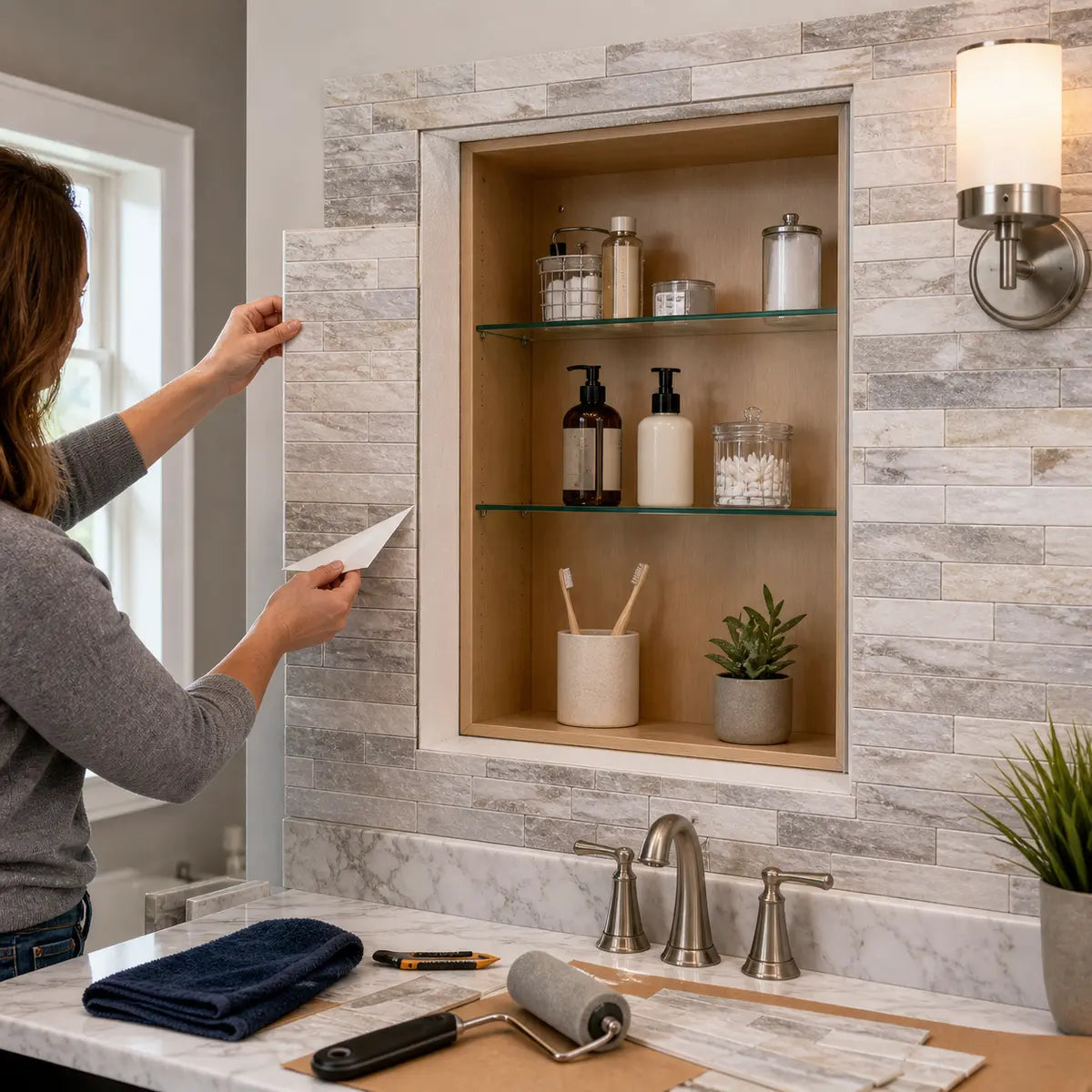
Illustrative joint detail, not evidence of migration, emissions or water-resistance testing.
Check 1: What does “food-safe” mean for a backsplash?
For a backsplash, “food-safe” is meaningful only when the manufacturer identifies the kind of food contact, the finished product covered, and the conditions of use. Ordinary installation near food preparation does not establish that the wall covering can serve as a direct food-contact surface.
Under the U.S. framework, food-contact evaluations focus on actual intended uses. The FDA food-contact substances overview explains that food-contact applications can include food-preparation surfaces, packaging components, adhesives, and colorants. Safety assessment is tied to the intended use, possible migration into food, and resulting exposure.
That framework leads to an important distinction.
Installed near food preparation
Most residential backsplashes are vertical wall coverings. Food may be chopped, mixed, plated, or stored on the counter below, but the wall is not intentionally used as the work surface.
A manufacturer may support this ordinary kitchen-wall use without making any direct food-contact claim. If the installation instructions expressly identify kitchen backsplashes as an intended application, that is useful location evidence. It still does not authorize cutting food on the tile, pressing dough against it, leaning unwrapped ingredients against it, or using it as a temporary serving surface.
Exposed to occasional splashes
Sauce, oil, batter, or beverage splashes may reach a kitchen wall during normal cooking. Instead of assuming that “incidental food contact” is a defined legal category for every residential wall covering, use plain questions:
- Does the manufacturer expect food or grease splashes in the intended application?
- Can the surface be cleaned promptly using an approved method?
- Can soil enter seams, raised textures, outlet cuts, or damaged edges?
- Will the approved cleaner remove the likely residue without softening, clouding, staining, or abrading the surface?
- Does repeated cleaning affect the printed layer or adhesive bond?
A backsplash exposed to splashes needs credible care instructions, even if nobody intends to place food on it.
Direct food contact
Direct contact means food is intentionally placed against or prepared on the surface. This is the highest documentation threshold in the Contact check.
Do not infer finished-product food-contact suitability from statements such as:
- “Food-grade adhesive”
- “Non-toxic ink”
- “BPA-free”
- “PVC-free”
- “Natural material”
- “Eco-friendly”
- “Safe for kitchens”
- “Meets safety standards”
Each phrase may refer to a different part of the product or a different type of safety evaluation. A layered backsplash may include a protective film, clear coating, ink, decorative layer, carrier, foam or composite substrate, and adhesive. A claim about one ingredient does not establish the status of the finished construction.
If direct food contact is genuinely intended, ask for written evidence that identifies:
- The exact product name, model, SKU, or construction.
- The finished surface or complete article covered.
- The jurisdiction or regulatory basis for the claim.
- The type of food contact covered.
- Any food types, temperatures, durations, or cleaning conditions that limit the claim.
- The current document date and responsible manufacturer or supplier.
If the seller cannot provide that information, treat the product as a wall covering only. Use a cutting board, washable mat, tray, or documented food-contact work surface for food preparation.
Why “FDA approved” deserves scrutiny
A vague “FDA approved” badge is not enough. Ask what, exactly, is approved or authorized, under which provision, for which intended use, and for which finished product.
The FDA’s food-contact framework does not classify all decorative kitchen materials as safe merely because they are installed near food. Nor does the absence of direct contact prove that a backsplash is suitable for heat, moisture, indoor air, or cleaning. Contact is one check, not a substitute for the other three.

Compare the actual sample, construction and written use conditions.
Check 2: Do peel-and-stick backsplashes contain VOCs or off-gas?
Some materials used in wall products can release volatile chemicals, but a category-wide statement about peel-and-stick backsplash off-gassing would be unreliable. The useful question is whether the exact finished product has credible, current emissions information for the configuration being sold.
A volatile organic compound, or VOC, is an organic chemical that can enter the air under certain conditions. In shopping language, VOC claims often blur two different ideas:
- VOC content: What volatile chemicals or regulated VOCs are present in a liquid, ingredient, coating, adhesive, or formulation.
- VOC emissions: What chemicals leave the finished product and enter surrounding air under defined test conditions.
Those are related, but they are not interchangeable.
Why “low-VOC” does not finish the analysis
A low-VOC label can be useful when its basis is clear, yet it is not a complete indoor-air or health conclusion. The EPA guidance on VOCs in household products explains that some regulatory VOC definitions were developed around outdoor ozone formation. Certain volatile chemicals may be excluded from those definitions even though indoor toxicology is a separate question. EPA also cautions that a lower total VOC measurement does not automatically establish that a product is safer overall.
This does not mean that emissions data are useless or that every low-VOC claim is misleading. It means the label needs a defined basis.
Ask:
- Does “low-VOC” describe an adhesive ingredient, a coating, or the complete backsplash?
- Is the claim based on chemical content or measured emissions?
- Which test method or certification program was used?
- Does the report identify the exact product?
- Was the adhesive included in the tested configuration?
- Does the color, print, finish, thickness, or backing match what you plan to buy?
- What result was reported, and under what test conditions?
- Is the report current?
What a chamber-emissions test tells you
An environmental chamber is a controlled enclosure used to measure chemicals released from a product under specified conditions. A defined method can set requirements for product preparation, loading, temperature, humidity, ventilation, sampling, analysis, and result calculation.
The California Department of Public Health chamber-emissions method evaluates specified chemical emissions under defined conditions. CDPH now lists Version 1.3 (June 2026), with specified revised criteria effective January 1, 2027. Check the method version and the applicable certification program’s transition rules when reviewing a report; do not assume every older report becomes invalid on the publication date of a new method.
A reference to that method is not, by itself, proof that a product was tested or passed. A credible product-specific claim should connect the method to an identifiable product, test date, tested construction, reporting program, and result. The method also does not answer food-contact, heat, moisture, or cleaning questions.
What an SDS can and cannot prove
A Safety Data Sheet, or SDS, communicates classified chemical hazards and related handling information, mainly in a workplace hazard-communication context. Under the OSHA Hazard Communication Standard, an SDS follows 16 ordered sections covering topics such as identification, hazard classification, composition, first aid, handling, storage, exposure controls, physical properties, and toxicology.
An SDS can help you identify:
- The product or chemical to which the sheet applies
- The responsible supplier
- Classified hazards
- Handling and storage precautions
- Relevant physical properties
- Exposure-control information
- Available toxicological information
An SDS does not automatically provide:
- A complete ingredient list
- A residential exposure assessment
- A finished-product emissions result
- A low-emitting certification
- Food-contact authorization
- A backsplash heat rating
- Proof that no relevant chemical can be emitted
Some finished articles or consumer products may not have an SDS under the same circumstances as hazardous workplace chemicals. An unavailable SDS does not prove that the product is hazard-free, just as an SDS with no classified hazards does not prove that the backsplash meets every intended-use requirement.
Can odor tell you whether off-gassing is safe?
No. Odor is an observation, not a quantitative emissions test. A strong smell does not, by itself, establish a harmful exposure, while little or no smell does not prove that emissions are absent.
The ATSDR guidance on environmental odors explains that people may smell some chemicals before harmful levels are reached. Sensitivity varies, and health risk depends on factors such as the substance, concentration, frequency, duration, and individual susceptibility.
There is no evidence-based universal statement that every peel-and-stick backsplash finishes off-gassing after a set number of hours or days. Product construction, installation area, ventilation, temperature, humidity, and other conditions can differ.
Use odor as a reason to pay attention:
- Follow the manufacturer’s installation and ventilation instructions.
- Stop installation if the odor is severe or someone develops symptoms.
- Move away from the area and seek appropriate medical guidance for concerning or persistent symptoms.
- Ask the manufacturer for product-specific emissions information.
- Do not cover an unexpected odor with fragrances and assume the underlying question is resolved.
For households with asthma, chemical sensitivities, young children, or other health concerns, product-specific information may deserve more weight in the purchasing decision. A healthcare professional can address individual medical risk; a marketing label cannot.

Illustration only; appliance clearance and product limits must be checked separately.
Check 3: Can peel-and-stick backsplash go behind a stove?
A peel-and-stick backsplash should go behind or beside a stove only when both the backsplash manufacturer and the appliance instructions support that exact placement. “Heat-resistant” without a temperature, duration, test condition, and clearance is not enough.
There is no universal peel-and-stick backsplash heat rating. Products can use different face materials, inks, coatings, carriers, and adhesives. Appliances also vary by fuel, burner output, vent direction, backguard design, installation geometry, and required wall finish.
The wall behind a cooking appliance may face several exposures:
- Radiant heat from burners, pans, or heating elements
- Hot air leaving an oven vent
- Flame or combustion heat from a gas burner
- Steam and hot grease
- Repeated heating and cooling
- Concentrated heat near side burners
- Heat from countertop appliances placed close to the wall
A product can remain visually intact while its adhesive softens or its edges lift. The face may also have a lower usable-temperature limit than another layer. For that reason, obtain a rating for the finished product rather than relying on a statement about a single component.
Read both sets of instructions
Start with the range, cooktop, oven, or countertop appliance manual. Look for:
- Required clearance to combustible or decorative wall materials
- Backguard or backsplash requirements
- Side and rear spacing
- Wall-construction requirements
- Vent and exhaust locations
- Restrictions around gas flames or high-output burners
- Instructions for surfaces above the cooking area
Then review the backsplash documents for:
- Maximum service temperature
- Whether the limit is continuous, intermittent, or peak
- Where the temperature is measured
- Minimum distance from a burner, heat source, or vent
- Approved appliance types
- Restrictions for gas ranges
- Required wall shields, panels, or backguards
- Adhesive temperature limits
- Warranty exclusions related to heat
The controlling answer is the strictest applicable instruction. A backsplash statement does not override the appliance manual, local code, lease terms, or building requirements. An appliance clearance does not prove that a particular adhesive wall covering is suitable within that space.
Why copied temperature numbers are risky
A rating published for one product line cannot be transferred to another material or adhesive. The same applies to a clearance number copied from a forum, retailer question, social post, or unrelated installation guide.
Even a real manufacturer value may leave unanswered questions. A stated temperature may refer to the visible tile, adhesive bond, short-term exposure, or a specific installation. If the document does not identify the measurement location or duration, ask for clarification.
Avoid treating a handheld infrared thermometer as a substitute for product approval. Surface measurements can help describe site conditions, but readings vary with appliance operation, pan size, burner use, surface reflectivity, timing, and measurement technique. A single low reading does not establish the highest temperature the wall may experience during normal or foreseeable use.
Stove-adjacent warning signs
Pause the installation if:
- The product documentation gives no heat limit or appliance guidance.
- The appliance manual prohibits the proposed wall finish.
- An open flame can extend toward the wall.
- A burner or oven vent directs concentrated heat at the backsplash.
- The product is already curling, shrinking, discoloring, bubbling, softening, or releasing from the wall.
- Edges are lifting near a heat source.
- The wall has heat damage, moisture damage, grease saturation, or unstable paint.
- The seller’s only evidence is “many customers use it behind stoves.”
For broader selection context, compare material and documentation needs in the guide to stick-on tiles for kitchen walls. Use that comparison to build a shortlist, then return to the exact product instructions before approving a stove-adjacent location.

The pictured position is not approval for installation beside this or any other appliance.
Check 4: Can the backsplash be cleaned safely?
A kitchen backsplash is a stronger candidate when the installed surface is smooth, durable, moisture-appropriate, and cleanable using methods the manufacturer expressly permits. Evaluate the completed installation, not just the center of a new tile.
Seams, lower edges, corners, outlet cuts, overlaps, and penetrations are often the harder parts to clean. A smooth face does not solve soil or moisture entry at a lifting edge. A “waterproof” face does not necessarily mean that the complete installation, adhesive, wall, seams, or cut edges can tolerate repeated water exposure.
The FDA Food Code wall-surface provisions offer a useful cleanability principle: in regulated food establishments, relevant wall surfaces are expected to be smooth, durable, and easily cleanable, with nonabsorbent materials used in areas subject to moisture. The Food Code is a model code for food establishments, not a residential backsplash approval standard, but its emphasis on the installed surface is practical for home purchasing decisions.
Texture changes the care burden
Deep grout impressions, embossed patterns, rough stone-like surfaces, and raised edges create more places for grease or food residue to collect. That does not make every textured backsplash unsuitable. It means the cleaning method and frequency must match the surface.
A Journal of Food Protection cleaning study tested stainless steel, textured plastic, and maple wood food-contact coupons contaminated with peanut-, milk-, and egg-containing foods. Under the tested conditions, wet and full cleaning methods were generally more effective than dry wiping, and textured plastic created removal difficulties.
The experiment did not test vertical peel-and-stick backsplashes, seams, printed films, installed adhesives, heat-aged materials, or residential kitchens. It cannot prove that one backsplash prevents allergen transfer or can be sanitized as a food-contact surface. Its practical lesson is narrower: surface characteristics and cleaning method can affect residue removal, and visual cleanliness may not tell the whole story.
Ask for approved cleaners, not generic advice
Before buying, identify what the manufacturer permits:
- Water only, or water with mild detergent
- Specific cleaner types
- Soft cloth, sponge, or another applicator
- Maximum water or cleaner temperature
- Whether disinfectants or sanitizers are allowed
- Whether alcohol, bleach, ammonia, acids, solvents, or degreasers are prohibited
- Whether abrasive pads or powders will damage the finish
- How quickly spills should be removed
- Whether seams or perimeter edges require sealing
- How damaged tiles or open edges should be repaired
Do not assume that a stronger cleaner creates a safer result. A chemical that removes grease may also dull a coating, loosen ink, attack the substrate, or weaken the bond. Using an unapproved cleaner can create a rougher or more damaged surface that becomes harder to maintain.
The same caution applies to steam cleaners. Heat and concentrated moisture can affect a pressure-sensitive adhesive or enter edges even if the face resists water. Use steam only if the backsplash instructions expressly allow it.
For installation and routine-care steps after the product passes the four checks, consult the peel-and-stick tile installation guide. Wall cleaning before installation and backsplash cleaning after installation are different tasks, so follow the correct instructions for each stage.

Use only the cleaner and exposure permitted for the actual finish.
Inspect the installation over time
Care is not a one-time purchase question. Periodically check:
- Lower edges above the countertop
- Seams behind the sink and cooking area
- Corners and termination points
- Outlet and switch openings
- Areas exposed to kettle, oven, or air-fryer exhaust
- Tiles near repeatedly warm surfaces
- Bubbles, cracks, staining, discoloration, or soft spots
- Any location where food residue or moisture can enter behind the surface
Do not keep pressing a repeatedly lifting edge back into place without identifying the cause. The problem may involve contamination, wall texture, moisture, heat, incompatible paint, insufficient pressure during installation, or product-location mismatch. The common backsplash installation mistakes guide can help distinguish preparation and installation errors from conditions that require a different product or location.
What do the product documents actually prove?
Each document answers a limited set of questions. No single product page, SDS, certificate, or technical sheet proves total kitchen safety. Build the answer by matching each claim to the document intended to support it.
| Document or claim | What it may help establish | What it does not establish by itself |
|---|---|---|
| Product page | Intended rooms, general material description, dimensions, appearance, basic installation claims | Direct food-contact status, measured emissions, exact heat limits, cleaner compatibility, or regulatory compliance unless specifically documented |
| Installation instructions | Approved substrates, wall preparation, temperature during installation, seams, pressure, curing or waiting periods, placement restrictions | Chemical emissions, food-contact authorization, or every long-term care outcome |
| Technical Data Sheet | Construction, thickness, service limits, storage, performance conditions, substrate requirements | Independent verification unless a test report or listing is identified |
| Safety Data Sheet | Classified workplace chemical hazards, handling, storage, exposure controls, and related information | Complete ingredients, food-contact authorization, residential exposure assessment, or chamber-emissions performance |
| Emissions report | Chemicals measured from an identified product under a defined chamber method and test configuration | Food-contact status, heat resistance, water resistance, or performance outside the test conditions |
| Certification listing | That an identified product met a defined program’s requirements at a stated time | Claims outside the program’s scope or coverage of a different SKU, finish, backing, or formulation |
| Food-contact declaration or authorization evidence | Suitability for a defined food-contact use under stated conditions | Heat, wall adhesion, moisture performance, or unrestricted contact with every food |
| Use-and-care instructions | Approved cleaners, tools, moisture exposure, stain response, and maintenance limits | Permission to use the wall as a food-preparation surface |
| Appliance manual | Clearances, wall requirements, backguard needs, and heat-source restrictions for the appliance | Suitability of a specific peel-and-stick product |
Three document checks catch many weak claims.
Does the document identify the exact product?
Look for the manufacturer, product line, SKU, model, thickness, backing, finish, color family, and construction. A report for a hard glass tile may not cover a flexible vinyl sheet. A test for an unprinted material may not cover the printed and coated version sold at retail.
Does it name the method and result?
“Tested” is incomplete. Ask what was tested, by whom, using which method, on what date, and with what result. A logo or method name without an identifiable product listing or report is not a result.
Does the scope match your decision?
A heat test does not prove low emissions. An emissions test does not prove food-contact suitability. An SDS does not approve a cleaner. A water-resistant face does not prove that seams can withstand sink spray.
This document-by-document approach may feel slower than relying on a label, but it prevents false confidence. It also makes product comparison easier because you can identify the exact missing evidence instead of asking a seller to confirm that the product is “safe.”
For a broader shopping process, use the peel-and-stick vinyl backsplash buying guide to compare construction, installation needs, reviews, and documentation. Reviews can reveal recurring installation experiences, but they should not replace technical evidence for food contact, emissions, heat, or cleaner compatibility.

Assess the actual work and splash paths rather than the room label alone.
Build a product file before you buy
Collect the exact product documents before ordering the full installation quantity. A small product file keeps model numbers, claims, and answers connected to the item you will actually install.
Record:
- Product name and SKU
- Seller and manufacturer
- Material and layer description
- Installation instructions
- Technical Data Sheet, if available
- Safety Data Sheet, if applicable and available
- Emissions report or current certification listing, if claimed
- Heat rating and rating conditions
- Appliance clearance restrictions
- Approved substrates and paint-cure requirements
- Moisture and seam instructions
- Approved cleaners and prohibited chemicals
- Warranty exclusions
- Written manufacturer answers
- Date each document was downloaded or received
Save screenshots or copies of claims that influence your decision. Product pages can change, and a later dispute is difficult to evaluate if you cannot show which instructions applied at purchase.
Ordering a sample can help you evaluate color, scale, texture, cutting, and basic cleaning response. A home sample test does not establish regulatory food-contact status, quantify emissions, or replace a heat rating. It can still reveal practical problems such as a texture that traps residue, a print that marks easily, or an adhesive that is incompatible with a small hidden area of the wall.
For layout and style planning after the safety questions are addressed, the kitchen backsplash ideas guide can help connect appearance with moisture, wall preparation, and sample selection.

A visible backing or material appearance does not establish a chemical or food-contact rating.
Ask the manufacturer precise questions
Ask narrow questions that can be answered with a document, rating, or explicit yes-or-no boundary. “Is this safe for a kitchen?” invites a broad marketing response.
Use the inquiry below as a starting point.
Subject: Technical information request for [exact product name and SKU]
I am considering installing this product at [exact wall location] in a residential kitchen.
Please provide current documents or written answers for the following:
- Is this exact product intended for installation in that location?
- Is the finished product intended for direct contact with unwrapped food? If yes, what regulatory basis and conditions of use support that statement?
- Does any “low-VOC” or emissions claim cover the finished tile or sheet, including its adhesive, print, coating, and backing?
- What test method, report, certification program, product identifier, test date, and result support the emissions claim?
- What is the maximum service temperature for the finished product?
- Is that temperature continuous, intermittent, or peak, and where is it measured?
- What minimum clearance is required from my appliance or heat source?
- Are there restrictions for gas ranges, cooktops, oven vents, air fryers, toaster ovens, kettles, or other countertop appliances?
- Is the product approved for the expected water, steam, grease, and food-splash exposure?
- Which cleaners, disinfectants, cloths, pads, and water temperatures are approved?
- Do seams, lower edges, corners, or outlet cuts require sealing?
- Which wall surfaces and paint conditions are approved?
- What conditions can cause edge lifting, wall damage, staining, or warranty exclusion?
Please confirm that the answers apply to [exact product name, SKU, finish, backing, and size].
A useful response identifies the product and attaches the relevant documents. “Yes, it is non-toxic and heat-resistant” leaves the central questions unanswered.
If the seller and manufacturer provide conflicting instructions, do not choose the more permissive answer by default. Ask the manufacturer to resolve the conflict in writing. For appliance-related placement, compare that response with the appliance manual and any applicable local requirements.
Use the Pass, Verify, or Avoid decision
Pass only when every critical condition is supported for the exact product and location. A favorable answer in three categories does not cancel an unresolved direct-contact or heat issue in the fourth.
Pass
A product can pass your purchase screen when:
- Kitchen-wall use is explicitly supported.
- Direct food contact is not intended, or the exact intended contact has product-specific support.
- Emissions claims identify the finished product, method, and result.
- The backsplash and appliance instructions both allow the proposed heat-source placement.
- The wall and paint meet substrate requirements.
- Moisture exposure is within the product’s instructions.
- Approved cleaning methods fit the residue likely in that location.
- Seams, edges, cuts, and penetrations can be installed and maintained as directed.
A Pass does not mean zero risk or universal food safety. It means the documentation supports the intended wall use within stated boundaries.
Verify
Keep the product on hold when:
- “Food-safe,” “non-toxic,” or “low-VOC” has no defined scope.
- A certificate logo appears without a searchable listing or report.
- The test document does not identify the product.
- The material description omits the adhesive, coating, or backing.
- The heat claim has no temperature or clearance.
- A temperature is published without duration or measurement conditions.
- The seller says “behind stoves” but the installation instructions do not.
- The cleaning instructions do not address grease, moisture, seams, or common cleaners.
- The product page and technical documents conflict.
- The exact SKU or formulation is unclear.
Verification is a purchase stage, not a failure. It gives the manufacturer a chance to supply a precise answer.
Avoid
Choose another product or location when:
- You plan to prepare or store unwrapped food directly against the backsplash and no finished-product contact evidence supports that use.
- The appliance or backsplash instructions prohibit the proposed placement.
- No usable heat limit or clearance can be obtained for a heat-exposed zone.
- The wall has unresolved moisture, grease, heat, or structural damage.
- The product cannot tolerate the cleaning required for the location.
- The installation would leave open, absorbent, damaged, or persistently lifting edges in a splash zone.
- A strong or unexpected odor creates symptoms and the product-specific questions cannot be resolved.
- The only support is a retailer badge, customer review, or verbal reassurance.
- Required local approvals or property permissions are unavailable.
Moving the backsplash farther from a heat source, choosing a smoother finish, adding an approved protective panel, or using a different wall material may turn an Avoid location into a workable project. The solution does not always require abandoning the design.
Which products belong on your shortlist?
Shortlist products by documentation and location fit before choosing by pattern or price. Appearance matters, but a beautiful tile that lacks the required heat, emissions, or care information is not yet ready for the intended installation.
A practical comparison order is:
- Intended room and wall location
- Product construction
- Substrate compatibility
- Heat limits and appliance restrictions
- Moisture and seam requirements
- Cleaning compatibility
- Emissions evidence, where relevant to your priorities
- Contact boundary
- Warranty terms
- Color, pattern, texture, quantity, and price
The DIY kitchen backsplash guide can help map preparation, installation, maintenance, and removal questions after a product has cleared the safety screen.
Store product pages can also be used to record the exact product name and prepare a documentation request. For example, you can review the Snowfall Grid product page or the Nature's Green product page as candidate style pages. Do not treat those links as proof of a temperature limit, emissions result, certification, direct food-contact status, or appliance clearance. Obtain current product-specific documents before approving either product for your location.
That boundary is important: a product recommendation is earned by evidence that matches the reader’s use. A category label or attractive listing cannot supply missing technical conditions.

Illustrative edge inspection. The image does not certify the full installed wall.
Compare documents by the question they answer
A useful product file does not need a large number of certificates. It needs a clear connection between each important claim and the evidence for the exact construction. Put the intended location first, then list food contact, air emissions, heat exposure and care as separate questions. A favorable answer in one column cannot compensate for an exclusion in another. This prevents an impressive-looking document from being used outside its actual scope.
For example, imagine that a seller supplies an indoor-emissions certificate and an installation guide for a decorative wall product. Those documents may help with the identified wall use, but they do not establish direct contact with unwrapped food. If direct food contact is essential, ask for the regulatory basis and conditions for that specific use. Do not treat the absence of visible residue on a sample as a migration test or a reason to use the material as a chopping surface.
The FDA explains that food-contact assessments consider potential migration and the resulting dietary exposure. Its food-contact notification authorizations are specific to the company and intended use, while other regulatory pathways have their own scope. A claim about an ingredient or one authorized use is therefore not a blanket endorsement of every finished decorative article. FDA explanation of food-contact review.
Keep method versions and certificate scope visible
Record the method version, report date and product identifier instead of writing only certified. As checked in September 2026, CDPH lists Standard Method Version 1.3 (June 2026), with identified revised emission criteria taking effect on January 1, 2027. This does not let a shopper independently declare every older report invalid. Ask the laboratory or certification program which version and transition rules apply to the submitted product and the claim being made. CDPH method versions and transition information.
A test report can also describe a specimen that differs from the installed assembly. Ask whether backing, decorative print, adhesive and any additional primer or sealant were included. If an extra product is introduced during installation, its information must be evaluated separately where relevant. A certificate for one supplied sheet does not automatically characterize every possible combination a homeowner might create.
Turn the answer into a practical purchase decision
Use a short decision note: approved location and substrate, applicable product identity, required preparation, exposure exclusions, care method and unresolved questions. Attach the supplier's response rather than paraphrasing away an important condition. If the answer is incomplete, ask a narrower follow-up or choose another appropriate use. No amount of color preference or pack discount makes an excluded application acceptable.
Keep the note when the order arrives. Compare the received product and visible labels with the evidence you relied on. Where a substitute is proposed, ask whether the documents cover it before installing. The substitute may be entirely suitable, but the answer should come from its actual identity and conditions, not from a similar picture or a shared brand name.
Review the same file when kitchen use changes. Moving a kettle, adding an air fryer or adopting a different cleaner can change the exposure without changing the wall's appearance. Recheck the relevant condition rather than assuming that the original purchase decision covered every future arrangement. This is an everyday maintenance step, not a claim that the product is unsafe whenever the room changes.
Frequently Asked Questions
Can food directly touch peel-and-stick backsplash tile?
Do not intentionally place or prepare unwrapped food on a peel-and-stick backsplash unless the manufacturer provides product-specific evidence supporting direct food contact under those conditions. Ordinary kitchen-wall suitability is a different claim.
Use a documented food-contact surface for cutting, kneading, plating, cooling, or storing food. If food accidentally splashes onto the wall, follow the backsplash manufacturer’s approved cleaning instructions.
Is a non-toxic backsplash automatically food-safe?
No. “Non-toxic” is too broad to establish direct food-contact suitability, low emissions, heat resistance, or cleaner compatibility.
Ask what the term refers to: a raw material, an ingredient, the finished product, a hazard classification, or a specific test. Then match that evidence to the decision you need to make.
Does a low-VOC peel-and-stick backsplash have no off-gassing?
Not necessarily. “Low-VOC” may refer to chemical content rather than measured emissions from the finished product. It may also rely on a VOC definition that does not answer every indoor-air question.
Ask for a product-specific emissions report or current certification listing that identifies the test method, complete product construction, result, and date. Do not use odor alone to confirm or reject the claim.
How long should I air out peel-and-stick backsplash before installation?
There is no verified universal airing-out period for every peel-and-stick backsplash. Follow the exact product’s storage, acclimation, installation, and ventilation instructions.
If instructions are absent, ask the manufacturer. Do not invent a waiting period based on a different wall product, adhesive, or customer review.
Is peel-and-stick backsplash safe behind a gas stove?
It may be suitable only if the exact backsplash instructions, gas-appliance manual, installation geometry, and applicable local requirements all support the placement. Gas cooking can involve open flames, concentrated heat, hot exhaust, and model-specific clearance rules.
A generic “heat-resistant” claim is insufficient. Obtain the finished-product temperature limit, required burner or heat-source clearance, gas-range restrictions, and measurement conditions.
Is waterproof peel-and-stick tile automatically safe behind a sink?
No. A waterproof or water-resistant face does not automatically establish that seams, edges, outlet cuts, adhesive, and the wall substrate can withstand repeated moisture.
Check the complete installation instructions, including perimeter treatment, seam requirements, approved substrates, and cleaning method. Address existing wall moisture before covering it.
Can I use disinfectant or bleach on a peel-and-stick backsplash?
Only if the product’s use-and-care instructions permit that cleaner at the proposed concentration and contact time. Strong chemicals may discolor a print, cloud a coating, soften a surface, or weaken an adhesive.
If disinfectant use is important in your household, make cleaner compatibility a pre-purchase requirement rather than testing an aggressive chemical across the completed wall.
Are peel-and-stick backsplashes safe for renters?
Rental status does not establish removability. Adhesive products may damage paint, paper-faced drywall, weak finishes, or other substrates during removal.
Obtain substrate, paint-cure, removal, and wall-damage guidance for the exact product. Get property-owner approval where required, and do not describe a backsplash as damage-free unless current product-specific evidence supports that claim.
Make a bounded decision, not a blanket verdict
A peel-and-stick backsplash is a reasonable kitchen candidate only when the exact product is documented for the exact wall location. Proximity to food does not make a decorative surface suitable for direct food contact, and one reassuring label cannot answer Contact, Emissions, Heat, and Care at the same time.
Proceed when you can confirm all of the following:
- The wall location is an intended application.
- The food-contact boundary matches how the surface will be used.
- VOC or emissions claims have a clear product-specific basis.
- The appliance and backsplash instructions support the heat exposure.
- The wall, paint, seams, and edges meet installation requirements.
- Moisture exposure is allowed.
- The approved cleaning method is practical for the area.
Pause when a critical document omits the product identity, test method, result, temperature conditions, appliance clearance, or cleaner restrictions. Ask the manufacturer for a written answer tied to the exact SKU.
Choose another product, protective system, or location if direct food contact is unsupported, heat or moisture conflicts with the instructions, or the installed surface cannot be kept intact and clean. That is the most defensible answer to peel-and-stick backsplash safety: verify the product, verify the place, and stay within the documented use.
Sources and scope
- FDA: Food-Contact Substances — Intended use, migration and exposure, not blanket backsplash approval.
- FDA: Allergen Removal and Transfer Study — Specific coupons and methods, not installed adhesive tiles.
- US EPA: VOC Definitions in Household Products — Content, regulatory definitions and indoor exposure differ.
- CDPH: VOC emissions method versions — Version 1.3 (June 2026) and specified criteria effective January 2027; check program transition rules, not brand approval.
- OSHA: Safety Data Sheets, Appendix D — Hazard communication and required information; not an installation or food-contact certificate.
- ATSDR: Environmental Odors — Odor response and exposure context; no product diagnosis or safety conclusion from smell alone.
- FDA: Food Code — Model code, not residential approval or local adoption.



Kommentar hinterlassen
Diese Website ist durch hCaptcha geschützt und es gelten die allgemeinen Geschäftsbedingungen und Datenschutzbestimmungen von hCaptcha.