




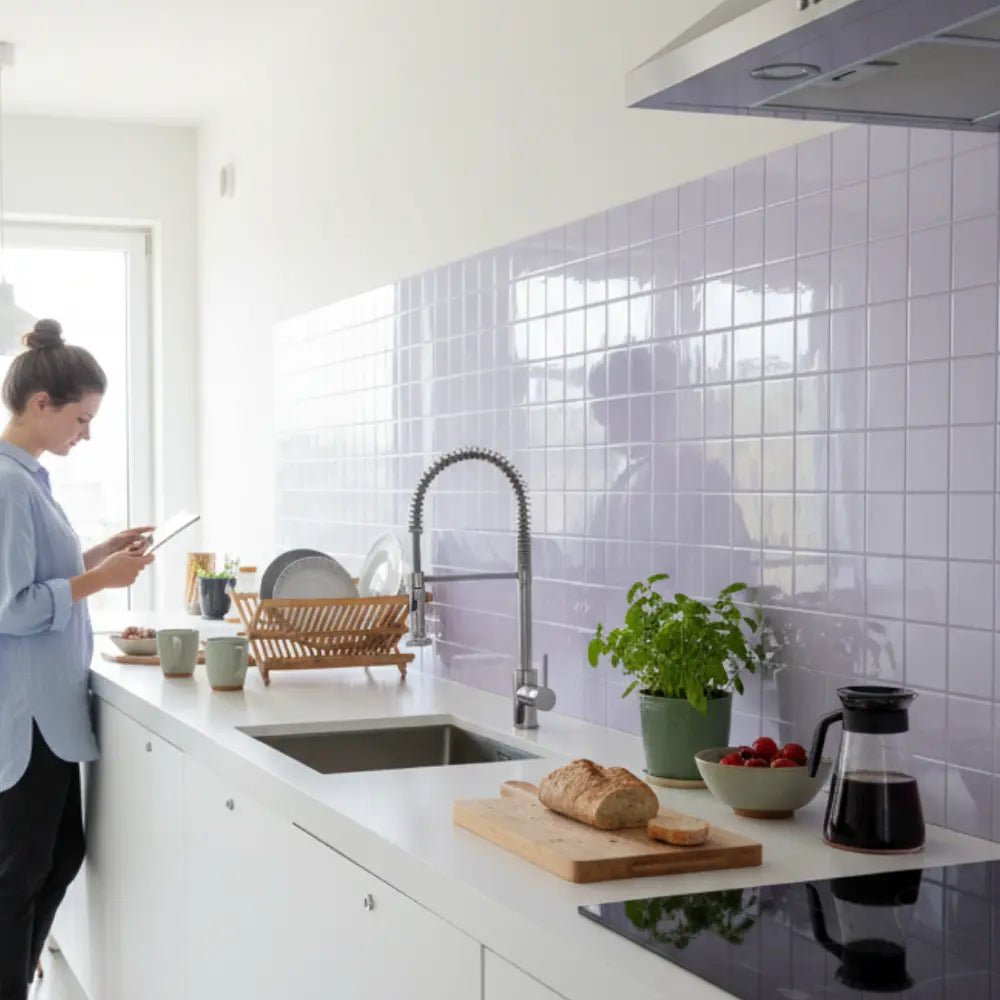






“Heat-resistant tile” can mean two completely different things in an Indian home. On a terrace, the priority is reducing solar heat gain at the exterior roof surface while preserving waterproofing and the complete roof assembly. In a kitchen, the priority is choosing a wall or floor finish that fits the appliance heat, substrate and cleaning conditions. A single material ranking cannot answer both projects.
This guide separates terrace cool-roof performance from kitchen heat exposure. It replaces generic “best tile” rankings, fixed re-coating schedules and universal waterproofing instructions with measurable roof properties, product-specific documentation and room-specific installation decisions.
For terraces, start with cool-roof physics rather than the word “tile”
India’s Bureau of Energy Efficiency describes a cool roof as a roof surface that reflects a large portion of incident solar radiation and efficiently re-emits some absorbed heat. The two key surface properties are solar reflectance and thermal emittance.
Solar reflectance describes the fraction of solar energy reflected by the surface. Thermal emittance describes how effectively the surface re-radiates absorbed heat as infrared energy. A roof can look light-colored and still have different measured performance from another light surface.
Use measured reflectance and emittance instead of “heat proof” marketing
The Bureau of Energy Efficiency Eco-Niwas Samhita 2024 explains cool roofs using solar reflectance, thermal emittance and Solar Reflectance Index (SRI). This is more useful than a seller simply calling a tile “heat resistant.”
When comparing terrace products, ask for measured reflectance/emittance or SRI, the test method, product age/condition and maintenance assumptions. Do not infer thermal performance from color name alone.
Cool roof is not a substitute for insulation
BEE’s ENS 2024 specifically says a cool-roof application should not be treated as an alternative to the roof’s thermal-transmittance requirement. The reflective outer surface and the roof assembly perform different jobs.
A reflective tile or coating can reduce solar heat absorbed at the surface, while insulation and the roof construction control heat flow through the building envelope. Use both parts of the design appropriately rather than expecting one surface finish to solve the complete thermal problem.
Local requirements can be stricter than a national example
Cool-roof requirements can vary by state, city, building type and code adoption. The Telangana Cool Roof Policy 2023–2028, for example, sets its own minimum initial solar reflectance and emittance criteria for qualifying cool-roof materials on low-slope roofs.
That state policy should not be copied as a universal India-wide threshold. Check the code or program that applies to the actual project location.
Solar Reflectance Index is useful only when the test context is clear
SRI combines solar reflectance and thermal emittance into an index representing how hot a surface is expected to become relative to defined reference surfaces. It is useful for comparing roof surfaces when the measurement and calculation are documented.
Do not convert SRI into an indoor-temperature guarantee. Indoor comfort also depends on insulation, roof mass, ventilation, air-conditioning, glazing, orientation, occupancy and climate.
Light color is a design clue, not a performance certificate
White and light-colored roof surfaces often reflect more solar energy than dark surfaces, but pigments, coatings, dirt and aging affect the actual value. Two white tiles can have different measured solar reflectance.
Use measured performance for energy decisions. Use color for visual coordination after the product meets the technical requirement.
Roof aging and dirt can reduce reflective performance
Dust, pollution, biological growth and surface wear can change reflectance over time. Some rating systems distinguish initial from aged values for this reason.
Ask the manufacturer how performance changes with weathering and cleaning. Do not assume the new-product value remains unchanged for the entire roof life.
Terrace waterproofing and cool-roof performance are separate systems
A terrace can have a highly reflective surface and still leak if joints, penetrations, drainage or the waterproofing system fail. Conversely, a waterproof roof can absorb substantial solar heat if the exposed surface has low reflectance and high heat gain.
Do not treat cool-roof tile as the waterproofing layer unless the complete roof system is specifically designed and documented that way. Preserve drainage slopes, outlets, parapet details and penetrations according to the roof design.
Do not prescribe one waterproofing membrane for every terrace
Terrace construction varies across reinforced concrete slabs, screeds, existing tile, membranes, coatings and other assemblies. The correct waterproofing method depends on the substrate, existing condition, drainage and local practice.
A decorating article should not prescribe one liquid membrane or polymer-modified adhesive as a universal solution. Use the roof designer, waterproofing manufacturer and applicable local standards for the complete assembly.
Cool-roof tile should be compared with coatings and other roof strategies
BEE recognizes multiple cool-roof approaches, including reflective coatings, colours, textures, tiles, broken-China mosaic and some metal surfaces. Green roofs and rooftop solar can also change roof heat gain through different mechanisms.
Choose among these strategies based on the roof condition, loading, maintenance, waterproofing, foot traffic, cost and local program requirements. A tile is one option, not the definition of a cool roof.
Broken-China mosaic is a roof-finish system, not a generic backsplash tile
Traditional broken-China mosaic can create a light reflective terrace finish, but it should be evaluated as part of a roof assembly with proper bedding, joints, drainage and maintenance. Do not assume a small indoor ceramic wall tile can simply be repurposed as an equivalent terrace system.
Likewise, a decorative peel-and-stick wall tile is not a roof product unless it is explicitly documented for exterior roof exposure—which most interior self-adhesive wall products are not.
Exterior exposure is much harsher than kitchen backsplash exposure
Terrace surfaces see direct UV, rain, dust, thermal cycling, standing-water risk, foot traffic and larger temperature swings. A product suitable for a kitchen wall may fail rapidly outside even if the indoor product is marketed as “heat resistant.”
Use exterior-rated products with documentation for the actual climate and substrate. Indoor wall products should stay indoors unless the manufacturer clearly approves the exterior application.
Terrace walking surfaces need slip and traffic considerations
If people use the terrace, surface temperature is not the only requirement. Wet slip resistance, abrasion, impact, cleaning and drainage matter as well.
A highly reflective glossy tile can become slippery when wet; a rough texture can collect more dirt. Choose a product rated for the intended foot traffic and wet conditions rather than optimizing only for color or reflectance.
Roof thermal benefit depends on the complete building
The same cool-roof surface can have different indoor effects in a top-floor apartment, detached home, insulated commercial roof or naturally ventilated building. Ceiling insulation, roof mass, night ventilation and air-conditioning all influence the result.
Use roof-energy calculations or local code methods when a quantified energy outcome matters. Do not promise a specific indoor-temperature reduction from one tile product unless the evidence applies to the same construction and climate.
For kitchens, start with the heat source—not the climate
Indian kitchens can use gas, induction, electric resistance, built-in ovens, tandoor-style appliances and countertop equipment. The wall behind each heat source experiences a different combination of flame, radiant heat and hot exhaust.
Map the exact appliance and follow the appliance manufacturer’s installation clearances. A terrace cool-roof tile rating is irrelevant to a backsplash clearance.
Ceramic and porcelain can be strong kitchen choices when the assembly is correct
Ceramic and porcelain tile faces tolerate kitchen cleaning and elevated temperatures well in many conventional installations, but the complete backsplash still includes mortar or adhesive, grout, substrate, trim and movement details.
Do not describe the tile face alone as “heat proof.” Use a setting system and wall construction appropriate to the appliance zone.
Vitrified tile is not automatically better than every ceramic tile
Vitrified tile is manufactured to have low water absorption and dense structure, which can be useful for floors and some wall applications. But heat performance, slip, thickness, substrate and installation still depend on the exact product.
Choose by documented product properties and location rather than ranking “vitrified” above “ceramic” for every hot-climate project.
Kitchen wall tile and kitchen floor tile need different criteria
A backsplash wall sees splashes, cleaning and appliance heat. A floor sees foot traffic, dropped objects, wet-slip risk, rolling loads and substrate movement. Do not use the same “best heat-resistant tile” list for both.
If the project is a floor, use a tile rated for floor traffic and the expected wet conditions. If it is a wall, choose a wall system documented for the appliance and cleaning environment.
Peel-and-stick wall tile should not be used as kitchen flooring by assumption
A self-adhesive wall tile can be convenient for backsplash or accent-wall projects, but flexibility or adhesive backing does not establish floor suitability.
Use peel-and-stick products only in the locations the manufacturer documents. Do not move a wall product onto the floor because it is easier to install than ceramic.
Do not use a “Class A” or fire-test label as a kitchen heat clearance
Surface-burning tests such as ASTM E84 describe reaction-to-fire behavior under a defined test. They do not establish how close a decorative wall tile can be placed to a gas burner, exhaust outlet or hot appliance.
Keep fire classification, service temperature and appliance clearance as separate questions. Follow the exact product and appliance documentation.
Backsplash heat should be managed by placement first
When a wall product has uncertain or limited heat tolerance, moving it outside the direct heat/exhaust zone is often safer than trying to create a “heat shield” with extra sealant or a metal trim.
If a noncombustible or rated wall assembly is required behind the appliance, build that assembly and use a compatible finish. Do not rely on a decorative layer to upgrade an unsuitable wall.
Metal-faced decorative tile can conduct heat
A metallic face can look suitable for a stove area, but thin metal readily conducts heat into the adhesive and substrate. The metal appearance does not prove the complete product is a heat shield.
Use metal-faced composite only within its documented service conditions. For genuine heat-protection requirements, select a system designed and tested for that function.
Heat and moisture can interact in Indian kitchens
Boiling, frying and pressure cooking can create humidity, grease and hot vapor near the backsplash. A product that tolerates dry heat may have different behavior when heat is combined with repeated cleaning and moisture.
Check the product’s complete service environment. Use extraction/ventilation appropriately and clean grease before it builds up on the wall finish.
Light-colored kitchen tile can reduce visual heat without changing room temperature much
A pale tile can make a kitchen look brighter and may reflect more light, but this visual effect is not the same as cool-roof performance. Indoor backsplash area is small relative to the roof and exterior envelope.
Choose kitchen color for design, cleaning and light reflection. Use roof and building-envelope strategies for actual solar heat control.
Do not compare brands before comparing specifications
Brand reputation can help you find service and technical data, but one company can sell multiple tile constructions with different properties. A brand-level ranking can therefore mix products that are not technically comparable.
Compare exact product size, construction, water absorption, intended use, slip rating where relevant, solar reflectance/emittance for terrace products, service temperature for kitchen wall products, warranty and installation guidance.
Use local availability and replacement stock in the decision
India’s tile market is large and regionally distributed. A product that is easy to replace locally can be more practical than a specialty tile with excellent specifications but uncertain future availability.
Keep spare material from the same batch when color or finish variation matters. Record the product, shade, caliber/size where applicable and purchase date.
Do not claim one brand is “best in Asia” without comparable evidence
Company size, marketing presence and dealer network do not establish heat performance. If a brand is included in a comparison, use comparable data for the exact products rather than creating a ranking from reputation alone.
When verified performance data are missing, label the information gap instead of filling it with assumptions.
Terrace installation needs drainage and movement planning
Reflective tile or mosaic adds another surface layer to a roof that already needs proper slope, drains, parapet details and movement accommodation. Water should not pond because the decorative finish disrupted the drainage path.
Use the roof-system and tile/adhesive manufacturer’s installation details. Expansion and movement requirements depend on the roof dimensions, materials and exposure.
Do not use indoor mortar or grout guidance automatically on a terrace
Exterior roofs see UV, rain, thermal cycling and movement beyond normal indoor backsplash conditions. Setting materials, grouts and joints should be rated for exterior exposure and the specific substrate.
Use the complete manufacturer system or project specification rather than an indoor ceramic-tile recipe copied onto the roof.
Coatings have product-specific maintenance, not a fixed 3–5 year rule
Reflective roof coatings can weather and may eventually need cleaning or recoating, but the interval depends on chemistry, film thickness, substrate, climate, traffic and manufacturer warranty.
Do not publish one universal “recoat every three to five years” schedule. Inspect the actual coating and follow the product maintenance/recoat criteria.
Terrace versus kitchen: compare the right property
| Project | Primary performance questions | Do not substitute |
|---|---|---|
| Terrace / roof surface | Solar reflectance, thermal emittance/SRI, exterior durability, drainage, waterproofing compatibility, foot traffic. | Do not substitute an indoor “heat-resistant” marketing claim for measured cool-roof performance. |
| Kitchen backsplash | Appliance clearance, service temperature, substrate, cleaning, sink splash, edge/seam design. | Do not substitute terrace SRI or roof-tile data for appliance heat guidance. |
| Kitchen floor | Floor rating, slip, abrasion, impact, substrate, wet cleaning, thermal exposure if relevant. | Do not use a wall peel-and-stick product merely because it is easy to cut. |
How to compare terrace products
- Confirm the roof assembly, waterproofing and drainage condition.
- Identify the applicable local cool-roof/code/program requirement.
- Collect solar reflectance and thermal emittance or SRI data for the exact product.
- Check exterior exposure, traffic and cleaning/maintenance limits.
- Verify setting/bonding materials for the substrate and weather exposure.
- Keep movement joints, drains and penetrations functional.
- Review aged performance or maintenance guidance when available.
How to compare kitchen backsplash products
- Identify the appliance and its clearance requirements.
- Confirm the wall-finish product’s service-temperature and placement limits.
- Check the substrate and preparation method.
- Separate sink splash from direct water exposure.
- Review cleaner compatibility and edge/seam design.
- Plan local repair and keep spare material.
How to compare kitchen-floor products
For flooring, verify that the product is rated for floor use and the expected traffic. Check slip performance, wear, substrate flatness, movement joints, cleaning and wet-area conditions.
Do not infer floor suitability from low water absorption alone. A terrace or wall product can have dense construction yet still lack the required floor performance or installation method.
Sample testing should answer narrow questions
A roof sample can help confirm color, texture and installation handling. A kitchen-wall sample can help with visual heat-zone placement, cutting and cleaner compatibility. A floor sample can help with appearance and texture.
Do not use a short sample to invent long-term roof-temperature savings, multi-year service life or appliance clearance. Those claims need documented product or project evidence.
Inspect terrace surfaces seasonally
Before and after the hottest or wettest parts of the year, inspect drains, joints, cracked pieces, ponding, coating wear and areas where dirt has reduced reflectivity.
Cleaning can restore some reflectance when dirt is the issue, but maintenance should follow the surface manufacturer. Avoid abrasive or chemical cleaning that damages the reflective layer or waterproofing system.
Check for hidden roof problems before replacing the finish
If tiles crack, debond or repeatedly stain, inspect the underlying screed, waterproofing, movement, drainage and moisture rather than simply replacing the surface pieces.
A recurring failure is evidence that the assembly needs diagnosis. A “stronger tile adhesive” may not solve movement or trapped moisture.
Kitchen maintenance should track the actual heat source
Inspect the backsplash near ranges and countertop appliances for discoloration, softening, edge lift or sealant changes. These symptoms can indicate a placement or heat issue even when the face still looks mostly intact.
If a condition appears, compare it with the appliance and tile instructions before repairing. Moving the appliance or changing the wall finish may be more appropriate than adding more adhesive.
Use pre-summer and post-monsoon roof inspections
Before the hottest season, inspect the terrace for broken tiles, open joints, dirt buildup, damaged reflective coating, blocked drains and areas where ponding occurred previously. Restoring drainage and surface condition can matter as much as choosing a high-reflectance product.
After the monsoon, inspect the roof again for leakage evidence, loose finish material, failed perimeter details and places where water sat for long periods. Keep waterproofing diagnosis separate from reflectance: a bright roof can still leak, and a watertight roof can still run hot.
Keep a roof handover record
Record the roof build-up, waterproofing system, cool-roof tile or coating, measured reflectance/emittance or SRI where available, installation date, approved cleaner and maintenance instructions. This helps future owners distinguish the reflective finish from the waterproofing layer and insulation below it.
If the surface is locally repaired or recoated, add the date and product to the record. A roof with a maintenance history is easier to troubleshoot than one where every white layer is assumed to be the same material.
Do not compare terrace surface temperature without context
Infrared thermometer readings can change with time of day, sun angle, wind, cloud cover, surface emissivity and the exact spot measured. A single noon reading on one tile does not establish annual energy performance.
If field temperatures are recorded, note the date, time, weather, surface condition and instrument method. Use the data as project observations rather than a universal claim that one tile will reduce indoor temperature by a fixed number of degrees.
Plan terrace replacement around the waterproofing layer
When a cool-roof tile or mosaic is removed, the work can expose or damage the waterproofing system beneath it. Coordinate replacement so the roof does not lose water protection while the reflective finish is being renewed.
Do not treat surface replacement as a cosmetic job if the underlying membrane, screed or drainage details also need repair. The roof assembly should be restored before the new heat-control surface is installed.
Frequently asked questions
What are the best heat-resistant tiles for an Indian terrace?
There is no universal “best tile.” For solar heat control, compare cool-roof properties such as solar reflectance and thermal emittance/SRI, along with waterproofing compatibility, drainage, exterior durability and traffic. Check local/state requirements for the actual project.
Are white tiles always cool-roof tiles?
No. Light color can correlate with higher reflectance, but measured performance matters. Ask for reflectance/emittance or SRI data rather than relying on color alone.
Does a cool roof replace insulation?
No. BEE ENS 2024 explicitly treats cool-roof surface performance separately from roof thermal-transmittance requirements. Use the complete roof assembly.
Do terrace tiles automatically waterproof the roof?
No. Waterproofing, drainage and surface finish are separate parts of the roof system. Use a roof assembly designed for the substrate and exposure.
How often should cool-roof coating be reapplied?
Use the coating manufacturer’s condition-based maintenance and warranty guidance. There is no universal three-to-five-year interval.
Are vitrified tiles better for hot climates?
Vitrified tiles can offer low water absorption and dense construction, but terrace cool-roof performance still depends on measured surface properties and the roof assembly. Kitchen suitability depends on the exact wall/floor product and heat source.
Can peel-and-stick tile be used on an Indian kitchen floor?
Only if the exact product is specifically rated for floor use. A decorative wall tile should not be moved to the floor by assumption.
Can a Class A tile go directly behind a gas burner?
Do not use a surface-burning class as an appliance-clearance rule. Follow the exact tile and appliance documentation.
Is porcelain automatically more heat resistant than ceramic?
Do not rank the categories from name alone. Porcelain is a type of ceramic tile with defined absorption characteristics, but the project still depends on the product, installation system, substrate and heat source.
Can I use cool-roof tiles as a kitchen backsplash?
A terrace product and a kitchen wall finish are designed for different conditions. Use a product documented for the kitchen wall rather than transferring roof performance data to the backsplash.
Does a cool roof guarantee lower indoor temperature?
No fixed indoor reduction can be promised from the surface alone. Building insulation, roof construction, ventilation, glazing, climate and HVAC all affect indoor temperature.
Procurement checklist for India
- Exact product and intended use identified: terrace, wall or floor.
- Local code/program requirement checked where applicable.
- Solar reflectance/emittance/SRI data collected for cool-roof products.
- Exterior durability and wet-slip/traffic properties reviewed for terraces.
- Waterproofing and drainage system confirmed separately.
- Appliance clearance and service-temperature data checked for kitchen wall products.
- Floor rating verified for any kitchen-floor product.
- Installation materials approved for the substrate and exposure.
- Maintenance and replacement stock planned.
Bottom line
In India, the useful question is not “Which tile is most heat proof?” A terrace and a kitchen face different heat mechanisms and need different evidence. Terrace design should focus on measured cool-roof performance, the complete roof assembly, drainage, waterproofing and exterior durability. Kitchen design should focus on appliance clearance, product service limits, substrate, cleaning and sink exposure.
Use BEE or applicable state/local cool-roof guidance for roofs, and use the exact product/appliance documentation for kitchens. Avoid category-wide rankings, fixed maintenance intervals and generic “heat-resistant” labels. The right product is the one whose measured properties and installation system match the real project.



Leave a comment
This site is protected by hCaptcha and the hCaptcha Privacy Policy and Terms of Service apply.