




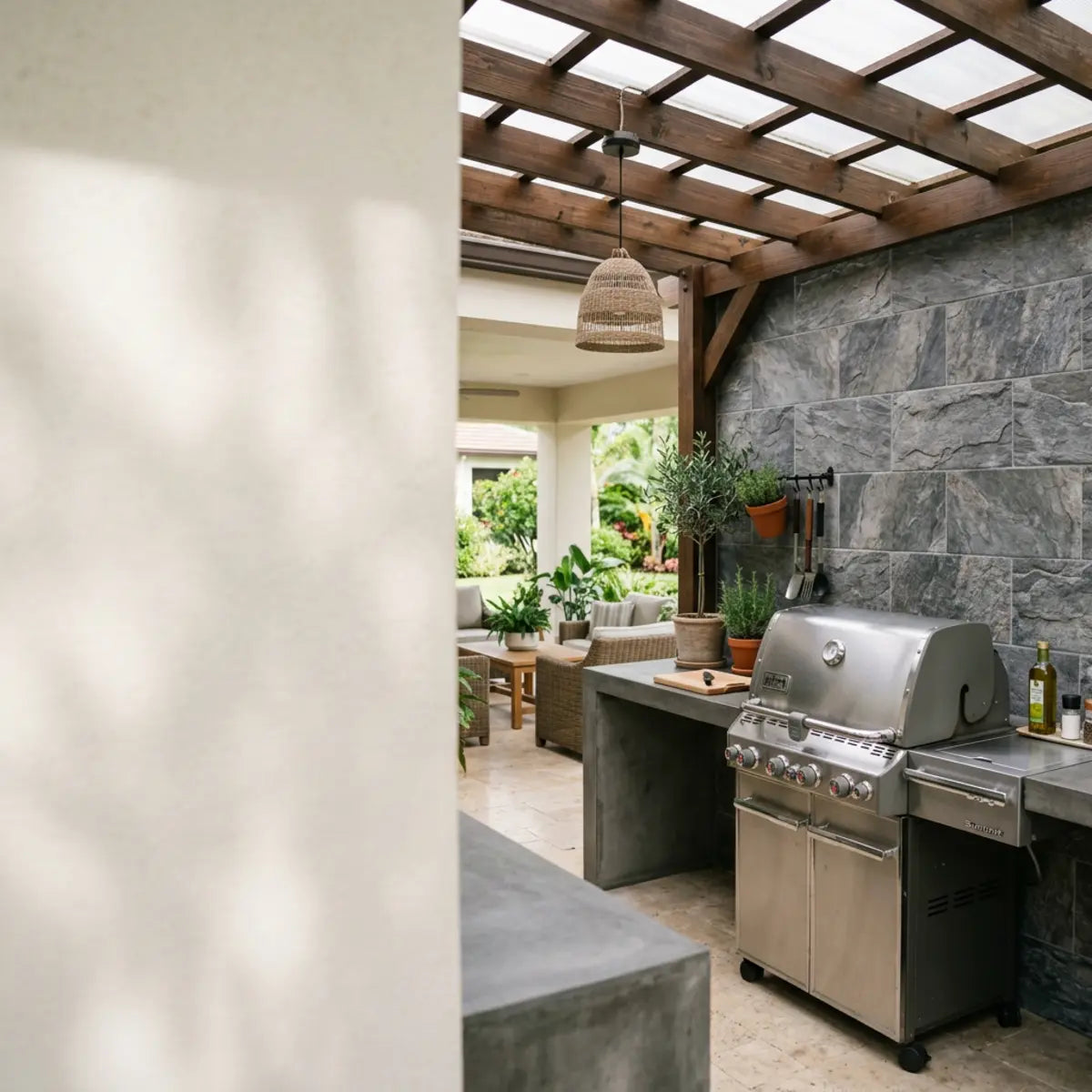
Do not assume Stickwoll or another peel-and-stick tile is suitable outdoors without written guidance for the exact product and proposed location. A roof, a waterproof label or a successful sample does not establish exterior suitability. This guide does not present a verified 12-month Stickwoll weathering trial or promise an outdoor lifespan.
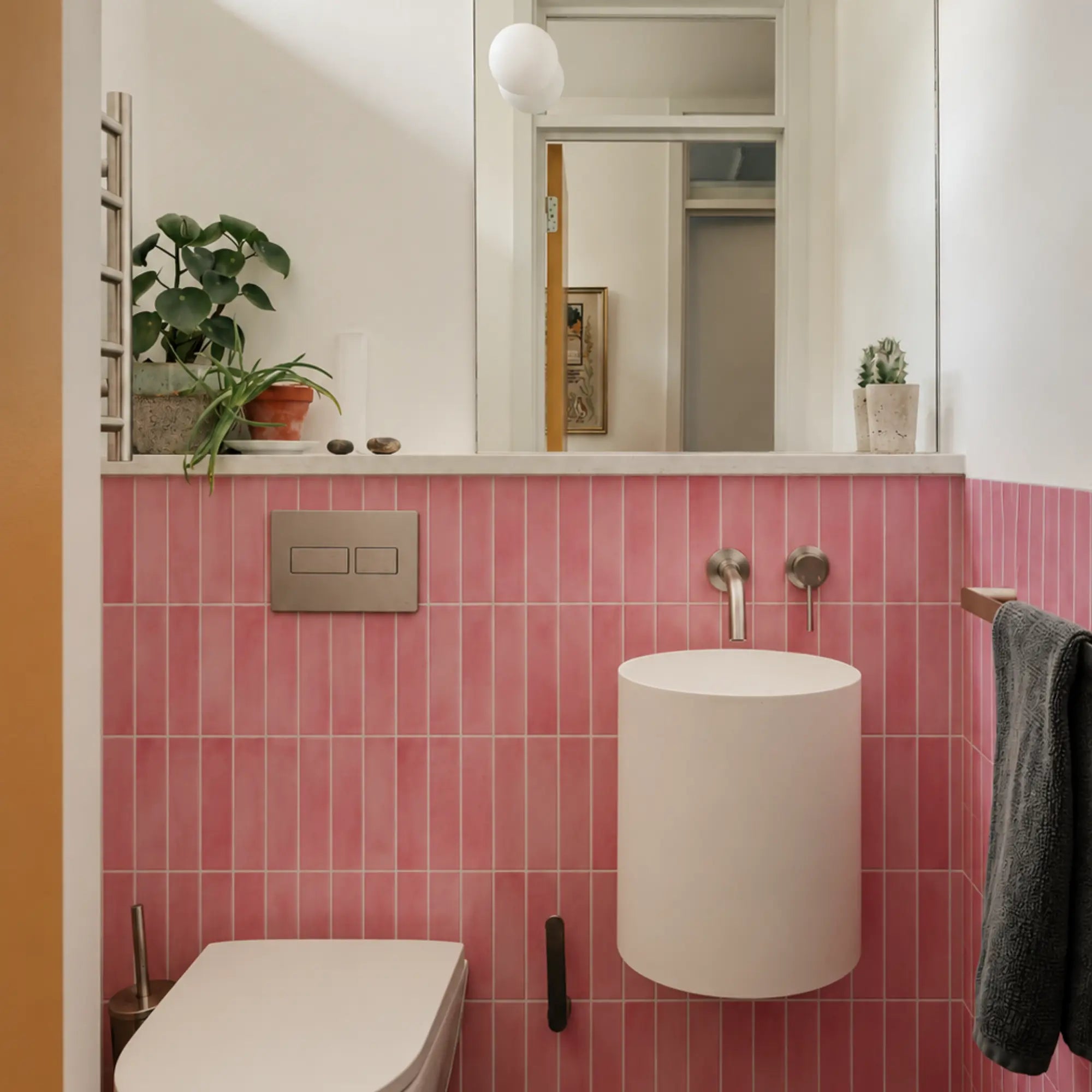
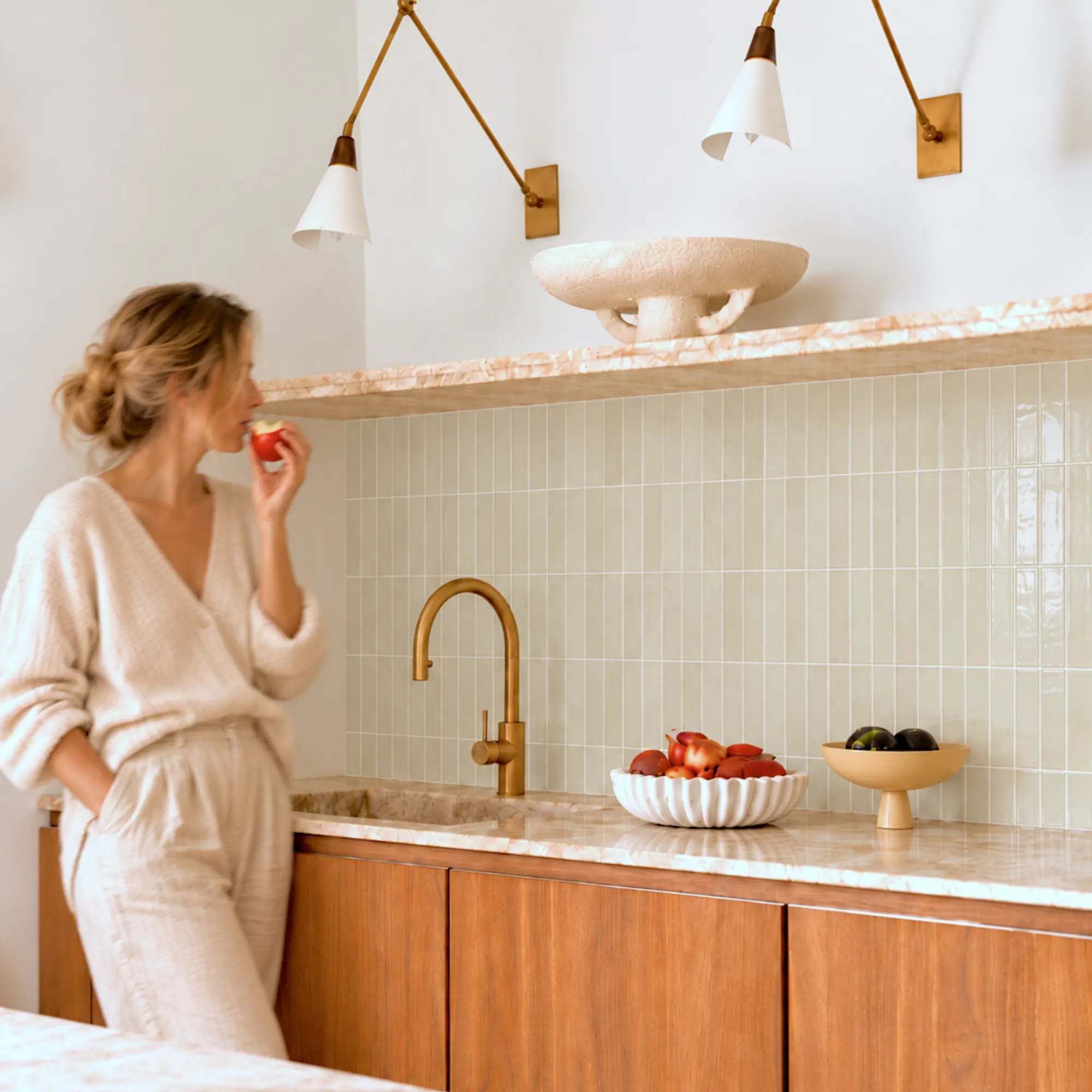
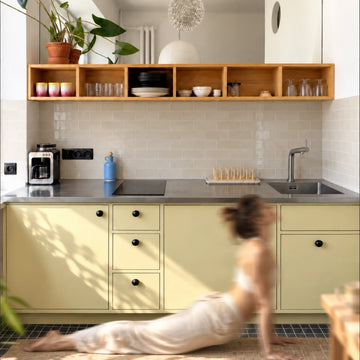
The cover image illustrates a setting; it is not evidence of a product test or approval of the pictured installation.
A covered patio still needs an exterior assessment
Describe the actual wall rather than calling it protected. Is the space enclosed and conditioned, or open to the weather? Can rain blow under the roof? Does sunlight reach the surface in another season? Is there condensation, freezing, a leaking sink or heat from a grill? The answers belong in the product selection decision.
| Situation | Buying decision |
|---|---|
| Open or covered outdoor wall without product-specific exterior approval | Do not proceed on an indoor or kitchen label alone. |
| Exact product approved for the stated exterior conditions | Check the substrate, fastening or adhesive, drainage, edges and restrictions as one system. |
| Wall beside a grill, oven, exhaust or open flame | Follow that appliance’s installation instructions and obtain suitable advice about the wall assembly. |
| Damp, moving, chalky or deteriorated surface | Repair and reassess before considering a decorative covering. |
Why weathering evidence needs context
Q-Lab describes light, heat and moisture as weathering factors and explains why accelerated exposure cannot be converted into years by a universal multiplier. [1] Ask what a reported test actually exposed, which properties were measured and what failure meant. A photograph of an attractive patio is not an adhesion or weathering result.
Machalická and colleagues found substrate-dependent strength loss after immersing industrial acrylic-tape joints for 21 days. This was not a decorative-tile outdoor trial. [2] It illustrates why the complete bond and substrate need evaluation, even when the adhesive material itself resists water. Its figures cannot be used as Stickwoll performance data.
Evidence to request from the supplier
- Exact identity: Product, construction and adhesive version matching what will be supplied.
- Permitted exposure: Written exterior use, temperature and moisture limits, and any sun, frost or coastal restrictions.
- Installation detail: Suitable substrate and preparation, required joints or drainage, and compatible trim or sealant.
- Test context: Test method, sample count, exposure conditions, duration and measured outcomes—not only a score.
- Practical terms: Care, inspection, replacement and the actual warranty conditions for the proposed use.
When those details are missing, choose a system with documented suitability for the exterior project rather than treating uncertainty as approval. This may be a different tile or cladding assembly. The face material alone does not decide whether a whole installation is appropriate.
Do not use a generic grill-clearance number
This guide provides no universal 15-inch or 36-inch clearance. Use the instructions for the exact grill or oven, including the requirements for nearby walls, overhead structures and exhaust. Get qualified installation advice when the wall composition or required protection is unclear.
Decorative adhesive tile is not a heat shield. Adding a metal sheet, stone facing or silicone does not by itself establish that an underlying wall assembly meets the appliance requirements. Do not reduce a required clearance on the strength of a blog article or a small sample trial.
Plan preparation only after suitability is established
Record whether the substrate is masonry, painted board, an existing exterior system or another material. Identify drainage paths, movement and any water entry before deciding how a new finish should end. Do not seal every perimeter indiscriminately; use the detail specified for the approved system.
Follow the product-specific preparation and application conditions. Extra primer or construction adhesive cannot turn an indoor-only product into an outdoor-rated one. A smooth surface is useful for some adhesive systems, but it is not a substitute for exterior approval.
What a useful trial record looks like
After the supplier has confirmed the proposed use, a small permitted trial can help identify workmanship and compatibility problems. Keep the product and batch, wall finish, preparation, installation date, location, orientation and exposure description together. Take repeat photographs from the same position with a scale beside any visible lifting.
During normal use, note rain, condensation, temperature changes, color changes, sheet movement and any repair. Distinguish an observation such as a measured edge gap from a calculated percentage of bond strength: the latter requires an appropriate mechanical test. Stop and seek advice if the wall becomes damp or the covering detaches.
A short trial does not establish years of service or performance in a different climate. This guide deliberately gives no durability score or pass certificate. For general preparation, consult the tile planning guide; for style in a suitable location, see tile design ideas. Contact us with the exact product and site details before proposing exterior use.
Describe the site before choosing the finish
An outdoor backsplash project starts with a site description. A covered bar, an open pergola, a screened porch and an enclosed conditioned room are different settings even when they appear equally sheltered in a photograph. Write down which sides are open, whether the space is heated or cooled, how water reaches the wall and what equipment operates nearby. A product supplier needs those details to assess the proposed use; the word covered is not enough.
Draw the wall, roof edge, sink, grill, electrical outlets, service access and adjacent materials. Mark where rain can arrive from the side and where water can run from a countertop or roof. Include sunlight at more than one time of day. A summer afternoon photograph does not show every seasonal sun angle or weather event. You do not need to create a laboratory exposure to understand the site, but you do need more than its best-looking moment.
Five exposure questions worth answering
First, is the wall normally dry or does it receive direct rain, runoff or repeated splashing? Second, does the surface receive direct sunlight, and for how much of the day? Third, what temperature conditions does the location experience during installation and ordinary use? Fourth, can the substrate move, deteriorate or retain moisture? Finally, are heat sources, cooking equipment or exhaust part of the proposed arrangement? Record unknowns rather than assuming a roof answers all five questions.
| Site detail | Information to collect | Decision it helps with |
|---|---|---|
| Roof and open sides | Photographs and a sketch of rain paths and shelter | Whether the actual exposure is covered by the product instructions |
| Sunlight | Wall orientation and observations at different times | Whether direct-sun restrictions apply |
| Water | Sink splashes, hose use, runoff and persistent damp locations | Required drainage and water-management details |
| Substrate | Material, coating, joints, damage and repair history | Compatibility and preparation requirements |
| Equipment | Exact appliance model and its installation instructions | Whether the entire arrangement is appropriate before decoration |
Keep the site assessment separate from a desire to use a particular pattern. You may discover that only an enclosed, normally dry section is a candidate for the decorative product you like, while an exposed section needs another system. That can still produce a coherent design. A planned transition is usually a better starting point than hoping one material can cover every condition around a patio.

Separate the different questions hidden inside weatherproof
A finish can retain its colour while its attachment changes, or remain attached while its appearance becomes unacceptable. Water resistance, colour stability, dimensional stability and adhesion are therefore separate questions. A photograph of an intact panel answers only a limited visual question unless it comes with a traceable observation record. Ask what was measured and how, especially when a product page offers one overall outdoor score.
Light and surface appearance
Evaluate colour and finish in the actual setting before ordering. Look at a permitted sample in shade and normal daylight, and compare it with the surrounding cabinetry or masonry. A glossy pattern can produce distracting reflections; a very dark pattern may be visually dominant under a shallow roof. These design observations do not establish resistance to sunlight or heat. Obtain the product's permitted exposure rather than turning a sample viewing into a durability claim.
For long-term records, use the same viewing direction and reasonably consistent lighting. A wet surface, a changed camera exposure or a shadow can alter the apparent colour in photographs. Save the original image files and label the circumstances. A before-and-after collage can be useful documentation, but it should not be treated as a calibrated colour measurement or evidence of an exact fading percentage.
Water at the face and water behind the covering
Trace how water would reach and leave the wall. Direct rain on the face is only one route. A countertop joint, an upper termination or an adjacent fixture can introduce water where it is not easily visible. The approved wall assembly should address those details. Do not use a decorative covering as a substitute for repairing a leak or for the drainage provisions of an existing exterior system.
A roof overhang may reduce some exposure while leaving wind-driven rain or seasonal dampness unresolved. Its dimensions should be described to the supplier, not converted into an automatic approval rule. Likewise, the absence of rain on a visit does not prove the surface stays dry throughout the year. Talk to the property owner about the wall's history and inspect after ordinary weather events when it is safe to do so.
Temperature and movement
Ask separately about storage, installation and service temperature limits. A product that is acceptable after correct installation may require a narrower range while the bond is being established. Air temperature is not necessarily the same as the surface receiving the adhesive. A sunlit wall, shaded masonry or a cold delivery carton can have different conditions. Measure according to the relevant instructions rather than relying only on a weather forecast.
Movement needs its own detail. Joints between building elements, changing substrates and existing cracks should not simply disappear beneath a continuous decorative sheet. Ask how the chosen assembly handles those locations. A locally repaired crack that returns is a reason to investigate the cause before covering it again. Extra adhesive is not a substitute for a movement detail.
Read outdoor test claims with the right questions
A credible performance claim should identify the product version, substrate, preparation, exposure, measurement and comparison conditions. Ask whether samples were naturally exposed or placed in accelerated equipment, and whether the reported outcome concerns appearance, mechanical strength or something else. A number without those details is difficult to use when planning a different wall in a different climate.
Do not confuse observation time with a guaranteed service life. An installation observed for one summer has not demonstrated behaviour through an unobserved winter. A one-year record is not automatically a three-year warranty. A laboratory exposure can help compare materials or investigate a mechanism, but the relationship to a specific outdoor installation still needs support. The weathering guidance and adhesive study linked earlier explain why those distinctions matter.
What an honest field record would contain
A useful record would include the installation date, product batch, wall construction, coatings, preparation materials and photographs of the actual work. It would describe exposure and any maintenance, repairs or replacements during the observation period. It would retain unsuccessful samples as well as attractive photographs. If a piece was reattached, that intervention should remain visible in the record rather than disappearing from a final success claim.
Mechanical results require appropriate measurements. A panel that looks flat is not thereby known to retain 92% of its original strength. A hand pull is not equivalent to a specified peel or shear test. When comparing reports, ask whether the same method and conditions were used. The goal is not to demand an industrial laboratory for every decorating decision, but to avoid claiming a measurement that was never made.
For a homeowner's approved sample installation, simple observations can still be valuable. Note whether edges remain in their original positions, whether a stain is removable and whether moisture appears where it was not expected. Call those observations what they are. They help identify practical problems without pretending to represent every product batch, wall construction or climate.
Plan cooking equipment independently of the decorative wall
The grill or oven must have an appropriate location before a backsplash is selected. Use the exact appliance instructions, including requirements for nearby surfaces, overhead structures, ventilation and access. A decorative tile with a metallic or stone-like appearance does not change the composition of the wall behind it. Where the equipment requires a particular wall assembly or protection system, have that arrangement specified rather than improvising a shield.
General grilling guidance from fire-safety authorities also emphasizes separation from buildings and other combustible surroundings. Such guidance is not a substitute for an appliance manual or a site-specific installation assessment. Do not interpret a photograph in this article as an approved grill arrangement, and do not reduce any required clearance because a surface has been covered with decorative tile. [3]
Keep fuel connections, shutoffs and service access unobstructed. A wall finish should not conceal equipment that must remain inspectable. Avoid positioning décor where routine cleaning or opening a lid pushes objects toward hot surfaces. When selecting a transition between a cooking area and a decorative section, plan it outside the equipment's restricted area and use the appropriate attachment and edge detail for each material.
Consider an illustrative outdoor-bar plan with a food-preparation counter at one end and a cooking appliance at the other. The owner first confirms the appliance layout with the installer, then chooses a documented exterior wall system for the exposed counter area. An indoor decorative product may instead be reserved for a separate conditioned room. The design can share colours without forcing the same construction into both locations.

Match preparation to the existing wall assembly
Identify whether the wall is masonry, a painted panel, existing cladding or another construction. Record the topmost surface the adhesive would actually contact. An exterior label on the underlying board does not establish compatibility with the decorative tile, and an intact-looking paint film does not prove every layer below it is sound. Ask about the proposed assembly, not just whether glue sticks to a sample of its face.
Painted and coated surfaces
Check the coating identity where possible. Find the permitted cleaning, full cure and any restrictions on coverings or adhesives. A new coating may need more time before being covered than before ordinary light contact. A coating that powders, flakes or releases from the wall needs assessment before another layer is added. Primer should be selected as part of an approved combination, not used to hide uncertainty about the base.
Do not begin with aggressive solvents or automatic sanding. Some surfaces need a particular preparation, and some are excluded entirely. Use the product and coating instructions to decide whether abrasion is appropriate. Keep preparation dust out of adhesive surfaces and follow the relevant safety controls. For unknown old materials, obtain suitable advice before disturbing them.
Rough masonry and textured finishes
A rough face can make a thin decorative sheet difficult to support consistently. Evaluate actual flatness and the approved substrate requirements. Do not invent a percentage of lost adhesion from a texture photograph. If the wall would need a new board or leveling system, include that entire assembly in the plan, including attachment, moisture management and the finish it can receive. Simply adding a thin board over a problem does not establish a suitable exterior wall.
A wall that has been patched in several places may present multiple surfaces to the adhesive. Record where the materials change and whether their instructions are compatible. Dry-fit the pattern across those transitions and assess the required joints. It may be more practical to choose a different finish than to force a lightweight adhesive product over a heavily irregular exterior surface.
Drainage, penetrations and terminations
Before covering a wall, understand how its existing water-management details work. Do not block designed drainage openings or cover service penetrations without the appropriate detail. A continuous bead of sealant around every edge is not automatically correct; some assemblies need water to leave at a defined location. The relevant system instructions, rather than a decorative pattern, should determine those decisions.
Photograph the wall before it is covered so future maintenance does not depend on memory. Mark any joint or service point that must remain accessible. This record also helps a future installer understand what was added and where. A successful small project should not create a hidden problem for the next repair.
Estimate quantity, pattern and total project work
Measure only the wall sections that remain eligible after the exposure and assembly checks. Break the area into rectangles and identify openings, returns and visible edges. Check the actual installed coverage of the product, particularly where sheets overlap. Count pattern matching and replacement spares separately rather than assuming the printed dimensions of a sheet always equal usable coverage.
For an illustrative calculation, a wall section three metres wide and 0.6 metres high has a face area of 1.8 square metres. If a permitted product's pack covers 0.45 square metres, four packs cover the area arithmetically before allowing for cuts or spares. The example supplies no Stickwoll coverage or price. Use the chosen product's real dimensions and draw the pattern to decide what extra quantity is justified.
Choose a starting point that makes the most visible part of the wall look intentional. Around a counter, that might be a central feature or the end seen from the seating area. Check the last piece at each boundary before fixing the first one. A pattern that works on a large uninterrupted wall can look awkward when squeezed between a sink, a window and a short return.
Budget for the assembly, not just the box
A useful budget includes investigation, preparation, any substrate repair, the finish, compatible trim, specified attachment materials and future maintenance access. Separate the time needed to do the work from the waiting periods required by coatings or adhesives. An adhesive finish may simplify part of the installation while still requiring meaningful preparation. Do not promise same-day completion before those conditions are known.
Compare options using actual quotations for the same scope. One quotation may include repairing the wall and another may cover only sticking panels to a prepared surface. Those are not equivalent prices. Keep repair and eventual removal in the comparison, particularly for a rental or seasonal business. A lower material cost does not compensate for a product that is unsuitable for the location.
You can also stage the project. Resolve the drainage or appliance arrangement first, finish a suitable decorative area second and leave the exposed section for a separately specified system. This can make costs and decisions easier to understand. It is preferable to a single rushed installation that mixes approved and unapproved locations behind one continuous pattern.
Keep an installation record that remains useful later
After the proposed product and assembly have been confirmed, record the conditions before installation. Note the product and batch, the wall material, coating, preparation and the instructions used. Measure the relevant temperatures rather than taking the daily weather forecast as a wall reading. Check that rain, dew or expected conditions during the required bond-building period will not conflict with the installation directions.
Keep materials protected as their storage instructions require. Do not heat cold adhesive panels with improvised equipment to meet a schedule. Do not leave release liners removed while arranging the entire wall. Follow the specified application method and inspect contact at edges without repeatedly lifting installed pieces. A tidy work sequence helps avoid contamination and unnecessary repositioning.
A permitted sample can help you rehearse cuts, edge details and cleaning access. Use a representative location, not only the easiest dry corner. A sample is appropriate only after the proposed use is permitted; it is not a way to override an indoor-only restriction. Save the observation record even when the decision is not to continue, because that information can help explain what changed in the final plan.
A seasonal inspection plan, not a simulated one-year test
| Occasion | Observation to make | Record to retain |
|---|---|---|
| After installation | Alignment, visible contact, specified joints and clean edges | Product details and baseline photographs |
| After normal rain or a damp period | Unexpected water paths, persistent wetness or staining | Location, weather context and photographs |
| During normal cleaning | Finish changes, residue and accessibility | Cleaner identity and any change in routine |
| At seasonal changes | Movement, cracks, lifting or changed exposure | Same-position images and any measured gap |
| Before a repair | The symptom and suspected source, without erasing evidence | Supplier advice and the repair actually carried out |
These are suggested occasions for observation, not mandatory laboratory checkpoints or a published set of results. Use the inspection requirements of the actual system where they exist. If a supplier requests specific measurements, record how they were taken and any uncertainty. Do not convert a visual inspection into a bond-strength percentage.

Clean gently and address the cause before replacing a piece
Use the finish's approved cleaning method and check compatibility with adjacent materials. Outdoor residue can include dust, pollen, grease and water marks, but the appropriate treatment depends on the actual surface. Start with the permitted method rather than moving straight to pressure washing, steam or a strong solvent. Keep runoff and access to edges in mind while cleaning.
If a corner lifts, record whether the movement is limited to the finish or includes paint or another underlying layer. Check for water and inspect the surrounding area. Do not immediately add a stronger adhesive: the problem may involve a coating, moisture, movement or an unapproved exposure. Share the product details and photographs with the supplier before choosing the repair.
Plan seasonal closure around the equipment and wall system instructions. Keep an inspection route available when furniture is stored or covers are added. Do not assume that tightly wrapping a decorative surface improves its moisture performance. Check the actual covering and storage requirements, and leave any designed drainage and ventilation features functional.
Retain spare pieces, labels and the final installation record together. A future colour match or local replacement is easier when the product version is known. Record any replacement as a repair rather than counting the installation as entirely unchanged. This practical honesty gives you a more useful maintenance history than an unsupported claim that a material is permanent.
The best outdoor decision is the one that matches a documented system to the real site. It may include a peel-and-stick product specifically approved for the exposure, a different exterior finish or a smaller decorative area indoors. A clear boundary does not reduce design possibilities; it helps you spend money on a finish that can be used and maintained as intended.
Frequently asked questions
Does keeping the wall under a roof make indoor tile acceptable?
No automatic approval follows from a roof. An open patio may still have weather exposure that differs from an indoor wall. The product instructions must cover the actual conditions.
How many years will Stickwoll last outdoors?
This guide has no verified product-specific outdoor service-life data from which to give a number. Do not interpret a decorative photo, a generic adhesive paper or an accelerated test duration as a lifespan promise.
Can I waterproof an unsuitable tile by sealing its edges?
Do not use sealant to override a product restriction. The required edge treatment depends on the approved system and the wall’s drainage and movement needs.
Can a sample that survives summer prove winter suitability?
No. It has not demonstrated behavior under the missing conditions. Ask for evidence and approval covering the proposed year-round exposure before making the full installation.


Leave a comment
This site is protected by hCaptcha and the hCaptcha Privacy Policy and Terms of Service apply.