








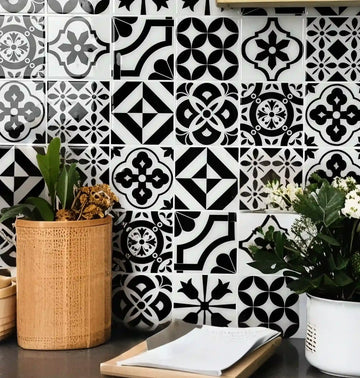

A wall-tile “fire rating” should be read as a specific test result for a specific product or assembly—not as a blanket promise that the material is safe next to any flame, stove, fireplace or heat source. The most common confusion comes from treating ASTM E84 or UL 723 surface-burning data as though it were an appliance-clearance rule, a noncombustibility certificate or a fire-resistance rating. Those are different questions.
This guide separates the test methods and decisions. It explains what ASTM E84/UL 723 measure, what they do not measure, how to verify a product report, why adhesives and substrates matter, and why heat-source placement must follow the exact appliance, wall assembly, product documentation and applicable code rather than a homemade clearance formula.
ASTM E84 is a comparative surface-burning test
ASTM currently lists ASTM E84-26a as the active version of the Standard Test Method for Surface Burning Characteristics of Building Materials. The method evaluates flame-spread and smoke-developed behavior under the controlled conditions of the Steiner tunnel.
ASTM describes E84 as a comparative fire-test-response method. It is useful for comparing surface-burning behavior under the test exposure, but the standard itself says the result does not incorporate all factors needed for a real-world fire-hazard or fire-risk assessment.
UL 723 uses the same basic surface-burning concept
UL describes UL 723 and ASTM E84 as methods used to determine flame-spread and smoke-developed indices for building materials in the Steiner tunnel. Those indices can be used in code and specification contexts where the relevant requirement calls for that test.
Do not treat “tested to UL 723” as an all-purpose safety statement. The report still needs to match the exact product construction, thickness, backing, adhesive, mounting method and intended application that matter to your project.
Flame-spread index is not the same as noncombustibility
ASTM explicitly states that E84 does not classify or define a material as noncombustible from flame-spread index alone. A product can achieve a low flame-spread result and still contain combustible components.
That distinction matters for composite wall products. A metal face can have very different thermal and combustion behavior from the polymer, foam, adhesive or backing behind it. The visible face should not be used to infer the classification of the complete product.
Surface-burning classification is not a fire-resistance rating
A fire-resistance rating describes the performance of an assembly in a different fire-test context, often for a specified time or construction. ASTM E84/UL 723 do not create a one-hour wall rating, two-hour partition rating or rated fire-door assembly.
UL’s guidance on elevator-door wraps illustrates the distinction: a material may have UL 723/ASTM E84 surface-burning data and still not satisfy the testing required for a fire-rated door assembly. The correct test depends on the component and code requirement.
Surface-burning classification is not an appliance-clearance number
A tile can have documented E84/UL 723 results and still require distance from a stove, fireplace, heater or another hot appliance. The surface-burning test does not measure every thermal condition that occurs near appliances, and it does not establish the installation clearance for an unrelated heat source.
Use the appliance manufacturer’s clearance instructions, the wall-finish manufacturer’s installation limits and the applicable building/fire code. Where those documents differ, the project needs the appropriate design/code interpretation rather than a generic distance copied from a decorating article.
Heat resistance and reaction-to-fire data answer different questions
Heat resistance may describe whether a material warps, softens, discolors, releases, delaminates or otherwise changes under elevated service temperature. Surface-burning data describe reaction under a defined fire-test exposure. One result cannot be substituted for the other.
A polymer wall tile may remain visually stable near ordinary kitchen warmth yet still have a separate surface-burning classification. A ceramic face may tolerate high temperature while the backing, mortar, adhesive or substrate imposes other limits. Use the complete system.
Verify the exact tested construction
Fire-test reports are only useful when they correspond to the product you are actually installing. Check the product name, thickness, facing, core, backing, adhesive, substrate or mounting method described by the report. A test on one component should not automatically be applied to a finished composite product.
UL notes that individual component values cannot simply represent a composite construction when the code or specification is asking about the complete material. That is especially important for peel-and-stick products, where the face, adhesive and backing work together as the installed finish.
Do not reuse a report from a different thickness or backing without support
A product family can contain multiple thicknesses, facings or adhesive systems. The fire-test specimen may have been prepared in a specific way. If the report does not identify the version you plan to install, ask the manufacturer whether the tested configuration covers it.
Marketing pages sometimes summarize a result while the technical report contains narrower conditions. Use the report or certification listing as the evidence source when a project decision depends on the classification.
Check whether the report is current and traceable
A useful report identifies the laboratory or certification body, test standard, product specimen and result. Certification listings can also provide ongoing production-control information that a one-time marketing statement does not.
If a seller provides only a badge such as “Class A,” “fire rated” or “flame resistant” without the underlying test or listing, treat the claim as incomplete. Ask for the exact report before using the statement in a code or safety decision.
Do not infer “Class A” from material appearance
A metal-looking face, stone-look pattern or ceramic-look texture does not establish a fire classification. A thin foil or metal layer can hide polymeric components behind it.
Likewise, a grout-free tile can look similar to ceramic while using a completely different core and adhesive. Fire-related decisions should follow documented test data for the complete product.
Do not use a metal face as a heat shield by assumption
Metal can conduct heat efficiently. A thin metal face over a polymer or pressure-sensitive adhesive can transfer heat to the backing rather than blocking it. Whether a product functions as a heat shield depends on the complete tested assembly and installation—not simply on having metal at the surface.
If the application requires a protective heat shield or hearth component, use a system specifically designed and documented for that purpose. Decorative metal-faced wall tile should not be promoted as a substitute unless the manufacturer provides the relevant evidence.
Adhesive performance can become the limiting factor
A decorative face may tolerate a temperature that the pressure-sensitive adhesive, foam layer or wall coating cannot. Heat can soften, creep, release or chemically change some adhesive systems.
That means a wall finish should be evaluated as a full assembly. If the technical data publish an installation or service-temperature range, keep the product within that range and the appliance clearances required by the project.
Substrate condition also matters near heat sources
Painted drywall, cement board, masonry, ceramic tile and metal can respond differently to heat. A tile manufacturer may approve multiple substrates for ordinary wall use while still restricting high-temperature placement.
Do not use a strong adhesive to compensate for a substrate that is not approved for the heat zone. If the wall assembly near a fireplace, stove or heater needs a specific noncombustible or rated construction, build that assembly first and choose a compatible finish afterward.
Fireplace surrounds need appliance and assembly documentation
Factory-built fireplaces, inserts and stoves publish clearances and surround requirements that depend on the appliance model. Site-built fireplaces and hearths can have separate code and material requirements.
Do not convert an ASTM E84 class into permission to install a peel-and-stick product on the firebox surround. Use the fireplace or stove manual, the wall-finish documentation and the authority having jurisdiction when the location is safety-critical.
Kitchen ranges and countertop appliances are different heat cases
The wall behind a range can experience flame, hot exhaust and radiant heat. A toaster oven or air fryer can direct hot air toward the backsplash. A coffee machine may produce steam but much less sustained heat.
Map the actual equipment rather than creating one generic “kitchen heat zone.” Follow each appliance’s installation/clearance guidance and the wall product’s own limits.
Do not publish universal service temperatures without product data
Statements such as “vinyl is safe below one temperature, composite below another, metal-faced tile below another” create false certainty unless they come from exact tested products and defined conditions.
Use manufacturer-specific service-temperature data where it exists. If the product has no documented temperature limit relevant to the planned location, keep it away from the uncertain heat source rather than inventing a category threshold.
Class labels only make sense inside the applicable code or specification
A marketing page may describe an E84 result using an interior-finish class label. That label is useful only when the code, project specification and tested construction all line up. A residential decorative wall, a commercial corridor, an air-handling plenum and a rated assembly can have very different requirements.
Do not use a class label to make a project-specific code conclusion without checking the adopted code and occupancy. The authority having jurisdiction, design professional or code consultant should resolve applications where compliance is required.
United States and Canadian test references are not interchangeable by assumption
UL Solutions Canada lists CAN/ULC-S102 and CAN/ULC-S102.2 for Canadian surface-burning applications and UL 723/ASTM E84 among related test standards. These methods can use similar concepts while differing in specimen mounting and application.
If the project is in Canada, do not assume a U.S. ASTM E84 marketing claim is automatically the exact evidence required by the Canadian code path. Verify which standard, mounting method and classification the project requires.
Plenums and special spaces can have their own requirements
Materials exposed in air-handling spaces can be subject to specific flame-spread and smoke-developed requirements under mechanical/fire codes. That does not mean a backsplash product with an interior-finish claim is automatically acceptable inside a plenum.
Use the code requirement for the actual space and verify a listing or report for that application. Decorative wall guidance should not be stretched into duct, plenum or concealed-space approval.
Rated doors, shafts and other protected assemblies need assembly-specific evidence
A fire-rated door, shaft wall or protected assembly has performance requirements beyond surface flame spread. Adding an aftermarket decorative layer can change the tested construction.
Do not apply a peel-and-stick finish to a fire-rated door, fire-resistance assembly or another protected component based only on ASTM E84/UL 723 data. Verify that the complete assembly permits the added finish.
Do not infer smoke toxicity from smoke-developed index alone
Smoke-developed index is a test output under the specific surface-burning method. It is not a complete analysis of smoke toxicity, chemical composition or occupant exposure during a real fire.
A claim such as “low smoke means non-toxic” therefore goes beyond what the index establishes. Use the test result for the property it measures and avoid expanding it into unrelated health conclusions.
Do not infer flame resistance from a small household test
Holding a lighter, torch or heat gun near a sample is not an ASTM E84 or UL 723 test and can create a serious safety hazard. It also does not reproduce the specimen size, airflow, ignition exposure or measurement method of a standardized test.
Do not perform uncontrolled flame tests to decide whether a wall product is safe. Request the manufacturer’s third-party test data instead.
Heat-gun or oven experiments do not establish appliance clearance
A sample that survives a short heat exposure can still behave differently during prolonged radiant heating, repeated thermal cycles or contact with a hot wall. Adhesive creep and substrate effects can also take time to appear.
Use documented service-temperature data and appliance clearances. A home experiment can be useful only for non-safety visual questions when the manufacturer permits it; it should not replace safety documentation.
Thermal cycling can affect adhesive and dimensional stability
Repeated warming and cooling can create differential expansion between the decorative face, adhesive and wall. The result can appear as edge lift, curling, buckling, print distortion or bond change even when no flame is present.
If the product is planned near a heat source, ask whether the manufacturer publishes service-temperature and cycling limits. Do not translate one short exposure result into a long-term placement claim.
Water and fire questions should remain separate
A product can have a documented surface-burning classification and still be unsuitable for a wet area. Likewise, a water-resistant face can have no documented fire-test result relevant to a commercial interior-finish requirement.
Evaluate heat/fire, water/moisture, substrate and cleaning as separate dimensions. One strong property does not certify the product for every room.
Metal, ceramic and polymer finishes each need complete-system interpretation
Ceramic and glass are often used in heat-adjacent locations because their faces tolerate elevated temperatures, but mortar, membranes, substrates and adjacent materials still control the assembly. Metal can conduct heat rapidly. Polymer/composite finishes can have product-specific service-temperature limits.
Do not rank these material families with one generic “heat score.” Choose the complete system documented for the actual wall and heat source.
A technical data sheet should answer more than one marketing phrase
For a safety-sensitive placement, look for the exact product name, construction, thickness, substrate or mounting assumptions, test standard, laboratory/certification source, flame-spread and smoke-developed results where applicable, service-temperature limits and installation exclusions.
If key fields are missing, ask the manufacturer. A project decision should not depend on a social-media graphic or retailer bullet point when the underlying technical report can be requested.
Keep the tested specimen and installed product aligned
If the test report covers a panel without an aftermarket adhesive but the installation uses a different adhesive, that added layer can change the assembly. If the report covers one backing and the current product uses another, the evidence may not apply without manufacturer confirmation.
This is especially important for peel-and-stick products because the adhesive backing is part of the installed construction. Verify the product as sold and installed, not just the visible face.
A report-verification workflow
- Identify the exact product. Record the model, construction, thickness and backing.
- Find the test standard. Confirm whether the claim refers to ASTM E84, UL 723, CAN/ULC-S102 or another method.
- Read the test scope. Determine what the test actually measured and how the specimen was mounted.
- Match the tested specimen to the installed product. Check adhesive, facing, core and substrate assumptions.
- Separate test result from project requirement. Determine which code or specification applies to the actual wall and occupancy.
- Check heat-source placement independently. Use appliance and product clearances rather than the surface-burning class.
- Keep the report with the project record. Future owners or inspectors should be able to trace the claim.
This workflow is deliberately evidence-based. It does not assign a “verified safety score” because missing information cannot be converted into honest points.
A stove or cooktop decision tree
First identify the appliance and its manufacturer installation manual. Record whether the heat source involves open flame, exposed electric elements, radiant glass, induction, hot exhaust or countertop equipment.
Next identify the wall product’s installation exclusions and service-temperature guidance. If the product explicitly excludes the area, stop. If the documentation is silent, do not treat silence as approval.
Then confirm the wall assembly and any code requirements for the specific appliance location. Only after those steps should visual finish be selected. A lower flame-spread index does not override an appliance clearance.
A fireplace decision tree
Identify whether the unit is factory-built, an insert, stove or site-built fireplace. Obtain the model manual or project design. Mark the noncombustible or clearance zones specified by that source.
Keep decorative polymer/composite finishes outside zones that require another construction unless the exact product/assembly is explicitly documented for the application. A metal-looking face or E84 result is not a substitute for the appliance’s surround requirements.
A bathroom or ordinary decorative-wall decision tree
When there is no significant appliance heat, surface-burning requirements may still apply in some occupancies or project specifications, but the product choice also has to satisfy moisture, substrate and cleaning needs.
Do not make the opposite mistake and assume fire-test data are irrelevant everywhere outside a kitchen. Commercial, multifamily or regulated spaces can have interior-finish requirements that a private low-rise home may not share.
Keep the authority having jurisdiction in the loop when required
Building and fire codes are adopted and amended by jurisdiction. A product report can provide evidence, but the authority having jurisdiction or project design professional decides how the adopted requirements apply to the project.
For a simple residential decorative wall, the process may be straightforward. For commercial interiors, rated assemblies, egress paths, plenums or unusual heat sources, obtain project-specific code guidance rather than relying on a retailer article.
Do not turn missing data into a recommendation
If a product has no accessible third-party surface-burning report, no relevant service-temperature data and no installation guidance for the planned heat source, the correct conclusion is “insufficient evidence,” not “probably safe.”
Choose a product with documentation that matches the project, or move the decorative finish outside the uncertain zone. Uncertainty should reduce the strength of the recommendation rather than being hidden by a score.
Use a project handover record
Save the product technical data, fire-test report or certification listing, installation guide, appliance manual, project photographs and any code/design clarification used. If the finish is replaced later, the next person can see why the original placement was selected.
This record is especially important when the visible material looks like ceramic, stone or metal but contains polymeric backing or adhesive that is not obvious after installation.
Frequently asked questions
Does Class A mean a peel-and-stick tile can go behind a gas stove?
No. A surface-burning classification does not establish stove clearance. Use the exact appliance instructions, wall-product limits and applicable code.
Does ASTM E84 prove a material is noncombustible?
No. ASTM states that flame-spread index by itself does not classify or define a material as noncombustible.
Is UL 723 the same thing as a fire-resistance rating?
No. UL 723 evaluates surface-burning characteristics. Fire-resistance-rated walls, doors and other assemblies use different tests and assembly-specific requirements.
Can a metal-faced peel-and-stick tile act as a heat shield?
Not by assumption. Metal conducts heat and the backing/adhesive can have lower temperature limits. Use a system specifically documented for heat-shield or hearth use when that function is required.
Can I use a lighter or torch on a sample to test it myself?
No. An uncontrolled flame test is unsafe and does not reproduce ASTM E84/UL 723 conditions. Request third-party test documentation.
Does a low smoke-developed index mean the smoke is non-toxic?
No. The smoke-developed index is not a complete toxicology assessment. Do not expand the result into a health claim it was not designed to support.
Can I use a U.S. ASTM E84 result for a Canadian project?
Do not assume automatic equivalence. Canadian projects can reference CAN/ULC-S102 or S102.2 depending on product/application. Verify the required standard and mounting method for the project.
What if the manufacturer says “fire resistant” but gives no report?
Ask for the test standard, report or certification listing and exact tested construction. Without that evidence, the marketing phrase is incomplete for a safety or code decision.
Can ceramic tile ignore appliance clearance because it is noncombustible?
No blanket conclusion should be made from the face material alone. The complete wall, setting materials, adjacent finishes and appliance installation requirements still control the project.
Should I choose the product with the lowest flame-spread number?
Not as a universal rule. First confirm that the tested construction and standard apply to your project, then evaluate the rest of the installation requirements. Lower numbers do not replace product suitability, heat clearance or code scope.
Final verification checklist
- Exact product and construction identified.
- Current test standard and third-party report or listing obtained.
- Test specimen/mounting method matches the installed product closely enough to be supported by the manufacturer.
- Surface-burning classification is not being used as a noncombustibility or fire-resistance rating.
- Appliance/fireplace clearances are checked independently.
- Adhesive, substrate and backing temperature limits are reviewed.
- Jurisdiction/code requirements are checked where applicable.
- No uncontrolled home flame or heat test is used as evidence.
- Project documentation is retained for maintenance and future review.
Bottom line
ASTM E84 and UL 723 are valuable tools for understanding comparative surface-burning characteristics, but they answer a narrower question than many product pages imply. They do not by themselves establish noncombustibility, a fire-resistance rating, fireplace suitability or stove clearance.
Use the exact product report, verify the tested construction, keep appliance/heat placement separate, and involve the appropriate code authority or design professional when the project requires it. For decorative peel-and-stick wall tile, safety claims should become more specific as the heat or code consequence increases—not broader.
Read ASTM E84 as a comparative surface-burning test
ASTM E84 measures surface flame spread and smoke density under its specified test exposure. The current standard explicitly describes the results as comparative measurements. It does not measure heat transmission through the tested surface and does not classify a material as noncombustible from flame-spread index alone.
That means an E84 result should be quoted with the exact product or assembly tested, specimen configuration and report context. It is not a universal statement that the material is safe beside every stove, fireplace or other heat source.
Keep fire classification separate from appliance clearance
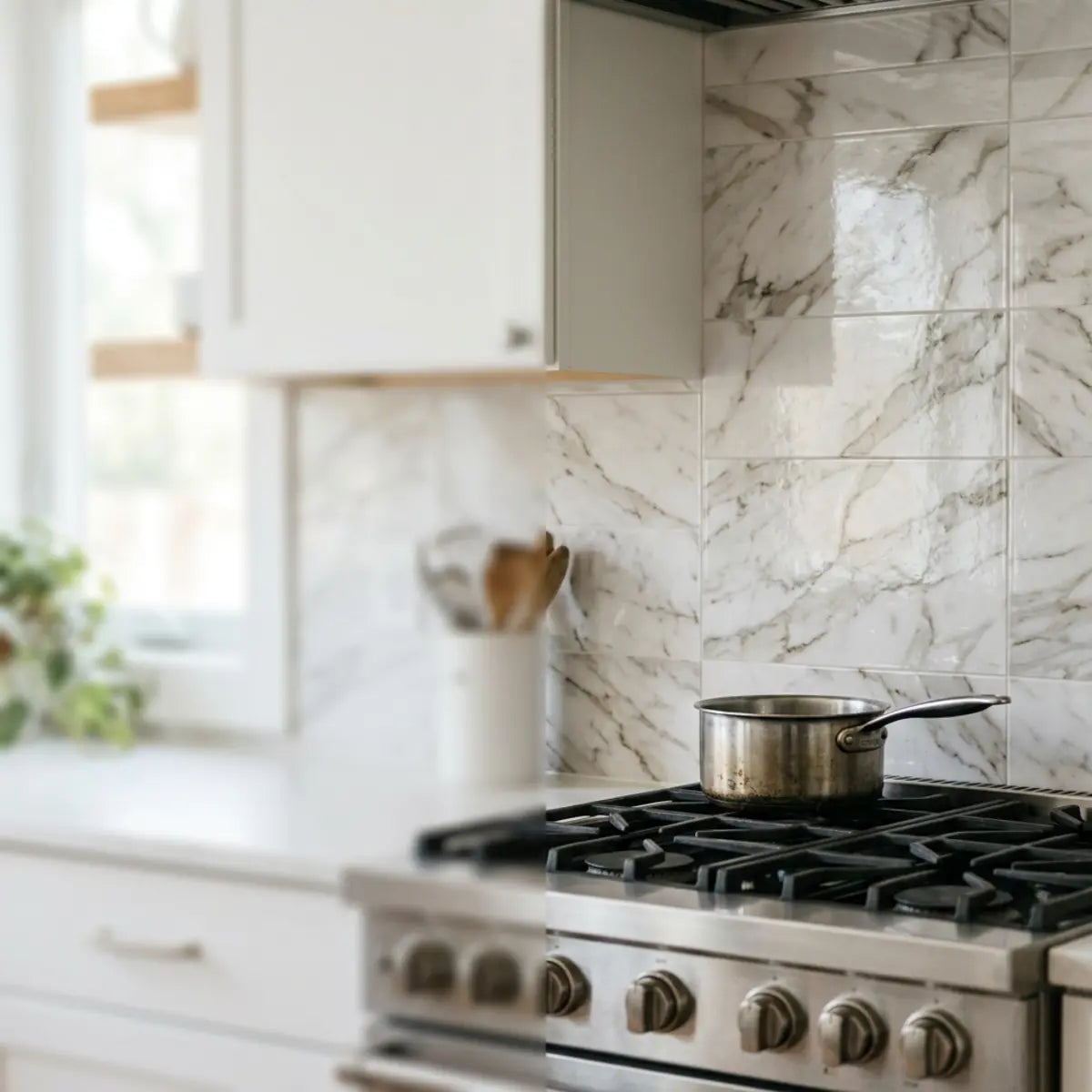
A wall finish can have a documented surface-burning classification while an appliance still requires a particular clearance, noncombustible surface or installation detail. Check the appliance instructions, product documentation and applicable local code path together.
Do not use a Class A label as a shortcut for an appliance-zone decision. The test question and the installation question are different.
Do not infer noncombustibility from a low flame-spread result
ASTM E84 itself states that flame-spread index alone does not define a material as noncombustible. Product composition, assembly details and other test methods may be relevant to the actual requirement.
When a project specification calls for noncombustible material, a decorative surface-burning result is not enough unless the governing requirement and supporting documentation say it is.
Verify the report rather than relying on the marketing badge
Ask for the current third-party report or technical data for the exact SKU, thickness, backing and mounting condition. Check the test standard edition, specimen description and reported indices. If the seller only shows a badge with no traceable report, treat the claim as incomplete.
For commercial, multifamily or regulated work, coordinate the document with the local code professional or authority rather than interpreting the badge as a permit decision.
Use a heat-zone decision tree
First identify the heat source and manufacturer clearance requirements. Next identify whether the wall finish is actually permitted in that zone. Then check any required fire or interior-finish classification. If any link is missing, move the finish or use a documented system rather than guessing.
This keeps surface-burning data in its proper role: one evidence input among several, not a blanket fire-safety assure.
Sources and scope
- ASTM E84: Surface Burning Characteristics of Building Materials — Current test-method scope and limitations; not a product fire approval by itself.
- 2024 IRC: General Mechanical System Requirements — Model-code context; local adopted requirements may differ.


Leave a comment
This site is protected by hCaptcha and the hCaptcha Privacy Policy and Terms of Service apply.