







Safety-first fireplace guidance
A fireplace makeover can look simple in a video: measure the wall, peel the backing, press the tile into place, and enjoy a new focal point by the weekend. Near an active fireplace, that sequence skips the question that matters most.
Safe-looking is not the same as fireplace-rated. The face of a peel-and-stick tile may resemble ceramic, stone, or glass, but the complete assembly also includes adhesive, backing material, grout lines or seams, the wall surface, and the heat conditions created by the appliance.
Peel-and-stick tile should never be installed inside a working firebox or on any surface exposed to flame, embers, escaping combustion gases, or direct high heat. It may be possible on a low-heat decorative wall only when the tile manufacturer expressly allows that application, the fireplace manual permits the finish, local requirements are satisfied, and the hottest surface remains within the product’s stated limit.
The practical question is not simply, “Can you use peel-and-stick tile around a fireplace?” It is:
Which fireplace zone are you covering, how hot does that zone become, and has the complete tile-and-adhesive product been approved for that use?
This guide uses a practical Heat-Boundary Risk Index to separate off-limits areas from conditional and lower-risk decorative areas. The index considers flame contact, ember exposure, radiant heat, vent proximity, measured surface temperature, and manufacturer approval. It is an editorial screening framework, not a code-recognized rating or laboratory certification.
Is peel-and-stick tile safe around a fireplace?
Peel-and-stick tile is usually unsuitable for the firebox, active hearth, flame-contact area, and other high-heat surfaces. It may be considered for a low-heat surround or nearby wall only after the exact product, fireplace model, surface temperature, and clearance requirements have been checked.
Manufacturers use different materials and different application limits. Smart Tiles, for example, states that the installed surface must not exceed 49°C (120°F) and that direct contact with a heat source and open-flame exposure must be avoided. That is a product-specific limit, not a universal temperature rating for all peel-and-stick tile. Smart Tiles’ fireplace and heat-use guidance supports that boundary.
Other manufacturers take a stricter position. Art3d identifies one self-adhesive product for clean, dry, smooth kitchen backsplash and bathroom-wall applications, while expressly excluding high-temperature environments such as a stove wall or fireplace. Art3d’s high-temperature application exclusions illustrate the difference.
That difference explains why online advice can feel contradictory. One product may be marketed as resistant to heat from stovetops and around a fireplace under a stated surface limit. Another may be prohibited around fireplaces altogether. The product label, installation guide, and fireplace manual control the decision.
The quick decision rule
Use this rule before you buy:
- Inside the firebox: Do not use peel-and-stick tile.
- Where flames, embers, sparks, or combustion fumes can reach: Do not use it.
- On an active hearth: Treat ordinary adhesive tile as unsuitable unless a qualified professional and the relevant manufacturers specifically approve the complete application.
- Directly over a vent, hot-air outlet, or heat-management opening: Do not guess. Check the appliance manual and use a material approved for that location.
- On an active surround or mantel wall: Conditional at best. The tile and adhesive must be approved, the surface temperature must stay within the product limit, and the appliance manual must allow the finish.
- On a non-heating faux fireplace or nearby accent wall: Usually the lower-risk option, subject to surface, lease, product, and electrical checks.
A working fireplace is an appliance, not just a decorative opening. The material decision must follow the appliance’s heat path.

What is the difference between a firebox, hearth, surround, mantel wall, and accent wall?
The safest material choice starts with identifying the exact surface you plan to cover. “Around the fireplace” is too vague because the firebox, hearth, surround, mantel wall, and accent wall face different hazards.
Firebox
The firebox is the chamber where wood burns or where gas flames are displayed. It is the highest-risk zone because it can involve direct flame, embers, sparks, radiant heat, smoke, and combustion gases.
Peel-and-stick tile does not belong inside a working firebox. Manufacturer guidance reviewed for this article prohibits direct flame or direct heat exposure, and a Napoleon gas-fireplace manual warns against adding material that can contact flames. Napoleon’s High Definition 81 installation restrictions provide model-specific context.
Even a tile face that appears hard or mineral-like does not make the adhesive backing suitable for firebox conditions. A firebox requires materials and construction methods specified for that appliance and use.
Hearth
The hearth is the floor-level surface in front of or beneath the fireplace opening. It may be masonry, stone, brick, concrete, tile, metal, or another listed material.
A hearth has several risks at once:
- Radiant heat from the opening
- Contact with embers or ash
- Foot traffic and impact
- Objects placed on the surface
- Cleaning chemicals and abrasion
- Heat cycling as the fireplace warms and cools
The International Residential Code provides model-code context for noncombustible hearth extensions and clearances from combustible materials, but local jurisdictions may adopt different editions or amendments. The model code does not turn a peel-and-stick product into a listed hearth material. The International Code Council’s fireplace and hearth provisions are model-code context rather than product approval.
Treat an active hearth as a poor location for ordinary adhesive-backed tile. A product that works on a vertical accent wall may fail when exposed to embers, shoes, furniture legs, or repeated thermal cycling.
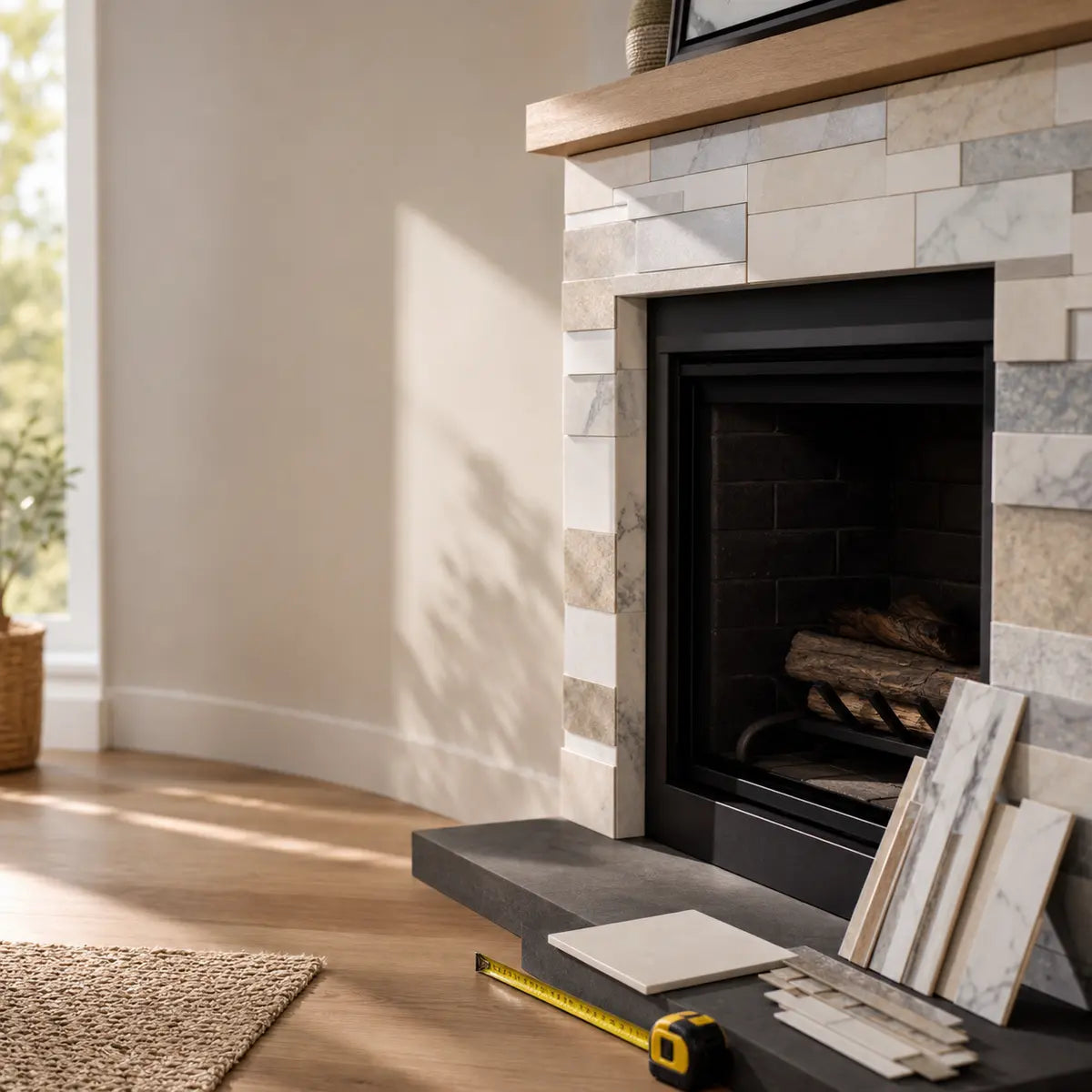
Surround
The surround is the material immediately framing the fireplace opening. It may extend vertically along both sides of the opening and horizontally across the top.
A surround can look like a wall finish, but its location may place it close to radiant heat, hot glass, vents, flames, or the appliance’s heat-management system. The surface temperature can vary across the same surround. Areas near the opening or upper vent may be much hotter than the outer corners.
A surround is therefore a conditional zone, not an automatic yes. You need written product approval, appliance-specific clearance information, and a surface-temperature check.
Mantel wall
The mantel wall is the wall above the fireplace, often behind or above a mantel shelf. It is easy to assume this is a cool decorative area because it sits outside the firebox.
That assumption can be wrong. Napoleon warns that the area above an appliance gets hot and prohibits combustible objects or materials in that area unless the required clearances are met. Its manuals direct users to model-specific installation instructions because mantel size, material, appliance configuration, and heat management affect the allowable placement. Napoleon’s Elevation owner guidance for above-appliance heat explains why the wall above the unit requires attention.
A mantel wall may be acceptable for some finishes at a specified height and distance, but an appliance clearance table is not the same as an adhesive temperature rating. Meeting a combustible-material clearance does not prove that a peel-and-stick backing will remain bonded.
Accent wall
An accent wall is a decorative wall that is separate from the heat-producing part of the fireplace. It may surround a non-operating faux fireplace, extend along a media wall, or sit beside an appliance without covering its enclosure, vents, or required clearances.
This is usually the strongest use case for peel-and-stick tile. WallPops states that products should not be placed directly on a heat source but identifies a faux fireplace that is not in use as an acceptable application in its FAQ. WallPops’ peel-and-stick fireplace FAQ guidance describes that lower-risk distinction.
The key distinction is functional: a faux fireplace wall that is genuinely not connected to an operating heat source has a different risk profile from a working fireplace surround. Still, verify that the unit has no hidden heating element, hot-air outlet, wiring issue, or requirement against covering the surface.
Which fireplace areas are off-limits or conditional?
The firebox and flame-contact zone are off-limits. The active hearth is generally unsuitable for ordinary adhesive tile. Surrounds and mantel walls are conditional, while non-heating accent walls are usually the lower-risk choice.
The following table gives a deterministic screening benchmark. The index runs from 0 to 5, where 5 means the area should be treated as off-limits for ordinary peel-and-stick tile and 0 means the area has no active heat boundary identified, subject to ordinary product and surface checks.
| Fireplace Area | Typical Heat or Ember Exposure | Heat-Boundary Risk Index | Peel-and-Stick Suitability | Required Verification |
|---|---|---|---|---|
| Firebox | Direct flame, embers, sparks, combustion gases, intense radiant heat | 5/5 | Off-limits | Use only materials and construction specified for the appliance |
| Active hearth | Embers, radiant heat, traffic, abrasion, heat cycling | 5/5 | Generally unsuitable | Check appliance manual, local requirements, and professional material approval |
| Active surround | Radiant heat, hot glass, vent paths, possible ember exposure | 4/5 | Conditional at best | Product approval, appliance clearance, hottest-surface measurement |
| Mantel wall | Rising heat, vent discharge, radiant heat, combustible-clearance limits | 3/5 | Conditional | Model-specific manual, clearance reference points, temperature check |
| Nearby decorative wall | Indirect heat depending on geometry and ventilation | 1–3/5 | Conditional | Confirm no vent, hot-air path, or excessive surface temperature |
| Faux fireplace wall with no active heat source | No operating flame or appliance heat; ordinary wall risks remain | 0–1/5 | Lower-risk decorative use | Confirm the unit is not heated, check surface and lease rules |
The score is a decision aid, not a fire-safety standard. It gives you a consistent way to ask the right questions. It does not replace the fireplace manual, local code, the authority having jurisdiction, or qualified professional advice.
Why the adhesive is often the weak point
The most common mistake is evaluating only the visible tile face. A peel-and-stick product is a layered assembly:
- Decorative face or printed surface
- Core or backing
- Adhesive layer
- Wall or substrate
The face may resist a certain amount of heat while the adhesive softens, creeps, loses tack, discolors, or releases an odor. Repeated heating and cooling can also stress the bond even when the surface never reaches a dramatic temperature.
That is why “heat resistant” needs a complete sentence after it. Ask:
- Heat resistant to what temperature?
- Is the limit for the tile face, the installed surface, or the adhesive?
- Is fireplace use named specifically?
- Does the rating cover gas, wood-burning, electric, or only stovetop conditions?
- Does it cover direct radiant heat, vent discharge, or hot glass?
- Is the product approved for a vertical surround, a mantel wall, or only a backsplash?
- What happens if fireplace fumes pass over the material?
A product claim that says “heat resistant” without a number, application boundary, or installation instruction is incomplete for fireplace use.

Is there a safe distance for peel-and-stick tile near a fireplace?
There is no universal peel-and-stick fireplace safe distance. A distance number is meaningful only when it comes from the specific tile instructions, the specific fireplace manual, and the actual geometry of the installation.
WallPops provides a 15-inch (38 cm) separation example for its peel-and-stick wallpaper from a stove, fireplace, or other heat source. That is a manufacturer instruction for that wallpaper product and should not be transferred to every peel-and-stick tile. The FAQ does not establish a universal measurement method from the opening, hottest surface, vent, or appliance face.
Fireplace manuals also vary. One Hearth & Home Technologies Glow Getter manual gives different combustible-mantel heights based on mantel depth and whether a hood is used. For the listed configurations, the required heights change as the mantel depth changes. The same manual also restricts carpet or vinyl within 14 inches of the fireplace face. Hearth & Home Technologies’ Glow Getter clearance tables show why model-specific measurements matter.
Those numbers illustrate the problem: a clearance for one appliance component or finish category is not a peel-and-stick adhesive rating.
Why one distance number fails
A single measurement cannot account for:
- Gas versus wood-burning operation
- Electric heating elements or fan discharge
- Open versus sealed combustion
- Vent location
- Hot glass or metal doors
- Mantel depth
- Heat shields or hoods
- Fireplace opening size
- Wall construction
- Tile composition and adhesive chemistry
- Duration and frequency of operation
Two fireplaces can look nearly identical from the living room and have different installation requirements. Two tile products can look identical online and have different temperature limits.
Use a distance number only when the manufacturer defines exactly what the number means and what product or appliance it applies to.
How do gas, wood-burning, electric, and decorative fireplaces differ?
Fireplace type changes the heat pattern, but no fireplace type automatically makes peel-and-stick tile safe. Combustion appliances create flame, embers, hot gases, or hot glass; electric units may reduce flame and ember exposure but can still create heated air and model-specific clearance requirements.
| Fireplace Type | Main Heat Pattern | Likely Risk Area | Required Check | Recommended Material Path |
|---|---|---|---|---|
| Wood-burning | Flame, embers, sparks, smoke, radiant heat, hot masonry | Firebox, hearth, opening, upper surround | Appliance and chimney guidance, hearth requirements, local code, professional review when unclear | Use listed noncombustible fireplace materials; keep peel-and-stick tile on separate decorative walls |
| Gas | Flame, hot glass, radiant heat, vent discharge | Firebox, glass, vent path, mantel wall | Exact appliance manual and finishing clearances | Use only materials expressly approved for the model and location |
| Electric | Heated air, hot surfaces, enclosure and ventilation requirements | Air outlet, upper enclosure, wall above unit | Exact electric-fireplace manual and surface-temperature check | Consider peel-and-stick only on verified low-heat decorative areas |
| Decorative non-heating or faux fireplace | No operating combustion or heater if genuinely inactive | Hidden heater, wiring, surface condition | Confirm the unit is not connected to an active heat source | Lower-risk accent-wall use, subject to product and lease rules |
Wood-burning fireplaces
Wood-burning fireplaces have the broadest range of uncontrolled conditions. Logs shift, embers can travel, and the surface around the opening can heat unevenly. A tile that survives normal radiant heat could still be exposed to an ember during an unusual burn.
The National Fire Protection Association recommends keeping a metal or heat-tempered glass screen in place on a fireplace and notes that fireplace components can become extremely hot. It also recommends annual chimney and vent inspection by a licensed professional. National Fire Protection Association fireplace safety guidance provides that context.
For wood-burning units, avoid adhesive tile on the opening, hearth, firebox, and any surface that may receive sparks or embers.
Gas fireplaces
Gas fireplaces can appear cleaner and more controlled than wood-burning units, but hot glass, flames, vents, and rising heat remain serious considerations. NFPA guidance cited above notes that gas fireplace doors can reach 1,300°F (705°C).
A gas-fireplace installation manual may specify clearances for mantels, trim, finishing materials, and objects above the appliance. Follow the exact model instructions. Do not substitute a generic blog distance or an online product review.
Electric fireplaces
Electric fireplaces may have lower flame and ember exposure than combustion fireplaces, but that does not create an automatic approval for adhesive tile. An electric unit may discharge heated air, warm the enclosure, or require clearances around vents and controls.
The correct question is still: What does the model manual permit, and what temperature does the surface reach during normal operation?
For an electric media wall, peel-and-stick tile may be more appropriate on a separate decorative section than directly over the heater enclosure or air outlet. A guide to electric fireplace wall design can help with the visual planning, but product placement still depends on the appliance manual.
Decorative and faux fireplaces
A non-heating faux fireplace is the clearest lower-risk scenario. It can provide the visual center of a room without exposing the tile to active flame, embers, or vent discharge.
Confirm that:
- The fireplace does not contain a working heater.
- No hot-air outlet will be covered.
- The unit is not required to remain accessible for electrical or service reasons.
- The wall surface is clean, dry, smooth, and suitable for adhesive tile.
- Your lease, condo rules, insurance requirements, or host-property policies allow the change.
For renters, a renter-friendly tile guide is a useful planning resource before you commit to a wall treatment.

How should you test the fireplace wall temperature?
Measure the hottest accessible surface after the fireplace reaches normal operating condition, then compare that reading with the exact product limit. A temperature test can support a decision, but it cannot certify an installation or override flame, ember, vent, code, or manual restrictions.
An infrared thermometer is a practical screening tool. It detects infrared radiation from the surface without requiring contact. Its reading can be affected by surface emissivity, reflected heat, viewing angle, distance, and whether you aimed at the hottest point.
Use this process:
- Identify the fireplace model. Look for the model and serial label on the appliance, inside the control compartment, behind a lower access panel, or in the owner’s paperwork.
- Read the installation manual. Look for terms such as combustible materials, finishing materials, mantel clearance, surround, vent, heat outlet, trim, and minimum distance.
- Read the tile instructions. Find the maximum installed-surface temperature, prohibited locations, application category, and any reference to fireplaces or heat sources.
- Inspect the proposed area while the fireplace is off. Mark the locations of vents, hot glass, open edges, seams, removable panels, and surfaces that may need service access.
- Operate the fireplace according to its manual. Do not create an unusual high-heat test by blocking vents, using unapproved fuel, overloading a wood-burning fire, or changing the appliance setup.
- Measure several points. Check the center of the proposed tile area, the area closest to the opening, the area above the appliance, both sides of the surround, and any location near a vent or heat outlet.
- Look for the highest reading. Compare the hottest accessible surface with the exact product limit. For Smart Tiles, the cited manufacturer benchmark is 49°C (120°F), but that limit applies to the named product guidance and does not transfer to another brand.
- Repeat under normal use conditions. If the fireplace is used for long periods, measure during the longer normal operating cycle rather than relying on a brief test.
- Stop if the result is unclear. A reading near the product limit, a fluctuating surface, an inaccessible hot spot, or a conflict between the manual and the product label calls for professional advice.
Do not touch hot glass, metal, vents, or masonry to confirm the reading. Do not place a hand near a flame or opening. Do not remove guards or appliance panels. An infrared thermometer is a comparison tool, not a fire-rating test.
A temperature below the product limit also does not answer every question. It cannot prove that the adhesive will withstand long-term thermal cycling, that fumes will not discolor the tile, or that the installation complies with local requirements.
What should you verify before buying peel-and-stick fireplace tile?
Do this before you buy: verify the product, the fireplace, the surface, the heat path, and the rules that govern the property. A low price and attractive pattern do not compensate for a product that is excluded from fireplace use.
Product verification
Look for clear written answers to these questions:
- Is the product approved for fireplace-adjacent use?
- What is the maximum installed-surface temperature?
- Does the limit apply to the adhesive as well as the tile face?
- Is the product approved for direct radiant heat?
- Is it approved near hot glass or a vent?
- Is it approved for a hearth or floor?
- Does the manufacturer prohibit use around working fireplaces?
- Does the product require a specific substrate or primer?
- Does the warranty exclude heat exposure?
Keep a screenshot or copy of the installation instructions. Product pages can change, and marketplace descriptions may omit restrictions found in the manufacturer’s documentation.
Fireplace verification
Find the exact model manual and check:
- Required clearance from combustible materials
- Mantel and trim dimensions
- Finishing-material requirements
- Air outlets and vent paths
- Access panels and service areas
- Heat shields or hoods
- Whether the surround is part of the listed appliance assembly
- Whether the appliance may be modified or covered
A fireplace refresh guide focused on surrounds and heat exposure can help you identify the area you are actually planning to cover.
Surface verification
Peel-and-stick tile usually needs a surface that is smooth, clean, dry, sound, and free of loose paint, soot, grease, dust, and moisture.
Do not install over:
- Loose or flaking paint
- Damp masonry
- Freshly repaired compound that has not cured
- Soot or creosote residue
- Textured walls that prevent full contact
- Crumbling mortar
- Surfaces that need regular access for service
- Areas that expand, flex, or vibrate during operation
Heat can expose a weak surface faster than a normal room-wall installation. If the wall coating releases, the adhesive bond may fail even when the tile itself remains intact.
Property and rule verification
Renters, condo owners, and short-term rental hosts should check:
- Lease requirements
- Landlord approval
- Condo or homeowners association rules
- Insurance conditions
- Local permit or inspection requirements
- Fire-safety policies for guest accommodations
- Restoration obligations at move-out
A renter-friendly project usually makes more sense on a separate, non-heated accent wall than on a working fireplace surround. Review renter-friendly accent wall ideas before choosing a location.

What are safer peel-and-stick fireplace makeover ideas?
The safer design strategy is to move the adhesive tile away from the active heat boundary. You can still create a strong fireplace focal point without placing peel-and-stick material on the firebox, hearth, hot surround, or vent path.
Create a faux fireplace focal wall
If the fireplace is decorative and non-heating, treat the surrounding wall as an accent project rather than a fireplace-component project. Use the tile to frame artwork, a television, a mirror, or a mantel while keeping electrical and service areas accessible.
This approach gives you the visual effect of a tiled fireplace wall without asking the adhesive to perform beside flame or high heat.
Tile the wall beside the fireplace
A side wall may offer more design impact and less heat exposure than the surround. Measure the surface rather than assuming distance from the opening guarantees safety. Check for radiant heat, vents, and unusual air movement.
If the side wall remains cool during normal operation and the product instructions allow the application, a decorative tile may be more appropriate there than directly above or beside the opening.
Use a removable decorative panel
A removable panel can create the appearance of a tiled fireplace feature while keeping the product on a verified low-heat surface. The panel can be made from a suitable rigid substrate and placed where it does not obstruct the appliance, vents, controls, or required clearances.
Do not use a panel to cover a prohibited zone. “Removable” affects convenience and reversibility; it does not change the temperature or fire exposure.
Use actual fireplace-rated materials for active zones
If your goal is to retile the active surround, hearth, or firebox, choose materials and installation methods intended for fireplaces. Depending on the design, that may involve ceramic or porcelain tile, natural stone, masonry, metal, heat-rated glass, or another material specified for the appliance and location.
Peel-and-stick tile can still be used elsewhere in the room to coordinate colors or textures. The DIY fireplace makeover guide covers planning concepts, surface preparation, and installation cautions for projects that use appropriate material boundaries.
Choose a product for the right zone
Store-local products such as Dual Ceramics peel-and-stick tile, Minty Ceramic 8, and Nature’s Green removable tile are described for kitchens, bathrooms, or accent walls. Their product descriptions should not be treated as approval for a firebox, active hearth, hot vent area, or other high-heat fireplace surface.
Use them where the intended application fits the material. Confirm current product instructions before considering any fireplace-adjacent location.

What should you do if tile has already started peeling or discoloring?
Stop using the fireplace until you understand why the material changed, especially if you see smoke, bubbling, softening, cracking, or a persistent odor. Peeling can indicate heat exposure, poor surface preparation, incompatible adhesive, moisture, or a combination of problems.
Look for:
- Lifted corners or seams
- Bubbling or wrinkling
- Soft or tacky adhesive
- Yellowing or browning
- A plastic, chemical, or burning odor
- Soot or residue on the tile
- Cracks near the opening
- Discoloration above a vent
- Material contacting hot glass or metal
Do not press the tile back down while the fireplace is hot. Do not cover a damaged area with another layer. Remove the material only when the surface is cool and the removal method is compatible with the substrate.
If the material has smoked, charred, or contacted flame, discontinue use and consult a qualified fireplace professional. A visual inspection may be needed to determine whether the appliance, venting, wall construction, or surrounding finish has been affected.
Frequently Asked Questions
Can you use peel-and-stick tile around a fireplace?
You may be able to use it on a low-heat decorative wall if the product manufacturer allows the application, the fireplace manual permits the finish, and the measured surface temperature remains within the product limit. Do not use it inside the firebox, on flame- or ember-exposed surfaces, or on an active hearth.
Is peel-and-stick tile heat resistant?
Some products are marketed as heat resistant, but that phrase does not establish a universal fireplace rating. Smart Tiles provides a product-specific maximum installed-surface temperature of 49°C (120°F), while Art3d excludes one self-adhesive product from high-temperature environments such as stove walls and fireplaces. Read the exact instructions for the product you plan to install.
Can peel-and-stick tile go on a fireplace surround but not the firebox?
Sometimes, but the surround is still a conditional zone. It may receive radiant heat, hot air, or heat from glass and vents. Confirm the product’s fireplace-use guidance, measure the hottest surface, and check the appliance manual. A tile face that looks noncombustible does not prove that the adhesive and backing are suitable.
Is there a standard peel-and-stick tile fireplace safe distance?
No universal distance applies to every product and fireplace. WallPops gives a 15-inch example for its peel-and-stick wallpaper, but that number is not a universal fireplace-tile standard. Fireplace manuals also use model-specific reference points and clearance tables.
Is peel-and-stick tile a good renter-friendly fireplace makeover?
It is usually a better fit for a non-heated accent wall, faux fireplace, or nearby decorative surface than for an active fireplace component. Before installing, check your lease, test the wall, plan removal, and confirm that the surface is away from heat and vents. A guide to peel-and-stick tile installation and removal planning can help with the non-heated parts of the project.
The bottom line: treat peel-and-stick tile as a decorative wall product
Peel-and-stick fireplace tile is not a firebox, hearth, or high-heat material. It is a decorative product whose suitability depends on the complete assembly: face, backing, adhesive, substrate, temperature, distance, ventilation, fireplace model, and local requirements.
Use the Heat-Boundary Risk Index as a first screen:
- Firebox and flame-contact areas: off-limits.
- Active hearth: generally unsuitable for ordinary adhesive tile.
- Active surround: conditional only with product and appliance approval.
- Mantel wall: conditional because heat rises and clearances vary.
- Nearby decorative wall: verify temperature and vent paths.
- Non-heating faux fireplace wall: lower-risk use case, subject to ordinary product and property checks.
Do not guess near heat. Find the fireplace model, read the manual, verify the product’s installed-surface limit, measure the hottest accessible point after normal operation, and stop when the instructions conflict or the result is unclear.
Before purchasing, use a written fireplace tile safety checklist to record the fireplace type, proposed zone, clearance requirements, product limit, surface condition, lease or condo rules, and professional questions. When the project touches an active heat area, a qualified fireplace professional is the right next step.


Kommentar hinterlassen
Diese Website ist durch hCaptcha geschützt und es gelten die allgemeinen Geschäftsbedingungen und Datenschutzbestimmungen von hCaptcha.