




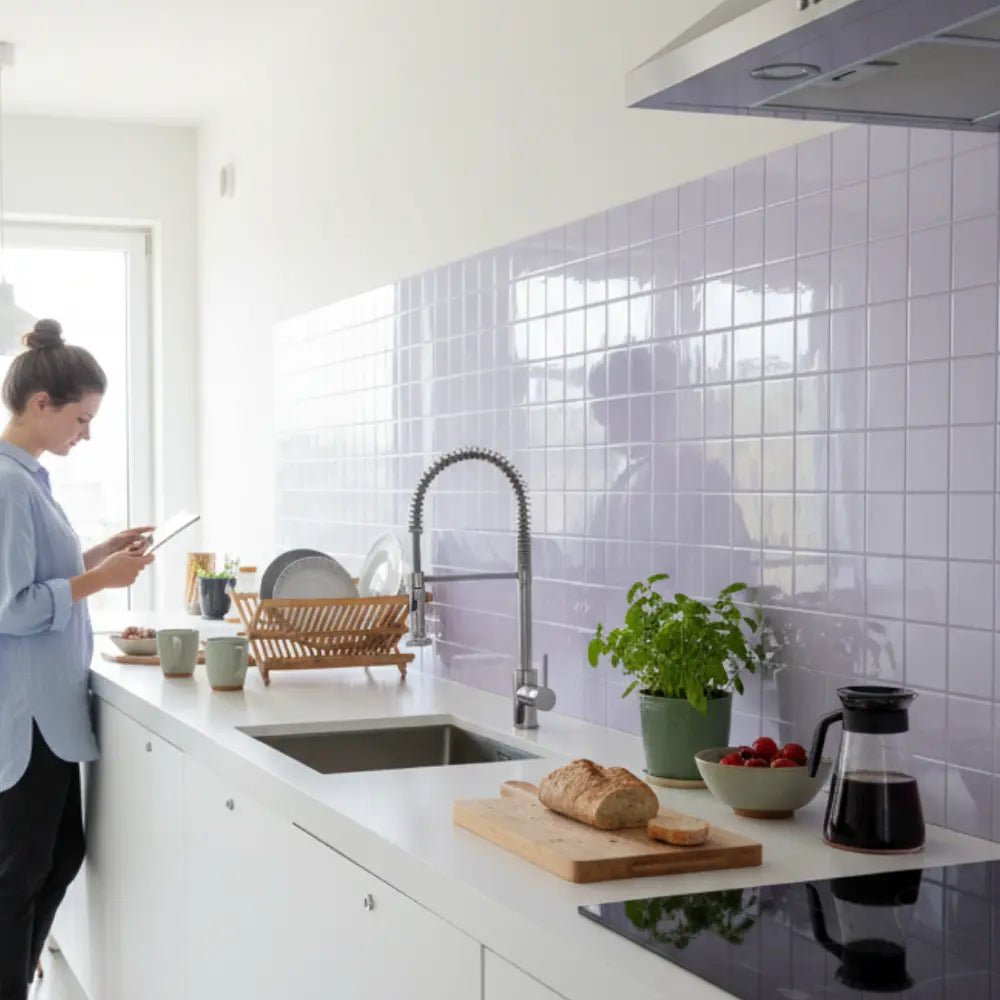



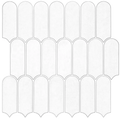
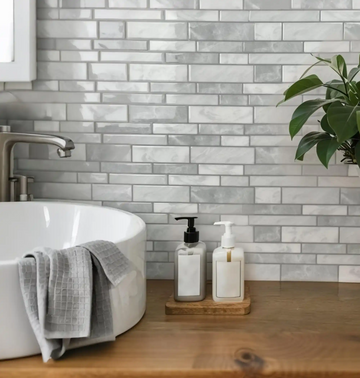
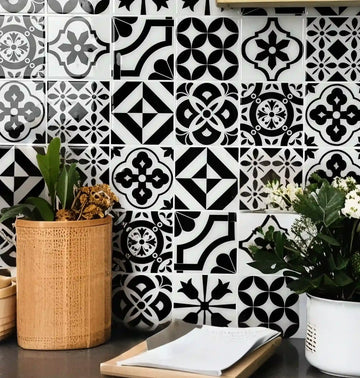
A decorative peel-and-stick tile should not be treated as a substitute for wall insulation or air sealing. It may change the surface you touch and the appearance of the room, but a warmer-feeling finish does not prove a warmer wall, lower heat loss or a smaller energy bill. Those claims need product-specific thermal data and an assessment of the complete wall and home.
A cold kitchen wall can prompt several different questions. Is the surface simply cool to the hand? Is there a draft near a window? Does condensation appear behind the counter? Is the whole room difficult to heat? These symptoms can overlap, but covering the wall does not answer all of them. The best next step is to identify the problem before choosing a decorative finish or a building-envelope repair.
Evidence boundary: this guide explains thermal resistance, measurement and project planning. It does not report a Stickwoll temperature trial, assign our tiles an R-value or claim a three-degree surface-temperature increase. Numerical examples below use stated hypothetical assumptions so you can understand the calculation without confusing it with a product specification.
First distinguish touch, surface temperature and room comfort
Touch tells you about an interaction between your hand and the material, not just the material's starting temperature. A surface can draw heat from your hand differently from another surface at the same temperature. The finish's thermal properties, contact area and the duration of contact all matter. It follows that a material that feels less cold is not automatically insulating the building to a meaningful degree.
Surface temperature is a different quantity. It can be measured with an appropriate method, but a single reading still needs context. Record the room conditions, outdoor conditions, location, heating cycle and recent sunlight or appliance use. A reading taken above a running stove cannot be fairly compared with one taken on an unheated morning near a window.
Room comfort is broader again. Consider where you stand, whether you notice air movement, which nearby surfaces are cold and whether the heating system serves the room as intended. A room can feel uncomfortable even when the thermostat reaches its target. Conversely, a decorative change can make a room visually inviting without changing its physical heating demand. Keep those benefits distinct rather than dismissing either one.
| Question | Useful evidence | What not to infer |
|---|---|---|
| Does the finish feel different? | A careful comparison of touch under similar conditions | A measured R-value or whole-home saving |
| Is the surface actually warmer? | Suitable temperature measurements with recorded conditions | The cause from one before-and-after photograph |
| Is heat moving through the wall? | Assembly information and an appropriate energy assessment | That every cold-looking patch is missing insulation |
| Is air leaking? | A safe inspection and, when needed, professional diagnostics | That a decorative sheet forms a compliant air barrier |
| Is moisture present? | Source investigation and appropriate wall assessment | That covering the stain resolves the source |
This separation helps you spend money on the intended result. A homeowner seeking a different color and texture may be satisfied with a suitable decorative finish. A homeowner with a recurring draft or damp corner needs a different investigation. Writing the objective clearly prevents a visual renovation from quietly becoming an unsupported energy retrofit.

Understand heat flow through the whole wall
Heat moves from warmer conditions toward cooler ones. In a home, relevant paths include conduction through materials, air movement and radiation between surfaces. A wall finish is only one part of a larger assembly that can include framing, insulation, sheathing, air-control layers and exterior cladding. Windows, doors and junctions add other paths that a small backsplash cannot change.
Natural Resources Canada's building-science guide explains heat, air and moisture control as connected parts of house performance. It also explains why insulation slows heat flow and why empty cavities are not equivalent to properly installed insulation. That provides a useful foundation for a cold-wall investigation, but it does not identify the construction or condition of your particular wall. [1]
Think of a small backsplash as one area within that assembly. Even a layer with some thermal resistance does not repair a missing seal around a window or change the insulation behind the rest of the wall. A product may also be installed only over a fraction of the room's exterior surface. The size and location of the treated area matter when interpreting any potential effect.
Framing and junctions can make the wall behave differently across its area. A simple calculation that adds material layers in one path does not capture every alternate path through studs, corners or openings. An energy assessor can consider those features rather than assuming every square metre has the same construction. This is one reason a material-level number should not be presented as a whole-wall result.
Read R-value, RSI and thickness correctly
Thermal resistance describes how strongly a layer opposes heat flow. R-value is commonly expressed in imperial units in North American insulation discussions, while RSI uses metric units. They describe the same kind of property on different scales. NRCan gives the conversion as R divided by 5.678 equals RSI. A number is therefore incomplete unless the unit and the construction it describes are clear. [1]
For a simplified, uniform material layer under steady one-dimensional conduction, its metric thermal resistance is thickness divided by thermal conductivity: RSI = t / k. Thickness is in metres and conductivity in watts per metre-kelvin, giving square metres-kelvin per watt. This elementary relationship is useful for understanding a specification. It does not replace a test of a multi-layer product or an assessment of a wall with alternate heat-flow paths.
A worked example using hypothetical values
Assume, only for illustration, that a uniform decorative layer is 4 millimetres thick and has thermal conductivity of 0.20 W/(m·K). Convert thickness to 0.004 metres, then divide by 0.20. The result is RSI 0.020 m²·K/W, equivalent to approximately R-0.114. These values were chosen for arithmetic; they are not measurements or declared properties of Stickwoll, vinyl tiles, ceramic tiles or any named product.
Now assume a simplified wall path already has RSI 2.0 and that the new layer can be added in series without changing anything else. The total becomes RSI 2.02. In that simplified model, the heat-flow ratio is 2.0 divided by 2.02, approximately 0.9901, or about a one-percent reduction through that path. This is not a household energy-saving forecast. The assumptions exclude air leakage, other wall paths, windows, weather changes and the limited area covered.
The example explains why thickness and a pleasant touch sensation should not be turned into an ambitious bill-saving promise. It also shows why saying the added layer has literally zero thermal resistance would be imprecise. The relevant questions are its actual resistance, how it is installed, what fraction of the assembly it affects and whether the claimed outcome follows from those facts.
For a real product comparison, request the tested or declared property, the applicable method, the thickness, any required air space and the exact product version. Ask whether the number applies to the material alone or a specified assembly. Do not compare an assembly value including an air space with a directly bonded sheet as though they were interchangeable. Keep the supporting document with your project notes.
Do not confuse a shiny face with an insulation system
A reflective appearance can be attractive, but it does not by itself describe the thermal performance of a wall. Ask how a claimed reflective effect is achieved in the actual installed assembly. If the supporting data require a particular air space, orientation or combination of layers, a sheet bonded directly to a wall is a different construction. The installation detail belongs with the number.
NRCan's effective thermal-resistance tables distinguish material and assembly contributions and note the importance of the surrounding construction. Their treatment of reflective or vapor-control materials should not be reduced to a rule that every foil-like decorative face adds a large R-value. Use the data only for the listed conditions and complete assembly. [2]
Similarly, a light-colored room can look brighter without demonstrating a measured cooling benefit from the wall tile. Research or guidance about exterior cool roofs involves a different position and exposure from an interior backsplash. Do not transfer an outdoor roof result to a wall because both surfaces are light or reflective. Keep decorative appearance, solar exposure and thermal resistance as separate claims.
This does not make finish selection unimportant. Choose color, reflectivity and texture for the way the room is used and lit. Simply avoid paying a thermal-performance premium on the strength of an unsupported visual analogy. A genuine insulation product should be evaluated using its documented properties and suitable installation, not by how metallic or thick it appears in a photo.
Inspect a cold wall without hiding the evidence
Write down when the problem occurs. Is the wall uncomfortable only on windy days, during very cold weather or after a shower? Does the effect follow a heating cycle or disappear when sunlight reaches the room? Note the location in a sketch rather than treating the entire wall as one condition. These observations help you ask a more specific question when seeking advice.
Look for visible gaps, damaged finishes, staining and recurring condensation from an accessible position. Do not remove electrical fittings, drill into a wall or disturb unknown old materials simply to investigate a cold patch. Keep photographs of any existing damage. If the wall is soft, wet or deteriorating, postpone the decorative work and have the source assessed before covering it.
Separate a possible air-leak problem from a material-conduction problem. An intact decorative sheet is not automatically a continuous air barrier, especially around outlets, cabinets, windows and the rest of the room. Do not seal designed vents or equipment openings because they feel cool. Proper air-control work must account for ventilation and combustion safety as well as the visible gap.
A professional energy assessment is useful when the cause is uncertain or the project involves more than a cosmetic change. NRCan recommends professional energy evaluation as a way to assess improvement potential, while the US Department of Energy describes assessments as combining inspection, diagnostics, data and reporting. Ask for a prioritized improvement plan rather than a promise based only on the coldest-looking photograph. [3] [4]
Questions to bring to an assessor
Explain the symptom, the affected room, the dates or weather when it occurs and any previous repairs. Ask which observations suggest air leakage, insufficient insulation, a thermal bridge or a moisture problem, and what further checks would distinguish them. Request an explanation of the proposed work and its assumptions. A clear diagnosis is more useful than adding several products whose individual purposes remain unclear.
Also explain your planned decoration. If the wall may need to be opened or repaired, that work should inform when and where the new finish is installed. Coordinating the tasks can avoid paying for a decorative covering that must soon be removed. Keep the scope of the energy work and the appearance work separate in quotations, even when the same contractor coordinates them.
Use infrared readings carefully on different finishes
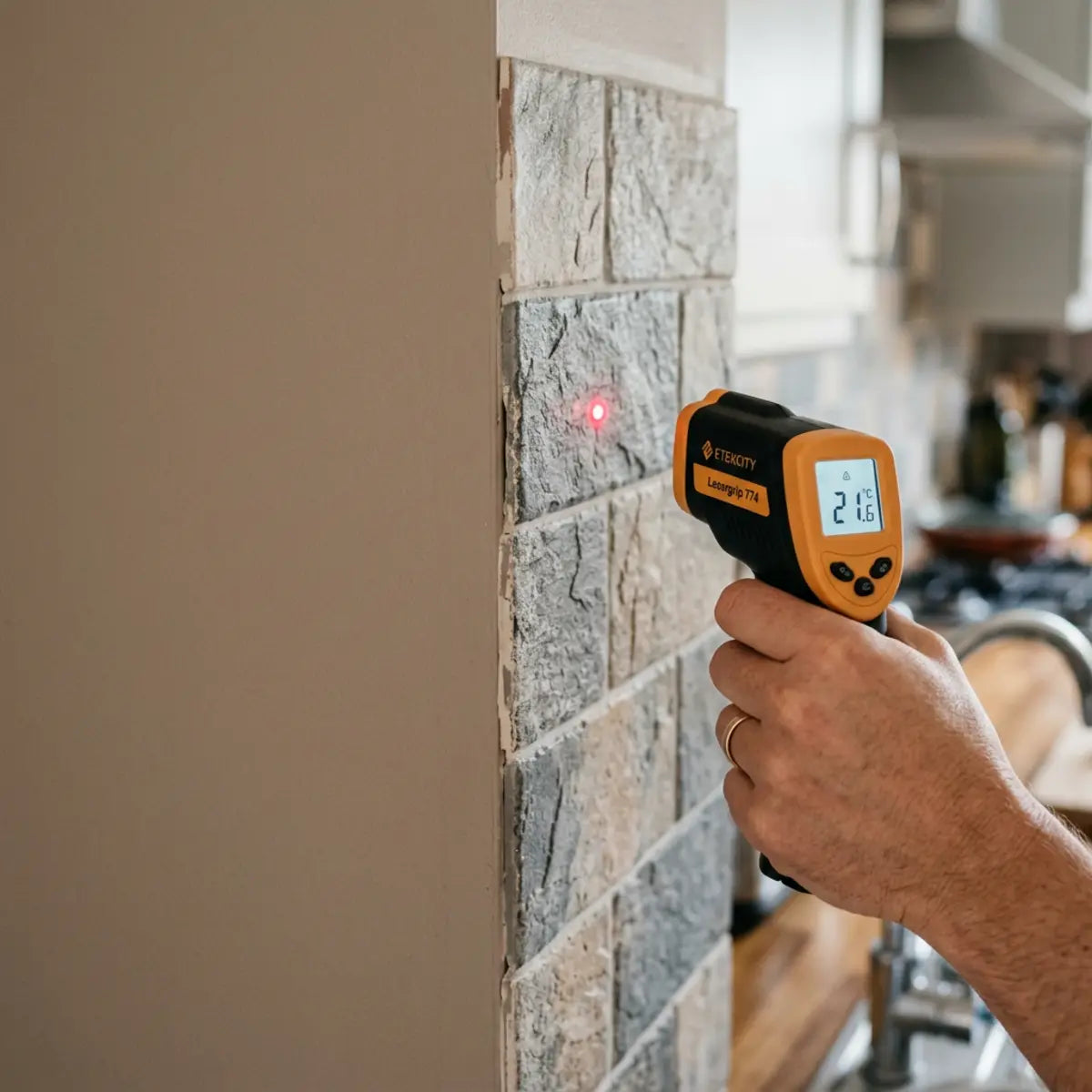
An infrared thermometer or thermal camera responds to infrared radiation from the surface and its surroundings. Its displayed value depends on the instrument setup and the target. A glossy decorative face can behave differently from the matte paint beside it. Comparing the two with unchanged assumptions may create an apparent difference that is not their true temperature difference.
FLIR explains that emissivity and reflected temperature are important when interpreting thermal images, particularly for low-emissivity surfaces. An object can appear warmer or colder than its surroundings because it reflects radiation from other objects. This is why a shiny patch on a thermal image is not independent proof of a thermal benefit or a hidden defect. [5]
Follow the instrument's guidance for the target material, measurement area, distance and operating conditions. A targeting laser does not necessarily represent the entire area contributing to the reading. Do not measure through a protective film or packaging and describe the result as the adhesive temperature. For difficult surfaces or decisions that depend on a small difference, use a suitable method and qualified interpretation.
Do not assume that adding black tape and waiting a fixed fifteen minutes guarantees accuracy. A reference material may help with an appropriate method, but its suitability, thermal contact, temperature stabilization and instrument settings still matter. It can also affect a fragile finish. Follow the measurement procedure rather than copying a single trick without its conditions.
| Measurement detail | Record it because | Common shortcut to avoid |
|---|---|---|
| Instrument and settings | Accuracy, resolution and target assumptions differ. | Treating a decimal display as proof of a tiny improvement |
| Position and distance | The measured area must match the intended surface. | Aiming at a small edge from far away |
| Room and outdoor conditions | The thermal situation changes with use and weather. | Comparing an unusually cold morning with a sunny afternoon |
| Appliance and heating operation | Nearby heat can change the result. | Attributing all warming to a new finish |
| Surface condition | Wetness, reflectivity and contact affect interpretation. | Comparing different finishes without accounting for them |
A measurement log is valuable even when it cannot establish a precise saving. It can show that the problem is intermittent, confined to one area or associated with a particular activity. Use it to guide the next question. Avoid turning a small collection of readings into a universal statement about every composite or vinyl wall tile.

Check moisture before adding another layer
Condensation connects the temperature question to the moisture question. A room can have one cold surface on which water appears while another surface remains dry. Relative humidity and dew point help describe those conditions, but neither reading alone identifies every hidden moisture source. A leak, a plumbing problem and condensation require different responses.
The National Weather Service explains that dew point is the temperature at which air becomes saturated when cooled, while relative humidity varies with temperature. That distinction helps explain why surface conditions matter when investigating condensation. It does not mean a decorative tile automatically prevents condensation or that one room reading certifies the wall. [6]
Do not cover recurring dampness or mold with a decorative layer. EPA's moisture guide emphasizes fixing the water problem and cautions against painting or caulking over mold. Keep that repair separate from the later appearance decision. A wall that looks dry immediately after wiping may still have an unresolved source that needs attention. [7]
Adding an interior layer can change how an assembly behaves, but the direction and importance of the change depend on the materials, climate and construction. Avoid blanket statements that every adhesive covering either traps moisture or solves it. Ask about the actual wall and product, especially for exterior walls, basements or locations with previous water damage. An appropriate building professional can assess the assembly rather than the decorative face alone.
Keep access to the areas that previously showed a problem. A new cabinet or shelving arrangement may make a corner harder to inspect. Photograph the repaired wall before covering it and retain any guidance about drying, curing and future observation. The finish should follow the moisture decision, not hide the evidence needed to make it.
Choose an intervention that matches the objective
For an appearance-only project on a sound, suitable wall, compare decorative finishes by pattern, cleaning and removal requirements. For a comfort or energy problem, compare actions based on an assessment of the building. These categories can overlap in a renovation, but they should not be sold as interchangeable. The right decorative tile can be worthwhile without pretending to replace insulation.
| Objective | Useful starting route | Boundary |
|---|---|---|
| Change the kitchen's appearance | Suitable wall finish, sample and layout | No implied energy-saving claim |
| Address a documented air leak | Appropriate air-sealing design and materials | Maintain required ventilation, fire and equipment provisions |
| Improve thermal resistance | A suitable insulation and wall-assembly plan | Use actual material and assembly data |
| Resolve dampness | Find and correct the water or condensation problem | Do not conceal active damage |
| Understand uneven comfort | Whole-room and building-system assessment | A single wall reading is not a complete diagnosis |
Do not select insulation from a universal number copied into a decorating article. Requirements and practical choices depend on location, existing construction, retrofit scope and applicable rules. A value appropriate for one wall or climate is not automatically the right target elsewhere. Ask the designer or contractor to explain which requirements apply and what complete assembly they propose.
Likewise, avoid prescribing one spray foam, sealant or gasket for every visible opening. Electrical boxes, fire-rated assemblies, equipment clearances and moisture-control details can impose specific requirements. Use suitable approved materials and qualified help where the work calls for it. Do not pack an electrical box, block an intentional opening or improvise around a combustion appliance.
Plan the order of work. Investigate first, complete necessary repairs and building-envelope improvements, let materials reach their required condition, then install a compatible decorative finish. This sequence keeps a cosmetic project from being damaged by later access work. It also gives you a clearer record of which change was intended to solve which problem.
Three example projects with different decisions
A renter with an uncomfortable breakfast corner
In this hypothetical case, the tenant likes the idea of a stone-look wall but also notices a draft around the nearby window. The first step is to report the draft and any damage to the landlord, with photographs and notes about when it occurs. The tenant does not assume that covering the wall will repair the window junction. Any permanent change to the surface also needs permission.
After the building issue is assessed, the tenant can choose an allowed decorative finish for the sound wall. A sample helps compare appearance, cleaning and eventual removal. The project folder distinguishes the landlord's repair from the tenant's decoration. If the room later feels better, the tenant does not attribute the entire change to the tile without considering the repair and weather.
A homeowner planning a larger kitchen renovation
In a second hypothetical case, the kitchen is about to be remodeled and an exterior wall may become accessible. The owner asks a qualified professional whether the planned work provides an opportunity to address insulation, air leakage or moisture details. The quotation describes that scope separately from cabinets and finishes. This avoids choosing an attractive covering before deciding whether the wall needs work behind it.
Once the assembly and service details are resolved, the owner selects a compatible backsplash. The finish is judged on intended use, cleaning, heat exposure and design rather than an unsupported thermal score. The owner keeps both sets of documentation. A successful renovation can include real energy work and a decorative upgrade without conflating their evidence.
A cold, damp basement wall
In the third hypothetical case, the wall is cool and occasionally marked by moisture. The owner postpones adhesive decoration and asks what is causing the dampness. The assessment may need to consider the foundation, drainage, indoor humidity or another source. The next action follows that finding rather than a generic instruction to cover the wall with an impermeable sheet.
These examples deliberately produce different outcomes. They show why a shopping decision should follow the problem definition. No example describes a completed Stickwoll field trial, a diagnosed customer property or a guaranteed improvement. They are ways to organize a real discussion with the owner, landlord, supplier or building professional.

Evaluate changes without inventing an energy-saving result
Before any approved work, record the symptom you hope to improve. For a visual project, useful criteria might be appearance under the room lighting, cleaning access and a finish that remains within its permitted use. For building work, the assessor may recommend specific diagnostics or a modeled comparison. Select the evidence that matches the claim rather than collecting convenient photographs afterward.
If you make informal temperature observations, use comparable locations and conditions. Note whether the heating system was operating, whether the wall had sunlight and whether cooking occurred nearby. Do not compare different seasons as though the covering were the only change. Keep the raw observations rather than only the highest apparent improvement.
Separate instrument resolution from uncertainty. A display that changes from 18.0°C to 18.3°C has shown a different number, but whether that difference is meaningful depends on the instrument, method and conditions. Repeated readings can reveal variation, yet repetition alone does not correct a systematic emissivity error. If the decision depends on a small change, ask what measurement method can actually resolve it.
A utility bill is even further removed from a small wall sample. Billing days, weather, occupancy, thermostat settings, other appliances and energy tariffs can all affect the comparison. A lower bill after decoration is not enough to establish that tile caused the reduction. Use an appropriate energy analysis when making a financial claim, and keep any modeled estimate separate from measured results.
For a simple project log, record date, location, room conditions, weather context, equipment use, method, observation and any intervention. Keep an image of the whole area as well as a close-up so the sample's position is clear. Note changes such as new curtains or a repaired seal. This makes your observations interpretable rather than turning them into a selective success story.
Do not create an extreme home experiment to prove a point. Avoid opening the building to unsafe weather, heating a decorative panel beyond its instructions or using a flame or smoke source to investigate leaks. A normal-use observation and a qualified assessment are more appropriate than a dramatic demonstration that introduces a new hazard.
Budget separately for decoration and building performance
List the decorative scope: eligible area, usable pack coverage, cuts, trim, preparation and spare pieces. Then list any building work independently: assessment, repair, insulation, air-control details and professional labor. Use real quotations for the actual scope rather than a generic cost per square foot. This separation makes it clear what each part of the spending is meant to accomplish.
A hypothetical budget can help you organize the decision without pretending to predict a return. One column can hold confirmed costs, another provisional allowances and a third unresolved items. Do not calculate a payback period until the saving estimate has an appropriate basis. An unknown benefit should remain unknown, not be filled with a marketing percentage to make the project look economical.
For a small appearance project, the relevant benefit may be simply a more enjoyable room and easier care. For a retrofit, the relevant benefits and trade-offs may include comfort, energy use, access, disruption and moisture performance. Ask which outcomes are expected, which are measured and which depend on future conditions. A clear budget supports a decision without requiring every improvement to be justified by energy savings.
Frequently asked questions
Can a peel-and-stick tile make a wall feel less cold?
It can change the surface you touch, and different materials can feel different under the same conditions. That does not establish a measured increase in wall temperature or a significant reduction in heat loss. Evaluate touch, actual temperature and building performance separately, and use the product for its documented purpose.
Does a thicker decorative tile always provide useful insulation?
Thickness alone is not enough. Thermal conductivity, construction and installation matter, as does the area covered relative to the whole wall. Ask for product-specific data. Do not assign all composite tiles a shared R-value or assume that an embossed face has the same thickness and properties throughout.
Can I use the example R-value as a Stickwoll specification?
No. The four-millimetre thickness and conductivity in the calculation are explicitly hypothetical. They illustrate how the equation works. They are not measured Stickwoll properties, and the simplified one-percent path calculation is not a prediction of household energy savings.
Does a thermal-camera image show missing insulation?
It can reveal patterns worth investigating, but interpretation depends on conditions, settings and the surface. Emissivity and reflections can change the apparent temperature. A thermal image does not by itself establish the wall construction or the cause of a pattern. Use qualified assessment when that distinction matters.
Should I cover a wall that has condensation?
First identify why the moisture appears and resolve any water or building issue. A decorative covering is not a general condensation remedy. The appropriate finish depends on the repaired assembly and intended exposure. Do not cover active dampness merely to hide staining or make the surface easier to wipe.
Where does decorative tile fit into a sensible renovation?
After the wall is suitable and any necessary building work is complete, choose the finish for the room and the manufacturer's permitted use. Compare layout and care using the tile planning guide, and check the separate wet-area guide where moisture matters. Decoration can be valuable without being presented as insulation.
Sources and technical boundaries
- NRCan: Keeping the Heat In, Section 2. Building-science principles and R/RSI conversion.
- NRCan: Effective Thermal Resistance of Opaque Assemblies. Assembly context, not a tile rating.
- NRCan: Keeping the Heat In, Introduction. Retrofit planning and professional assessment.
- US Department of Energy: Residential Program Guide glossary. Energy-assessment definitions.
- FLIR: How Does Emissivity Affect Thermal Imaging? Measurement limitations.
- US National Weather Service: Dew Point vs. Humidity. Air-moisture concepts.
- US EPA: A Brief Guide to Mold, Moisture and Your Home. Moisture management; not product certification.


Leave a comment
This site is protected by hCaptcha and the hCaptcha Privacy Policy and Terms of Service apply.