

5 erreurs courantes lors de la pose d’une crédence adhésive (et comment les corriger comme un pro)
Les conseils d’un expert pour éviter que votre rénovation ne tourne au désastre.
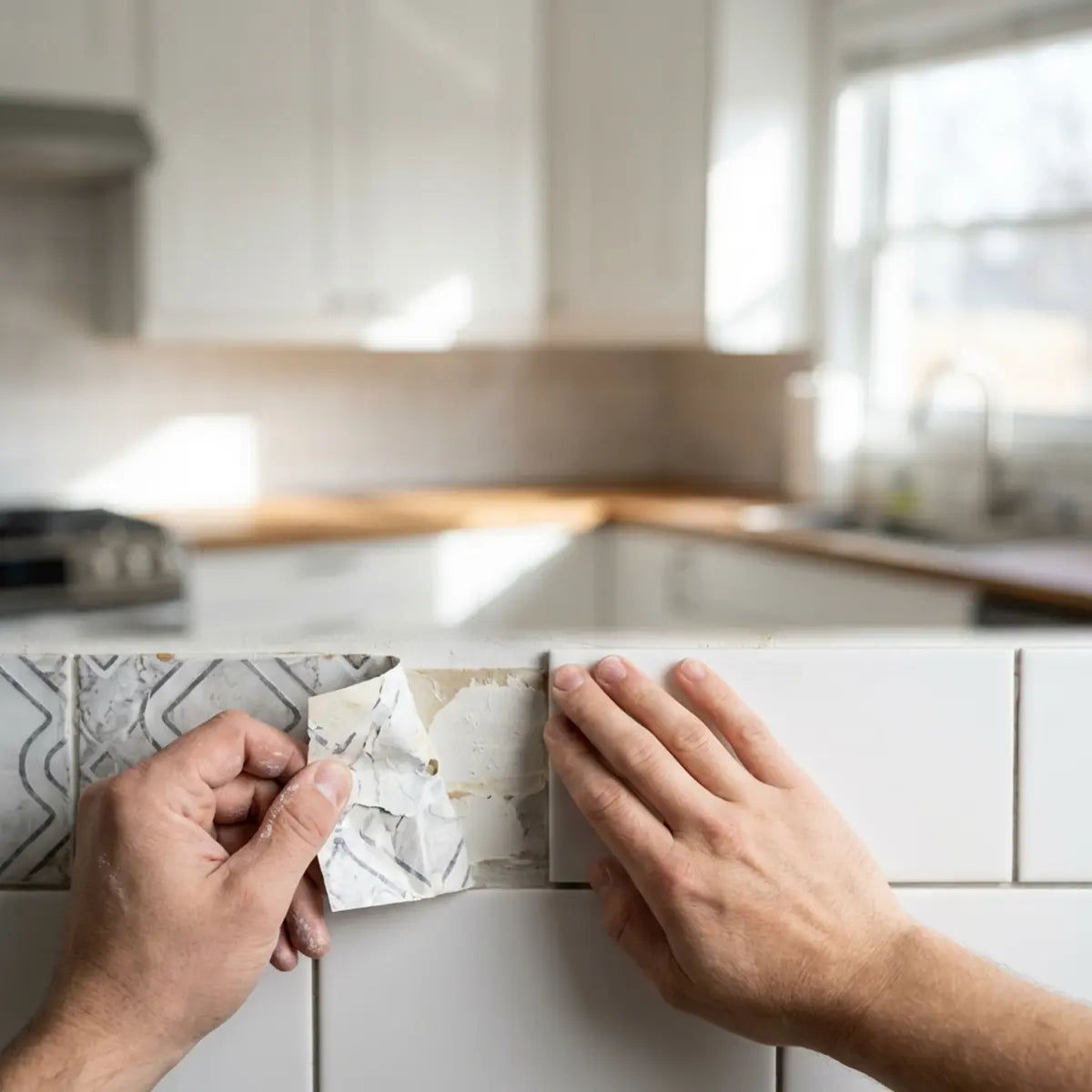
Vous avez passé le week-end à mesurer, découper et poser soigneusement votre nouvelle crédence, avant de prendre un peu de recul pour admirer la transformation. Mais dès le lundi matin, vous remarquez qu’un coin se décolle ou qu’une ligne de joint est franchement de travers. C’est une sensation désagréable que connaissent trop bien les adeptes du bricolage.
La frustration de voir du matériau gaspillé et un résultat irrégulier peut donner envie de tout arracher. Mais pas de panique. La plupart des problèmes de pose ne viennent pas du produit lui-même, mais de petites étapes souvent négligées lors de la préparation et de l’application.
Vous préparez votre projet ?
Des instructions détaillées sur les outils à prévoir, les erreurs courantes à éviter, les solutions aux problèmes de pose et les réponses aux questions fréquentes dans les situations délicates : angles, prises électriques et espace derrière la cuisinière.
Lire le guide de pose DIY étape par étapeRéponse rapide : corriger les erreurs courantes de pose
| Problème principal | Cause du problème | Solution |
|---|---|---|
| Décollement / chute | Des murs sales, gras ou texturés empêchent une bonne adhérence. | Nettoyer et appliquer une sous-couche : Frottez avec du TSP, poncez la peinture brillante et appliquez une sous-couche. |
| Rangées irrégulières / de travers | Se fier au plan de travail ou au sol pour servir de repère de niveau. | Ligne de niveau : Tracez une ligne de référence à l’aide d’un niveau laser ; ne vous alignez pas sur le plan de travail. |
| Bords qui se soulèvent | L’humidité s’infiltre ou les bords n’ont pas été suffisamment pressés. | Sceller les bords : Appliquez un mastic silicone transparent sur les bords et utilisez un sèche-cheveux pour réactiver l’adhésif. |
| Espaces autour des prises électriques | Une découpe réalisée à main levée manque de précision. | Méthode du gabarit : Réalisez un gabarit en papier avant de découper le carreau lui-même. |
| Fonte / déformation | La crédence est posée trop près d’une source de chaleur, sans zone tampon. | Protection contre la chaleur : Prévoyez une zone de sécurité derrière la cuisinière ou installez une protection arrière en acier inoxydable. |
En aidant des propriétaires à rénover leur intérieur, nous avons constaté que les carreaux adhésifs constituent une solution durable sur le long terme, à condition de respecter le fonctionnement de leur adhésif. Ce guide présente les cinq pièges les plus courants lors de la pose d’une crédence adhésive et vous explique les techniques utilisées par les professionnels pour les corriger.
Pourquoi ma crédence adhésive ne tient-elle pas correctement ?
Le problème :
Avez-vous l’impression que vos carreaux refusent d’adhérer au mur et se décollent quelques heures seulement après la pose ?
La solution :
Cette section explique le fonctionnement de l’adhésif et comment préparer une surface pour obtenir une adhérence durable pendant des années.
La réclamation que nous entendons le plus souvent concerne crédence adhésive qui ne colle pas. Il s’agit rarement d’un défaut de la colle : le problème vient presque toujours de la surface sous-jacente. Les murs de cuisine sont souvent recouverts de couches invisibles de graisse, d’huile de cuisson ou de poussière, qui forment une barrière entre l’adhésif et la cloison sèche.

De plus, de nombreuses peintures modernes sont « lavables » ou « résistantes aux taches ». Elles contiennent des additifs à base de Téflon ou de silicone, conçus spécialement pour repousser la saleté. Malheureusement, ils repoussent aussi l’adhésif. Si vous posez les carreaux directement sur ces surfaces, la gravité finira par avoir le dessus.
La solution : le protocole « TSP et ponçage »
Pour corriger le problème ou l’éviter, vous devez préparer le mur jusqu’à obtenir une surface compatible avec l’adhésion.
- 1 Dégraissez soigneusement : Le liquide vaisselle classique ne suffit pas. Utilisez du phosphate trisodique (TSP) ou un dégraissant spécialement conçu à cet effet pour éliminer des années d’accumulation d’huile de cuisson.
- 2 Cassez la pellicule protectrice : Si votre peinture est brillante ou résistante aux taches, poncez légèrement la surface avec du papier abrasif à grain fin (grain 120). Le but est de créer une accroche, c’est-à-dire de minuscules rayures auxquelles l’adhésif pourra adhérer.
- 3 Appliquez une sous-couche adaptée : Appliquez une sous-couche à forte adhérence. Elle scelle les éventuelles zones où le papier de la cloison sèche se décolle et crée une surface uniforme.
Astuce de pro : le « test du ruban adhésif »
Avant de risquer de gâcher une feuille entière de carreaux, essayez cette astuce de pro : collez une bande de ruban de masquage sur le mur. Laissez-la en place pendant 20 minutes. Si elle se décolle sans la moindre résistance, votre mur n’est pas prêt.
Vous avez affaire à une peinture difficile ?
Découvrez nos instructions détaillées pour poser des carreaux adhésifs sur un mur peint, avec des conseils de préparation de la surface et d’adhérence, ainsi que des astuces pour éviter les erreurs courantes qui peuvent entraîner une reprise coûteuse des travaux.
Lire le guide : poser des carreaux adhésifs sur un mur peint →Comparatif des produits nettoyants pour préparer les murs
| Produit nettoyant | Efficacité | Utilisation recommandée |
|---|---|---|
| Liquide vaisselle | Faible | Éliminer la poussière courante (laisse des résidus). |
| Vinaigre et eau | Moyenne | Éliminer les saletés légères, mais pas la graisse tenace. |
| TSP | Élevée (standard professionnel) | Dissoudre les graisses importantes de la cuisine et mater la peinture. |
| Alcool isopropylique | Élevée | Effectuer un dernier nettoyage pour éliminer les résidus de produits chimiques. |
Comment corriger une crédence adhésive irrégulière ou posée de travers ?
Le problème :
Vous est-il déjà arrivé de prendre du recul et de constater que vos lignes pourtant « droites » dévient progressivement vers le haut ou vers le bas ?
La solution :
Nous vous expliquons comment cesser de faire confiance à vos yeux (et à votre maison) pour vous fier enfin aux lois de la physique.
est de croire que la pose d’une crédence adhésive consiste à partir du principe que vos meubles hauts, votre plan de travail ou votre sol sont parfaitement de niveau. C’est presque jamais le cas. Si vous posez la première rangée de carreaux directement sur le plan de travail, votre crédence va suivre l’inclinaison de celui-ci.
Au moment d’arriver à la troisième ou quatrième rangée, cette légère 2mm inclinaison se transforme en un espace bien visible ou en une ligne de travers qui brise l’harmonie visuelle. Le résultat saute aux yeux et donne immédiatement une impression de pose amateur.
La solution : la « ligne de niveau flottante »
Pour corriger l’alignement irrégulier d’une crédence adhésive vous devez ignorer les irrégularités de la pièce et tracer une véritable ligne horizontale.
- Repérez le point le plus bas : Mesurez à plusieurs endroits la distance entre le plan de travail et les meubles hauts. Repérez le point le plus bas du plan de travail.
- Tracez une ligne de référence : À l’aide d’un niveau laser (ou d’un long niveau à bulle), tracez une ligne horizontale parfaitement droite sur toute la largeur du mur, à environ une hauteur de carreau au-dessus du plan de travail.
- Posez les carreaux vers le haut : Alignez le haut de votre première rangée de carreaux sur cette ligne tracée au crayon.
- Découpez la partie inférieure : Il restera probablement un petit espace entre le bas du carreau et le plan de travail. Comblez-le avec du mastic. Cette illusion d’optique donne une apparence bien droite aux carreaux, même si le plan de travail s’incline légèrement.

Pour aller plus loin : la méthode de la « pose à blanc »
Imaginez que vous posez vos carreaux comme dans une partie de Tetris. Ne retirez jamais le film protecteur avant d’avoir fait un essai à blanc. Maintenez le carreau en place avec du ruban de masquage pour vérifier qu’il s’ajuste correctement. Vous éviterez ainsi la panique de devoir arracher un carreau déjà collé lorsque vous vous apercevez que le motif ne correspond pas.
Maîtrisez la technique
Si vous avez du mal à effectuer la pose, nous avons deux ressources dédiées pour vous :
- Les bases : Découvrez la méthode simple de pose par collage avec des conseils essentiels sur la préparation et des astuces pour éviter les erreurs courantes.
- Pour les carreaux métro : Consultez notre guide d’installation illustré et adapté aux débutants pour les personnes n’ayant jamais posé de carrelage auparavant.
Que faire si les bords de ma crédence se soulèvent ?
Le problème :
Les coins de vos carreaux se recourbent-ils comme de vieux autocollants, laissant apparaître le mur derrière eux ?
La solution :
Cette section vous révèle comment assurer l’étanchéité contre l’humidité et activer l’adhésif par la chaleur pour maintenir fermement ces bords en place.
Bords d’une crédence adhésive qui se soulèvent Le soulèvement des bords d’une crédence adhésive est généralement dû à deux facteurs : l’infiltration d’humidité ou une pression insuffisante lors de la prise initiale. Dans une cuisine ou une salle de bains, l’humidité est constante. Si le minuscule espace au bord du carreau n’est pas étanchéifié, la vapeur de votre casserole de pâtes ou de votre douche va s’infiltrer derrière l’adhésif et le désactiver progressivement.
Par ailleurs, les adhésifs sensibles à la pression (le type utilisé pour ces carreaux) nécessitent une pression ferme et prolongée pour bien épouser la surface et adhérer au mur. Il ne suffit pas de passer simplement la main sur le carreau.
La solution : chauffer et étanchéifier
Si les bords commencent déjà à se décoller, il n’est pas forcément nécessaire de remplacer le carreau. Vous pouvez souvent le récupérer.
- 1 Réactivez la colle : Utilisez un sèche-cheveux à basse température ou en mode tiède pour chauffer délicatement le bord qui se soulève. La chaleur ramollit l’adhésif et lui redonne son pouvoir collant.

- 2 Appuyez fermement : À l’aide d’un rouleau presseur en J ou du dos d’une cuillère, appuyez fermement sur le bord chauffé pour le remettre contre le mur. Maintenez la pression pendant 30 secondes.
- 3 Étanchéifiez le pourtour : C’est l’étape la plus importante. Appliquez un fin cordon de mastic silicone transparent tout autour de votre crédence, à la jonction avec le plan de travail et les meubles. Cela « bloque » les bords et empêche l’humidité de s’infiltrer.
Astuce pratique : la technique du pistolet à mastic
Pour appliquer le mastic, coupez l’embout à un angle de 45°. Ne poussez pas le pistolet ; tirez-le le long du joint. Une erreur fréquente consiste à utiliser trop de silicone. Un cordon de l’épaisseur d’une allumette suffit.
Gardez une cuisine impeccable
Pour obtenir des conseils complets sur le nettoyage et l’entretien de vos carreaux, y compris les bonnes pratiques et les erreurs à éviter pour prolonger leur durée de vie, consultez notre Guide d’entretien des carreaux adhésifs 2025.
Pourquoi ma crédence fond-elle ou change-t-elle de couleur derrière la cuisinière ?
Le problème :
Avez-vous remarqué que vos magnifiques nouveaux carreaux se déforment ou jaunissent juste derrière votre cuisinière ?
La solution :
Découvrez les zones de sécurité et les matériaux nécessaires pour protéger votre installation de la forte chaleur dégagée par la cuisson.
De nombreux bricoleurs oublient que les carreaux en vinyle et à base de gel ont une limite thermique. Bien que beaucoup résistent à la chaleur, ils ne sont pas thermo-résistants. Poser une crédence adhésive trop près d’une flamme nue ou d’un brûleur puissant sans zone tampon, c’est courir au désastre.
Les carreaux en vinyle standard peuvent commencer à ramollir à des températures d’environ 120 °F à 140 °F. Si votre cuisinière à gaz encastrable est installée juste contre le mur, la chaleur évacuée par la ventilation peut facilement dépasser cette limite et faire cloquer, fondre ou se décoller les carreaux.
La solution : créer une « zone de sécurité »
Vous devez vérifier les spécifications de résistance à la chaleur de vos carreaux, mais certaines règles générales de sécurité s’appliquent.
- La règle des 15 pouces : La plupart des fabricants recommandent de laisser un espace d’au moins 15 inches entre le brûleur et les carreaux.
- Plaque de protection en acier inoxydable : Si votre cuisinière est très puissante, envisagez d’installer un panneau en acier inoxydable ou en verre directement derrière celle-ci, en l’encadrant de carreaux adhésifs. L’ensemble paraîtra soigné et parfaitement intégré.
- Vérifiez le matériau : Les carreaux adhésifs en métal ou en composite d’aluminium supportent généralement mieux la chaleur que les modèles entièrement en vinyle.
Astuce pratique : une idée reçue fréquente
On croit souvent à tort que « résistant à la chaleur » signifie « ignifuge ». Ce n’est pas le cas. Consultez toujours la fiche technique du fabricant. Si vous ne pouvez pas laisser votre main sur le mur derrière la cuisinière pendant la cuisson parce qu’il est trop chaud, il l’est aussi pour des carreaux adhésifs.
Rénover en toute sécurité
Pour choisir les matériaux et les améliorations adaptés à la cuisine, conçus pour résister à cet environnement, consultez notre guide pratique :
À lire : comment rénover sa cuisine avec des carreaux adhésifsPourquoi mes découpes autour des prises sont-elles irrégulières et mal ajustées ?
Le problème :
Vos prises électriques donnent-elles l’impression d’être entourées de pièces de puzzle irrégulières et mal assorties ?
La solution :
Nous vous expliquons la technique du gabarit pour réaliser des découpes précises à chaque fois.
Rien ne gâche plus rapidement l’illusion d’une pose professionnelle que de grands espaces irréguliers autour des prises électriques ou des interrupteurs. Les débutants essaient souvent de mesurer et de découper le carreau « à l’œil », ou de le couper alors qu’il est déjà partiellement collé au mur. Cela conduit inévitablement à réaligner des carreaux de crédence mal positionnés ou à utiliser trop de mastic pour camoufler les erreurs.
La solution : la méthode du gabarit en papier
Ne devinez plus. Pour découper une forme complexe avec précision, le plus fiable est de créer un gabarit.
- 1 Retirez la plaque de finition : Dévissez toujours la plaque en plastique de la prise (coupez d’abord le courant !).
- 2 Tracez sur du papier : Fixez une feuille de papier sur le boîtier de la prise. Frottez un crayon le long des bords du boîtier pour en reproduire la forme, ou découpez le papier au cutter afin qu’il s’ajuste parfaitement.
- 3 Reportez la forme sur le carreau : Placez ce gabarit en papier sur votre carreau adhésif (du côté de la pellicule de protection). Tracez-en le contour.
- 4 Découpez et posez : Découpez le carreau sur un tapis de découpe à l’aide d’un cutter bien aiguisé. Une fois posé et la plaque de finition remise en place, les bords de la découpe seront dissimulés derrière la plaque pour un résultat impeccable.
Pour aller plus loin : la règle de la lame neuve
Les carreaux en vinyle et en gel émoussent les lames très rapidement. Si vous déchirez le matériau au lieu de le trancher, c’est que votre lame est émoussée. Les poseurs expérimentés cassent un segment de lame neuf toutes les 3 à 4 découpes.
Besoin d’un guide visuel ?
Pour découvrir, étape par étape et en images, comment réaliser les découpes délicates et utiliser les bons outils, le guide Comment poser une crédence adhésive en vinyle est une ressource précieuse. Vous y trouverez des conseils, des solutions aux problèmes courants et des recommandations pour retirer les carreaux sans endommager les murs d’une location.
Quelle étape de la pose vous inquiète le plus ?
Votez pour découvrir les difficultés rencontrées par les autres bricoleurs !
En conclusion
Faire des erreurs lors d’un projet de bricolage fait partie de l’apprentissage, mais poser une crédence adhésive ne doit pas forcément tourner à l’épreuve du feu. En nettoyant soigneusement le mur, en traçant une ligne de référence parfaitement horizontale et en protégeant vos bords contre l’humidité, vous pouvez obtenir une finition digne d’un professionnel, pour une fraction du coût d’une pose de carrelage classique.
N’oubliez pas que l’objectif n’est pas seulement de recouvrir un mur, mais aussi d’apporter de la valeur et de la joie à votre intérieur.
Prêt à transformer votre cuisine ?
Vous rêvez de rénover votre cuisine, mais le temps, le coût et les travaux vous découragent ? Les carreaux adhésifs sont la solution idéale pour vos projets de bricolage. Si vous êtes prêt à vous lancer en toute confiance, commencez ici.
Découvrez les plus beaux designs de 2025 →


Laisser un commentaire
Ce site est protégé par hCaptcha, et la Politique de confidentialité et les Conditions de service de hCaptcha s’appliquent.