






Choose a backsplash for accidental cookware contact by considering the exact material, its backing, support, edge details and repair options. A polymer face may dent or scratch, while a glass or ceramic piece may chip or crack, but a material label alone does not predict the result of an impact. Do not use a home skillet-drop demonstration as proof of safety, adhesion or service life.
Explore this guide
A kitchen wall lives beside activities, not inside an isolated materials chart. A pan can turn while being washed, a lid can slide in a rack and a small appliance can be pushed backward during cleaning. The most useful design response combines appropriate material selection with a layout that reduces those contacts and keeps repairs manageable.
This guide does not report a completed Stickwoll impact trial. It does not claim twelve successful drops, a measured dent depth, retained bond strength or a proprietary kitchen-impact score. Numerical examples explain basic physics using stated assumptions. The photographs are illustrative and do not establish a test method or a product rating.
Map the contacts that actually happen near the wall
Watch an ordinary kitchen routine from a safe position. Where are large pans washed and dried? Where do lids stand? Does the coffee machine need to move forward for service? Which items are stored against the backsplash? Record the movements that bring objects close to the wall rather than creating an impact to see what happens.
Separate frequent light contact from an unusual heavy strike. A utensil brushing a face, a pan handle knocking an edge and a heavy object contacting a corner are different events. Their locations and consequences can differ even when the same material covers the whole wall. A useful plan identifies those areas specifically.
Include the working position of the person using the room. A layout that is convenient for one person may force another to turn a large pot close to the wall. Consider reach, space around the sink and the route to storage. Moving a rack or choosing a different storage position may reduce a nuisance more directly than replacing the backsplash.
Do not move hot, heavy or connected equipment merely to conduct a visual exercise. Follow appliance handling guidance and obtain help where needed. The observation should reveal ordinary use without introducing a new risk. A design checklist is not a reason to stage a dangerous demonstration.
Compare construction rather than a hard-versus-soft slogan
A backsplash product may include a decorative face, core, backing, adhesive and supporting wall. Some products are single-material pieces; others are layered. The behavior of the complete installed assembly can differ from a loose sample held in the hand. Record what the product actually contains before comparing it with another finish.
Glass is non-crystalline, so explaining its behavior as a crystal lattice that always shatters is incorrect. The Corning Museum of Glass describes the non-crystalline nature of glass. That material fact does not provide an impact threshold for a particular tile or prove how a mounted piece will break. Corning Museum of Glass material explanation.
Different glass products can have different manufacture, thickness, backing and edge treatment. Do not infer safety-glazing performance from a decorative tile's appearance. Ask for the exact product information when a claimed impact or safety property matters. A general glass label is not a substitute for the relevant documentation.
Polymer-faced products also vary. A flexible face, foam-backed construction and rigid composite do not necessarily react alike. A face that does not fracture in one event might still show a dent, cut, scratch or separation. An attractive sample should be evaluated for its intended use rather than described as unbreakable.
Ceramic, natural stone and metal-faced panels introduce other construction details. Their surface resistance, edges and attachment can fail in different ways. Avoid a universal ranking from a material family. Ask which property was measured, on what assembly and under which conditions.

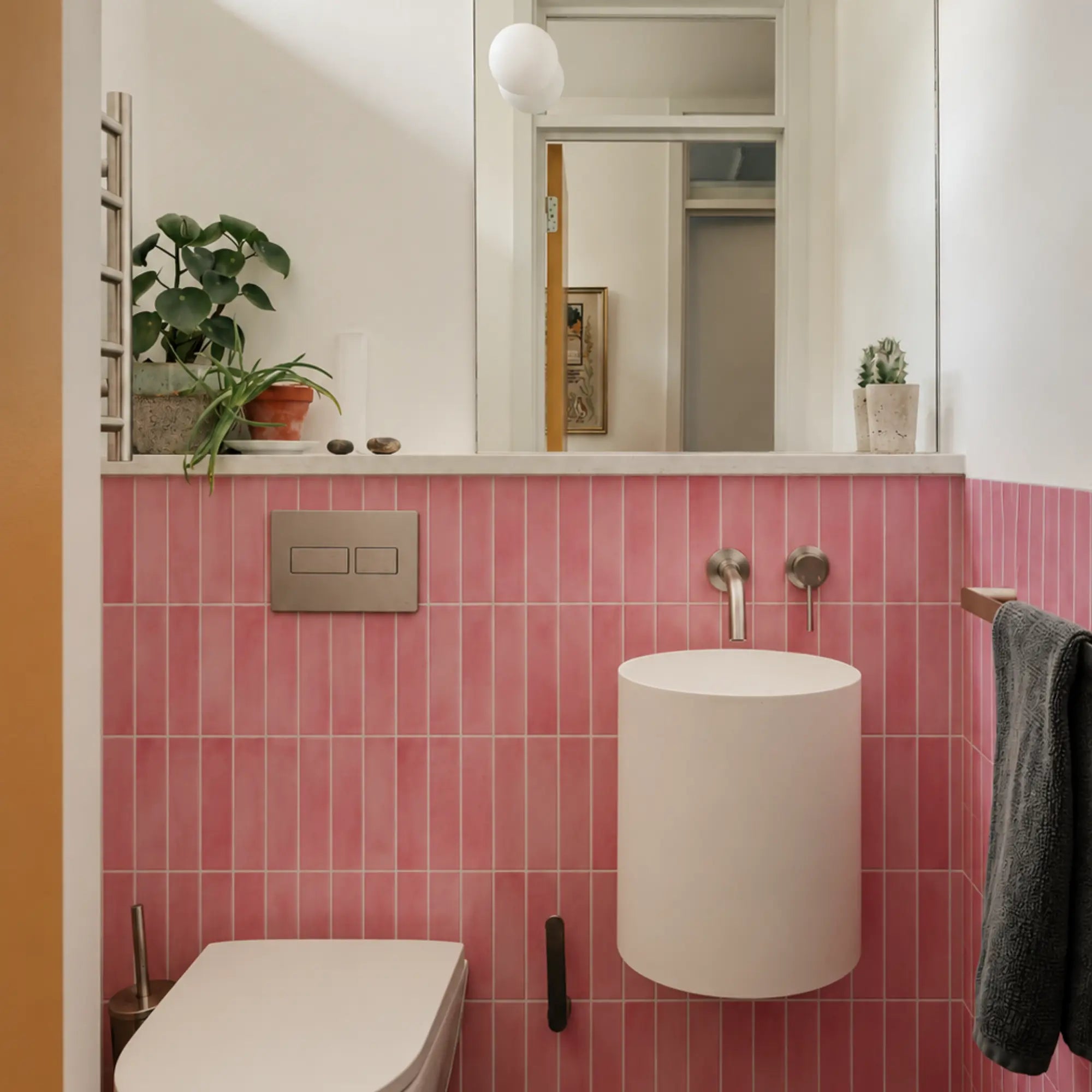
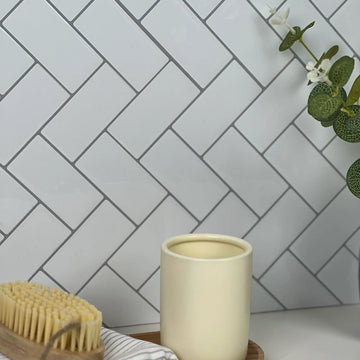
Illustrative cookware proximity, not a measured drop test or a recommended experiment.
Separate scratch resistance, impact response and adhesion
A scratch is not the same event as a blunt strike. A surface can resist ordinary scratching yet be vulnerable at a damaged edge, or absorb some contact while showing visible abrasion. A scratch-hardness claim cannot be converted into a safe cookware-drop height. Keep the tested property and the use question together.
Adhesion is another property. A face can remain visually intact while its bond or underlying paint changes. Conversely, a securely attached piece can have surface damage. Looking only at the center of a panel may miss movement at an edge or a weak coating behind it.
Stiffness, toughness and strength describe different aspects of material response and should not be used as interchangeable praise. A heavier or thicker sample is not automatically safer in every installation. A rigid layer may require different support from a flexible one, and the supporting wall can be the limiting part.
For a practical comparison, list the question first: visible scratching during care, edge damage near cookware, attachment under normal use or repair after an accident. Then ask for the product evidence relevant to that question. A report about a different property can still be informative, but it does not close the gap.
Use energy calculations to understand limits, not to set a home test
Near Earth's surface, a change in gravitational potential energy can be approximated by mass multiplied by gravitational acceleration and vertical height change: E = mgh. OpenStax explains this relationship and the energy units. It is a basic model, not a prediction of the force or damage in a real kitchen collision. OpenStax energy explanation.
For a hypothetical calculation, a two-kilogram object losing 0.10 metres of height changes gravitational potential energy by approximately 2 × 9.81 × 0.10 = 1.96 joules. At 0.20 metres, the change would be approximately 3.92 joules. These values are arithmetic examples, not measured pan impacts, approved test heights or Stickwoll performance ratings.
The calculation does not say all that energy reaches one point on a vertical wall. The object may rotate, rebound, strike another surface or deform. Contact area, shape, speed, angle and support matter. A pan contacting with a broad side is not equivalent to a narrow rim or handle end contacting an exposed tile edge.
Force is not supplied by the energy number alone. The distance and time over which motion changes also matter, as does the changing contact geometry. Dividing by an invented stopping distance can produce an impressive number without a measured basis. Do not use that shortcut to label one tile safe and another dangerous.
This is why a dramatic online drop video is difficult to generalize. Without a defined specimen, support, impactor, method and outcome, it may show only that one object and sample behaved a certain way once. It should not become an installation instruction or a reason to intentionally strike your wall.
Ask what an impact claim actually tested
A useful report identifies the exact product version and the complete test assembly. It describes the substrate, attachment, conditioning, impactor, contact location and measured outcome. Ask whether the sample was supported as it would be in the proposed installation. A loose piece on a bench and a bonded panel on a wall answer different questions.
Check whether the reported outcome is visible damage, fracture, indentation, retained attachment or another defined criterion. A statement that the sample passed is incomplete without knowing the criterion. A test can allow a kind of damage that matters aesthetically to you, or omit a property needed for the intended use.
Look for the number of specimens and the handling of failures. Repeated impacts on one sample are not the same as independent samples, and a selected successful video does not show the distribution of results. Ask whether repairs, reattachment or sample replacement occurred during the demonstration.
Do not transfer a floor, glazing or packaging test to a wall panel merely because it includes the word impact. The method's purpose and scope matter. Where a formal classification is required, have an appropriate professional interpret the actual report and installation, not just a marketing badge.
Keep the limits visible in the purchase decision. An absent test report does not prove a product will fail, but it does mean a specific numerical claim remains unestablished. Choose based on documented use and the actual kitchen conditions rather than filling that gap with a homemade score.
Evaluate the supporting wall and attachment
A finish can only be as dependable as the assembly supporting it. Loose paint, a weak patch, contamination or a damp wall can affect attachment independently of the face material. Inspect the substrate and follow the exact product's preparation requirements before considering any performance comparison.
Do not assume stronger adhesive corrects every concern. An adhesive can grip a coating more strongly than the coating grips the wall. Adding an unapproved product also changes the system and its removal behavior. Ask for a compatible complete method rather than applying glue to compensate for an unidentified defect.
For a layered panel, identify whether a visible separation is within the face, backing, adhesive or supporting coating. A photograph may help describe the location, but it does not necessarily establish the chemical cause. Preserve the evidence and contact the supplier before altering the failed area.
Do not use the decorative covering to support shelves, hooks or cookware racks. Those loads need an appropriate attachment to a suitable supporting structure. A small hook that initially holds is not proof that the wall finish can carry equipment safely or over time.
Keep the location's heat and moisture requirements separate from impact concerns. A material chosen for its expected contact behavior must still be approved for the appliance zone and cleaning exposure. Impact confidence cannot compensate for an excluded installation location.

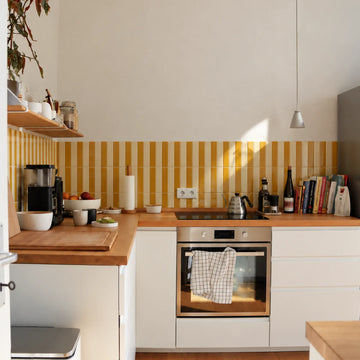
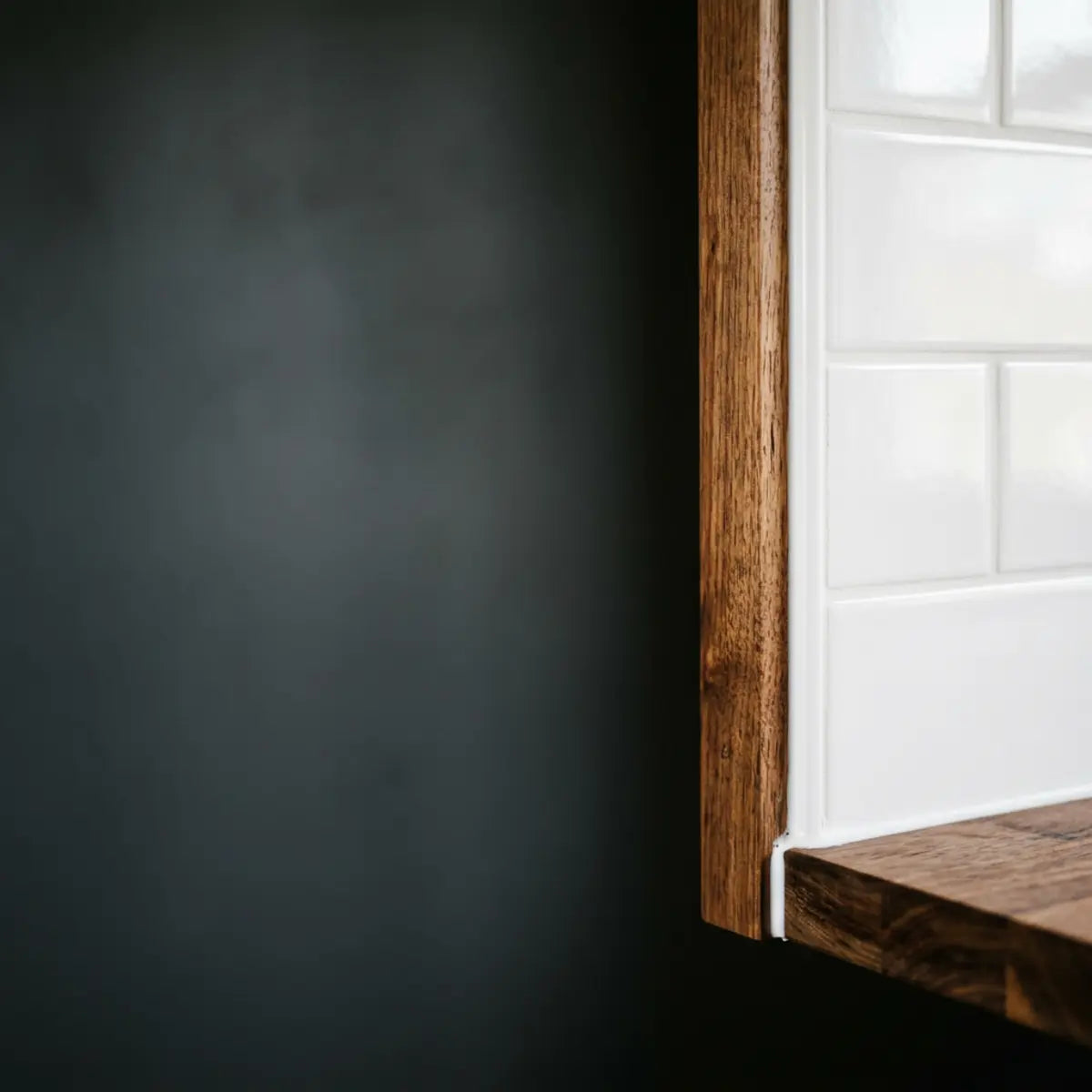
Illustration only; it does not establish a product's failure threshold or compare installed backsplash systems.
Reduce accidental contact through layout
Begin with the sink and drying area. A large pan may need more turning space than an ordinary plate. Check whether the rack encourages heavy lids to lean against the wall or whether a handle projects into a route. A more suitable arrangement can reduce repeated contact without claiming that accidents become impossible.
Keep frequently used heavy items in a position that can be reached comfortably. A storage choice that requires lifting a pan across another object can increase awkward handling. Consider the route between storage, stove, sink and drying area. The backsplash is one part of that workflow, not the only component that can be changed.
Use suitable supports for racks and organizers independently of the decorative finish. Follow their installation and load requirements. Do not attach a rack to an adhesive tile simply because the tile feels firmly bonded. The weight and leverage of stored cookware introduce a different demand from the tile's own weight.
Maintain appliance service space and clearances. A machine pushed too tightly against the wall may contact it each time a reservoir or tray is removed. Check the manufacturer's instructions rather than using a decorative trim as a stop. A small layout change can improve maintenance access as well as protect the finish.
For a hypothetical coffee corner, the owner moves the drying pitcher to a stable tray away from an exposed panel edge and leaves the machine's service route clear. This is an organization example, not a tested reduction in damage. The useful result is a layout whose movements are easier to observe and manage.
Plan vulnerable edges and transitions
Inspect where the finish ends beside a cabinet, window or open wall. An exposed edge can receive a different kind of contact from the center of a panel. Choose a compatible finishing detail and check how it attaches. A trim's appearance does not establish that it provides impact protection.
Keep edges supported as the product requires. A narrow overhanging strip or poorly fitted cut can behave differently from a full piece. Dry-fit difficult areas before exposing adhesive and avoid stretching a tile to make the final gap disappear. An accurate layout reduces awkward pieces without guaranteeing every future contact will be harmless.
At inside corners and changes of material, follow the specified joint detail. Do not bridge movement with a rigid decorative layer because it creates a continuous pattern. Likewise, adding sealant to an unsuitable gap does not establish a complete protective assembly. The geometry and product compatibility need to be resolved together.
Where a countertop or appliance can move, allow the required relationship between it and the wall finish. A repeated knock may come from equipment placement rather than the tile itself. Record when the contact occurs and correct the source before repeatedly replacing damaged pieces.
Keep cleaning damage separate from impact damage
A mark noticed after cooking may come from residue, an abrasive tool, a chemical change or physical contact. Describe what is visible before choosing a treatment. A dull patch is not automatically a scratch, and a sticky surface is not automatically adhesive leaking through the face.
Use the cleaner and tool permitted for the exact finish. Do not polish or scrub a damaged area aggressively in an attempt to make it look new. A method suitable for ceramic or metal may be unsuitable for a printed polymer surface. Inspect after drying so cleaner residue is not confused with permanent change.
Keep scouring tools used on cookware separate from the wall-care kit. A cloth or sponge carrying grit can mark an otherwise suitable finish. Use clean sections of a soft tool where the care guide permits it, and control liquid near seams and electrical components.
If the finish changes during cleaning, stop and record the product, dilution, contact time and tool. The grease-cleaning guide explains how to organize those observations. It does not approve every cleaner for every material or turn a spot check into a long-term chemical-resistance test.
Respond to damage without making a risky inspection
When a piece is cracked, sharp, loose or near damaged electrical equipment, keep people away from the affected area and obtain suitable help. Do not run a bare hand over a damaged edge or deliberately flex the piece to see how far the crack extends. The priority is safe use of the area, not completing a photograph.
Document the accessible condition from a safe position. Include a wider image showing location and a closer image showing the visible change. Record the object involved and sequence if known, but distinguish observation from inference. A mark discovered later may not have a known cause.
Do not pry around outlets, drill through the finish or chisel a wall without knowing what is behind it and how the assembly should be repaired. A seemingly small damaged tile can sit beside wiring, plumbing or waterproofing. The right repair method depends on that context.
If a detached piece can be retained safely, keep its product information and the relevant images for the supplier or installer. Do not clean all residue away before an assessment when it can be preserved safely. The visible layer on the back can help describe where separation occurred, although it may not prove the underlying cause.
A cosmetic repair should follow an assessment of the source. A new piece over weak paint, recurring water or an unsupported edge can reproduce the same problem. Ask what must be corrected before replacement and what conditions apply before the area returns to use.
Compare local replacement and larger repair
A local replacement can be attractive when the underlying wall remains suitable and matching material is available. Check whether removal affects adjacent pieces, joints or the coating beneath. A small visible defect does not always mean a small repair, and a larger repair is not automatically necessary.
For a patterned finish, compare a spare piece under the actual light before installing it. Lot, color, sheen and print direction can make a replacement noticeable. Keep the original layout map and product labels so the installer can identify the intended orientation. Do not assume the same product name guarantees an invisible match years later.
For a resin, glass, ceramic or natural-stone system, ask the supplier or installer about the appropriate repair route. A compatible filler or surface treatment may be possible in some circumstances, while others need replacement. Do not transfer a repair method from one material to another because the damage looks similar.
Include edge finishing, cleanup and any equipment movement in the quotation. A repair that leaves a service point inaccessible or changes a required joint is not complete merely because the face looks better. Ask for the final care and return-to-use instructions.
Keep the repair in the maintenance record. Record what was replaced, what preparation changed and whether the contact source was altered. That history makes future decisions more useful than describing the installation as untouched despite repeated repairs.
Budget for plausible scenarios rather than a predicted failure rate
Start with the documented initial installation cost. Then describe a few possible repair scenarios separately: one piece replaced, an edge detail revised or a larger area repaired because the substrate is affected. Do not assign a probability to each scenario without evidence. A planning allowance is not a measured expected cost.
For an illustrative calculation, suppose the quoted initial work is 600 currency units. A separately quoted local replacement costing 150 would produce a 750-unit one-repair scenario. If a larger wall repair were quoted at 500, that different scenario would total 1,100. These are example numbers, not market prices or a forecast that either repair will occur.
Compare proposals on the same scope. One repair quote may include restoring paint and another may cover only replacing the face. One may include moving equipment safely while another excludes it. List those differences before choosing the lowest number.
Keep aesthetic preferences separate from repair cost. A material that you strongly prefer may be worth its maintenance requirements, provided the use is suitable and the budget is understood. There is no need to fabricate a superior impact score to justify a legitimate design preference.
Use samples for appropriate questions
A sample can show color, pattern, relief, edge construction and permitted cutting behavior. It can help you understand how a finished piece will look beside the counter. It should not be struck, heated or loaded beyond instructions in an attempt to certify the product at home.
Ask whether a sample represents the exact construction and finish being supplied. A small decorative swatch may not include the installed edge or backing. If a claimed property matters, request the corresponding product documentation rather than assuming the swatch is a complete test specimen.
For a permitted installation trial, record the substrate, preparation, date and normal-use observations. Do not repeatedly pull at the edge to check strength, because that changes the condition being observed. A stable sample over a short period does not establish a service life or impact rating.
Keep successful and unsuccessful observations. If a piece was reattached or a cleaner changed, note it. A useful sample record is not a marketing demonstration; it is a way to identify obvious concerns and ask better questions before covering a larger area.

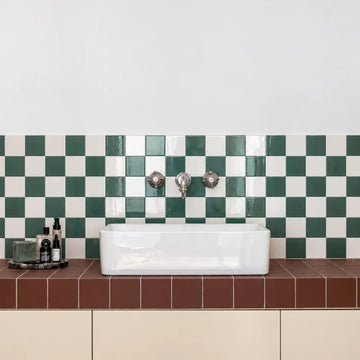
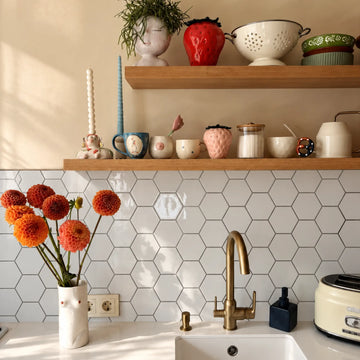
Layout inspiration, not evidence of retained adhesion or approved appliance clearances.
Choose a finish with realistic expectations
Shortlist only products documented for the wall, appliance and cleaning conditions. Within that shortlist, compare appearance, edges, maintenance and repair access. A flexible face may suit one design goal, while another household may prefer glass, ceramic or stone. The choice should follow the actual product and assembly rather than a universal material verdict.
Do not use a decorative wall tile as flooring, a worktop or a load-bearing surface unless it is explicitly intended for that use. Those applications involve different loads and requirements. A product that remains attractive on a vertical wall is not thereby suitable under appliances or foot traffic.
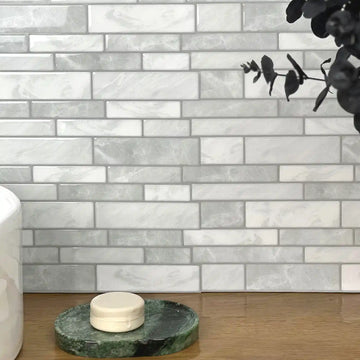
For Stickwoll design options, the Blanco Chevron product page and Olive Lines product page can be reviewed for style and current intended use. These links do not establish an impact certification, measured drop result or floor suitability. Request the exact technical information relevant to your project.
Use the general wall-tile guide for preparation and layout questions and the cafe wall-maintenance guide for commercial planning boundaries. Commercial use, wall attachment and impact response are related but distinct questions.
Keep a simple record for future maintenance
Save the product and batch, installation date, supporting surface and approved care method. Photograph the completed edges and any service points before equipment obscures them. Keep a few suitable spare pieces where the product and layout justify them, labeled for this installation.
Give the household a short care note identifying the permitted cleaner and what to report if a piece moves or becomes damaged. A person noticing an edge change should not feel responsible for diagnosing the adhesive chemistry. A location, date and clear description are useful enough to start an assessment.
Review the arrangement when equipment, storage or the household's routine changes. A previously quiet wall can become a frequent-contact area after a rack is moved. Address the new use rather than assuming the original installation decision covers every future layout.
The practical goal is not an indestructible kitchen. It is a suitable finish, a manageable workflow and a clear response when damage occurs. Those choices provide more useful protection than a dramatic drop demonstration or an unsupported score.
Frequently asked questions
Is polymer backsplash always safer than glass?
No universal conclusion follows from those labels. Exact construction, edges, support, intended use and the kind of contact matter. Polymer may dent or cut while glass may chip or crack, but a comparative safety claim needs appropriate product and assembly evidence.
Can I test a sample by dropping a pan on it?
Do not use an improvised drop as a certification exercise. It can create sharp debris or injury and does not reproduce every installed condition. Use samples for permitted appearance and handling questions and request relevant test documentation for an impact claim.
Does a surface that does not crack still need inspection?
Yes, visible face damage and attachment are different observations. Check accessible edges and the surrounding area without prying or stressing the assembly. Movement, dampness or a changed coating deserves investigation even when the center looks intact.
Does a scratch-hardness number predict cookware impact?
No. Scratch resistance and impact response concern different events. The test method and specimen must match the claim. A number for one property should not be converted into a safe drop height or a guarantee that the wall will not need repair.
Will extra glue prevent future damage?
Not automatically. Added adhesive can change compatibility, support and removal behavior and cannot repair a weak underlying wall. Use only an approved repair method after the cause is understood. Decorative tile should not carry shelves or equipment loads.
What should I ask before buying?
Ask about the exact construction, permitted location, substrate, cleaning, edge detail, available performance documents and repair route. Describe the real kitchen activity. A broad request for the strongest tile is less useful than a question tied to the proposed installation.
Build a useful damage report for the supplier or installer
Start with product identity and location. Include the name, batch if available, installation date and the supporting wall or coating. Then describe the visible change without guessing its mechanism. A chipped edge, displaced panel and scratched face are more informative descriptions than simply saying that the material is weak.
Record the sequence when known. If a pan contacted the wall, describe the object and contact location without inventing its speed or impact force. If the damage was discovered later, say so. Do not reconstruct an accident by striking another sample or estimate a precise energy value from memory.
Photograph the wider area before focusing on the mark. The relationship to a sink, rack, cabinet or appliance can help explain the practical context. Include close views only where they can be obtained safely, and do not handle sharp fragments to improve the image. Keep original photographs in addition to annotated copies.
Ask which question the evidence can answer
A supplier may need to distinguish material damage from a substrate or installation concern. An installer may need to inspect support or an edge detail. Neither task is completed by a single dramatic photograph. Ask what information is missing and whether an on-site assessment is needed before removing or repairing the area.
If a test report is offered in response, check whether it concerns the same product and the property relevant to the event. A scratch result may not answer an edge-impact question. A peel result may not explain a cracked face. Keep the report's scope visible rather than accepting a large number as a general durability guarantee.
Compare the consequences of different repair routes
A repair decision should account for safety, underlying condition, appearance, access and future care. Replacing a single piece may be reasonable when the wall is sound and the product permits it. A broader repair may be needed when adjacent material or the supporting surface is affected. The visible size of the mark is not enough to choose between those routes.
Ask whether the repair changes the assembly, care instructions or exposure limits. Adding another adhesive, a coating or a trim may create a different construction from the original. Obtain compatible guidance rather than assuming more material always makes the wall stronger. Keep any changes in the maintenance record.
Retain a clear distinction between observation and rating
A household can report that a particular installed piece showed a visible mark after an event. That is a useful observation. It is not a statistically representative comparison of all polymer and glass tiles, nor a certification of impact safety. A product-level claim needs the appropriate method, specimens and interpretation.
This distinction also helps when reading customer reviews. A negative review can identify a concern worth asking about, while a positive photograph can show a successful appearance. Neither automatically establishes the cause of every failure or the outcome in your kitchen. Use the reviews to formulate questions and the product documents to establish the intended use.
The final choice can remain practical without a universal score. Select an eligible assembly, reduce avoidable contact through layout, keep service access and understand the repair route. Those decisions address everyday use more directly than treating a home drop demonstration as an engineering verdict.
Label repair stock for the actual installation
Keep spare pieces with their product and batch information and a photograph of the installed pattern direction. Store them under the stated conditions with release liners intact. A spare damaged by poor storage or separated from its identity is less useful when a repair is needed. This practical record does not imply a predicted failure; it preserves an option without inventing an impact rating.
Sources and scope
- OpenStax: Gravitational Potential Energy — mgh arithmetic only; not an impact rating or a home test recommendation.
- Corning Museum of Glass: Glass, the Stone That Pours — Glass is non-crystalline; not a fracture threshold for a backsplash.



Leave a comment
This site is protected by hCaptcha and the hCaptcha Privacy Policy and Terms of Service apply.