













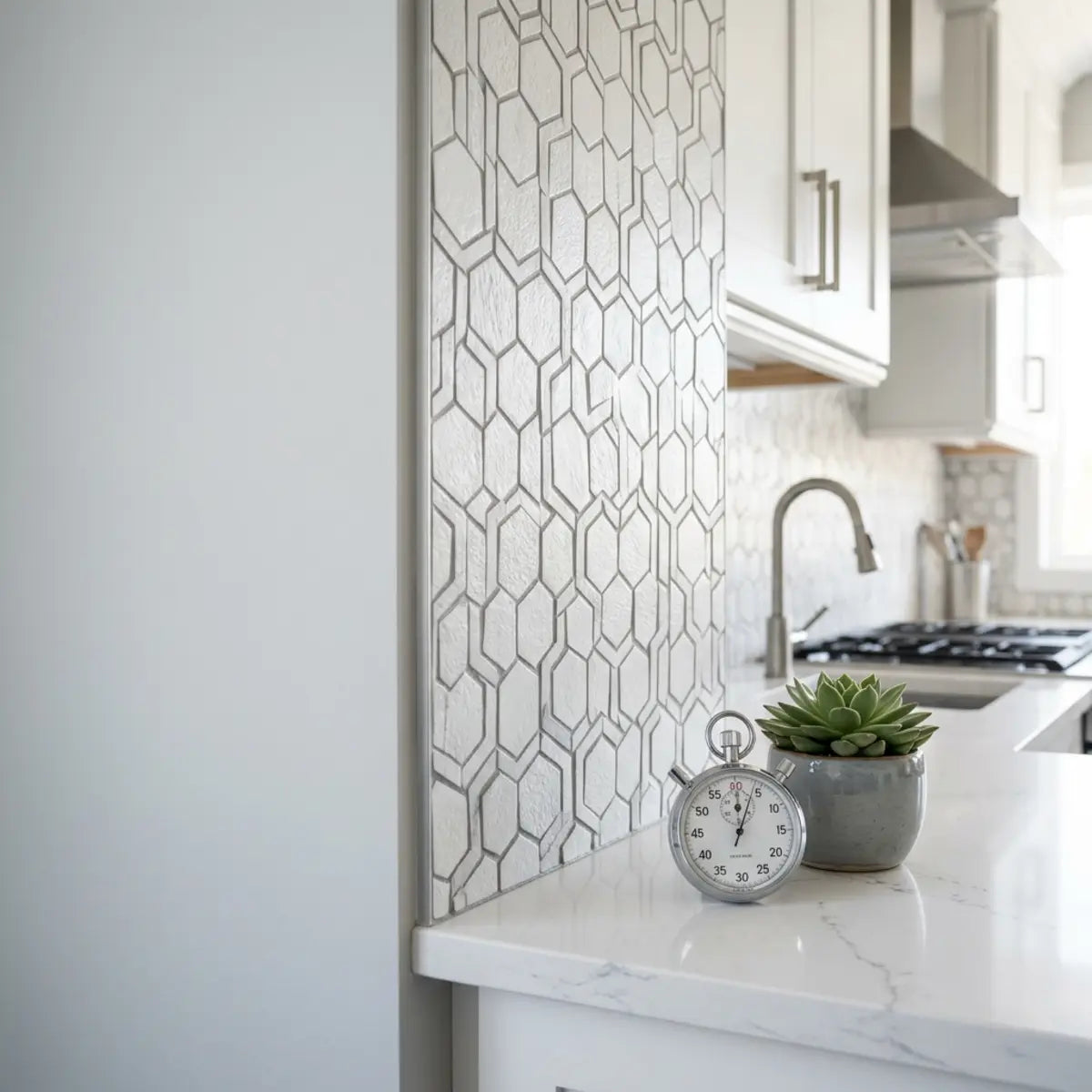
A fast backsplash refresh before listing a home should begin with wall condition, product suitability and an honest schedule. A 24-hour planning window can organize decisions, but it cannot shorten paint cure, adhesive conditioning, repairs or required professional work. Choose the smallest useful improvement that can be completed correctly and described accurately to the next owner.
Explore this guide
Preparing a kitchen for photographs can create pressure to cover every dated surface quickly. Sometimes an eligible decorative finish is a sensible improvement. Sometimes cleaning, repairing a detail or leaving a sound backsplash in place is the better choice. The decision should follow the actual condition and available time rather than a promise that a new pattern automatically raises the sale price.
This is a pre-listing planning guide, not a timed Stickwoll renovation trial or a valuation model. It does not report a buyer study, an appraisal increase or a measured marketing return from a backsplash. Budget examples are hypothetical and should be replaced with actual local quotations and the advice appropriate to the property.
Inspect before deciding whether to cover the wall
Look at the backsplash in ordinary light and identify the actual concern. Is it dirty, visually dated, damaged or unsuitable for the current appliance arrangement? Those conditions need different responses. A dated but sound surface does not have the same priority as a loose or damp wall.
Check accessible edges, the sink junction and areas around appliances. Record staining, softness, lifting or cracked material before altering it. Do not cover a suspected water problem to improve the photograph. The source and affected materials should be assessed before a decorative decision is made.
Identify the existing surface and any recent repairs or paint. Ask whether the proposed finish accepts that substrate and exposure. A product described as suitable for kitchens may still have restrictions near heat, direct steam or repeated water. The room name alone is not approval.
Keep the project within the work you can do competently and safely. Electrical fittings, plumbing, damaged walls and uncertain old materials may need qualified help. A cosmetic deadline is not a reason to improvise around them. Put those tasks into the schedule before ordering decoration.
Compare cleaning, repair, replacement and no change
Start with the least disruptive option that addresses the real issue. A permitted clean can reveal that the original finish is in good condition. A local repair may restore a damaged edge without replacing the whole wall. A new finish may be appropriate when the substrate and use are suitable and the visual change supports the room.
No change is also a valid option. A sound neutral backsplash may fit the kitchen better than a rushed new pattern. Spend the available time on a clear, well-maintained room rather than treating every existing surface as a problem. The aim is a property that can be presented honestly and used comfortably.
| Option | When to consider it | What still needs checking |
|---|---|---|
| Clean and retain | The surface is sound and the main issue is residue | Material-compatible care and any remaining defects |
| Local repair | A limited issue has an understood cause | Matching material, underlying condition and approved repair |
| Decorative refresh | The wall is eligible and the design change is useful | Product use, preparation, timing, edges and disclosure |
| Full replacement | The existing system is unsuitable or the scope justifies it | Professional work, cost and a realistic schedule |
| Postpone | The condition or product requirements remain unresolved | Source investigation and a documented next step |
Compare options on the same included area. A small dry return and a complete backsplash around a sink are not equivalent projects. Mark the proposed scope on a photograph so the decision does not expand silently after materials are purchased.

Planning illustration, not a timed trial or approval of the existing surface.
Keep staging evidence separate from a backsplash return claim
NAR's 2025 home-staging survey reported that some agents associated staging with higher offers or shorter marketing time. For example, 29% reported a one-to-ten-percent increase in offered value and 49% of sellers' agents reported reduced time on market. These are survey responses about staging, not a randomized study of a particular backsplash or a guaranteed financial result. NAR survey release.
Use that distinction when planning spending. A clean, coherent kitchen may improve presentation, but a sale depends on many property and market factors. Do not calculate a promised sale-price increase by multiplying the tile cost by an invented return factor. Ask the relevant property professionals what matters for this home and market.
A photograph can communicate care and layout, but it should not conceal material identity or unresolved defects. Describe a stone-look decorative panel as such, not as natural stone. Do not use camera angles or props to hide damage that needs repair or disclosure. Accurate information is part of a responsible handover.
Keep the purpose modest and testable: improve the visible condition, coordinate the room or complete an appropriate repair. Those goals can be assessed after the work. A marketing score, buyer-confidence index or appraisal prediction without data adds false precision rather than helping the decision.
Build the schedule around gates, not a countdown
Before the work day, confirm product availability, instructions, the eligible wall area and any professional tasks. Have a representative sample approved for appearance and use. A 24-hour plan that begins with discovering a wall problem is not the same as one that begins with a prepared, suitable surface.
Separate hands-on work from waiting periods. Cleaning, measuring and cutting can be scheduled, but a coating's cure or an adhesive's required conditions cannot be compressed by working faster. If the instructions require a delay, either move the photography date or choose a different appropriate scope.
Use a simple sequence: inspect and document, resolve defects, confirm materials, prepare, dry-fit, install, maintain required conditions, then inspect before normal use. Each stage has a completion condition. A clock reaching the next appointment is not evidence that the wall is ready.
For a hypothetical one-day preparation session, the morning might be used to inspect, clean as permitted and measure. The afternoon could be used for a dry layout and ordering. If the wall needs repair or fresh paint, installation may properly occur on a later date. A useful day does not have to end with adhesive on the wall.
Choose a design that belongs to the existing kitchen
Start with cabinets, countertop, flooring and hardware that will remain. Compare the proposed finish with those actual materials under the installed lighting. A popular pattern can still look out of place if its undertone or scale competes with the counter.
Choose one primary visual emphasis. A heavily patterned counter may work better with a quieter backsplash; a plain kitchen may allow a more noticeable pattern. These are design options, not rules that every buyer shares. Avoid selecting a material solely because an online forecast calls it the next trend.
Look at the room from the entry, work area and any adjoining space. A finish that looks calm in a close-up can create a strong repeat across a long wall. A glossy sample may show a reflected band under the actual lights. Test the full relationship before buying enough for the whole field.
Keep the layout and edges deliberate. A small amount of a suitable finish with well-planned terminations can look more resolved than a larger rushed installation ending in narrow strips. Do not stretch or rotate products contrary to their joining requirements to force a preferred visual effect.
Prepare without hiding an unresolved defect
Use the preparation accepted for the existing surface and the new product. Cleaning should remove the relevant contamination without damaging the coating. Do not automatically sand or use a strong solvent merely because the wall will be covered. An unknown old coating may require assessment before disturbance.
Repair material must be suitable for the location and ready to receive the finish. Dry to touch is not the same as fully cured or accepted for an adhesive covering. Keep the repair and paint instructions with the tile instructions so the most relevant requirements are not lost between trades.
A membrane or sealer is not a general cure for unexplained dampness. Identify the source and appropriate repair first. EPA's moisture guidance emphasizes fixing water problems rather than covering mold or moisture damage with a new surface. EPA moisture guidance.
Photograph completed preparation before it disappears behind the finish. Save product names and any professional repair documentation. These records help the next owner understand the work and can support future maintenance without making the decorative surface stand in for proof of hidden conditions.
Measure the complete layout before removing backing
Break the eligible area into rectangles and record openings, cabinet ends and changes of plane. Use the product's usable installed coverage, especially when sheets overlap. An area calculation provides a starting quantity but does not show where each difficult cut will fall.
Dry-fit the first row and the visible final pieces. Check the intended starting point against both ends of the wall. A centered layout can be useful, but the product pattern and interruptions may justify another reference. Choose deliberately rather than starting at one end and hoping the remainder works.
Make paper templates for complicated shapes where appropriate, keeping the actual product's orientation visible. Cut on a stable protected surface using the permitted tool. Do not cut against the installed wall near wiring or plumbing. Where electrical fittings need alteration, use the appropriate qualified person.
Keep release liners in place until the fit is understood. Repeatedly peeling and reapplying a piece can change its condition. Follow the manufacturer's placement and pressure method, and do not add unapproved adhesive to compensate for a bad cut or weak wall.

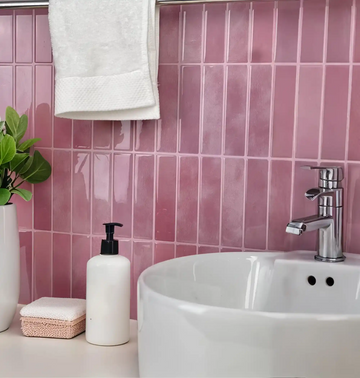
Illustrative handling; follow the exact product and substrate requirements.
Finish the edges and service details honestly
A decorative edge should look intentional and remain compatible with the system. Check the depth and attachment of any trim and how it meets the countertop or cabinet. Do not treat trim as a way to hide an active leak, loose material or a gap that needs a different construction detail.
Keep outlets, switches, shutoffs and service panels accessible. A neat faceplate does not resolve a mounting-depth or electrical issue. Where the finish changes the relationship around a fitting, obtain suitable advice. The final appearance must not conceal a problem that the next occupant inherits.
At water and heat zones, follow the actual product and appliance requirements. A waterproof face or heat-resistant label does not provide a universal clearance, nor does an added sealant validate every seam. A finish excluded from the intended exposure should be removed from the shortlist rather than rescued with a cosmetic detail.
Inspect from normal positions before calling the work complete. Check visible cut edges, pattern alignment, accessible seams and the relationship to adjacent surfaces. Record any accepted limitation. An accurate finished-state photograph is more useful than editing away the detail in the listing image.
Separate installation completion from ready-to-show condition
The last piece being placed is not always the end of the work. Follow any required conditioning or return-to-use period, remove waste appropriately and confirm that preparation products have been handled according to their instructions. Do not use strong fragrance to conceal a chemical odor or assume the absence of odor means the area is ready.
Clean only with a method accepted for the finish at that stage. A newly applied coating or joint may have different requirements from one in normal service. Do not rush a deep clean to meet a photography booking. Ask the installer or supplier when and how the surface can be cleaned.
Return equipment to its proper operating position with the necessary service clearances. Confirm that moving it has not damaged connections or the new finish. Use qualified help for connected or heavy equipment where needed. The room must work normally after the styling objects are removed.
Keep the presentation simple enough that the condition can be seen. A few ordinary objects can show scale, but do not place them to conceal a known defect. A buyer should be able to understand the actual finish and layout rather than an arrangement that only works for the photograph.
Use a project budget, not an invented return multiplier
List materials, preparation, tools, trim, delivery, labor and any professional work. Separate confirmed quotes from provisional allowances. Keep the cost of correcting a defect separate from the cost of changing the appearance so the purpose of the spending remains clear.
For a hypothetical 18-square-foot eligible area, a chosen 15% allowance produces a material target of 20.7 square feet. If the selected packs provide 3.5 usable square feet each, six packs cover that arithmetic requirement. These numbers are a planning example, not Stickwoll coverage or a standard waste allowance. The actual pattern and cuts determine the purchase.
Suppose six packs are quoted at 28 currency units each, supplies at 32 and compatible trim at 40. The listed subtotal is 240 before any tax, delivery, wall repair or paid work. This example shows how to expose missing categories. It is not a market price or a claim that every kitchen can be refreshed for that amount.
Compare the subtotal with the no-change, cleaning and repair options. A smaller intervention may leave budget for a more important property issue. Do not assume that every unit spent on the backsplash returns more than a unit in sale proceeds. That requires evidence beyond a decorative project calculation.
Include the value of time only if it helps the decision and state the assumption. Do not count personal labor twice as both an hourly allowance and a contractor quote for the same task. A delayed project may have consequences, but those should be based on actual circumstances rather than a generic daily loss figure.
Prepare a useful record for the next owner
Keep the exact product, batch, installation date and supporting surface in the project file. Save the instructions and any warranty terms supplied with the purchase. A future owner may need to repair one piece or determine which cleaner is permitted, and the product name alone may not be enough.
Record any substrate repair or professional work separately. A decorative finish should not be presented as evidence that plumbing, wiring or waterproofing was upgraded unless that work actually occurred. State the scope accurately and retain the relevant invoices or reports.
Where disclosure obligations or sale representations are involved, obtain advice appropriate to the jurisdiction and transaction. This article does not determine what a particular seller must disclose. As a practical rule, do not misdescribe synthetic stone-look material as natural stone or hide a known unresolved issue behind a new surface.
Leave care and service information accessible. Include the permitted cleaner, any relevant exposure restrictions and where suitable spare material is stored. A transparent handover can make the improvement more useful without requiring an unsupported durability promise.
Three realistic pre-listing decisions
A sound but visually busy backsplash
In this hypothetical kitchen, the existing surface is intact and the main issue is visual competition with a patterned counter. The owner first cleans it using the approved method and simplifies the surrounding accessories. If that resolves the presentation concern, replacing the finish may not be necessary. The decision is based on the room, not a requirement to buy new tile.
A suitable dry wall with enough lead time
A second owner has a documented sound surface, a permitted decorative product and enough time for the required preparation and conditioning. A sample confirms the appearance under the actual lights. The owner plans the cuts and edges before installation, then records the product and care information for handover. This is an appropriate cosmetic project without a promised sale-price increase.
A wall with recurring staining
A third owner finds a stain that returns near a fitting. The listing deadline does not make covering it acceptable. The source is assessed and repaired first, with the affected materials addressed appropriately. Decoration is scheduled only after the wall is suitable. The final record describes both the repair and the finish rather than allowing one to stand in for the other.
These examples deliberately lead to different choices. A useful fast plan can result in cleaning, a smaller refresh or postponement. The quality of the decision is not measured by how much new surface appears within 24 hours.

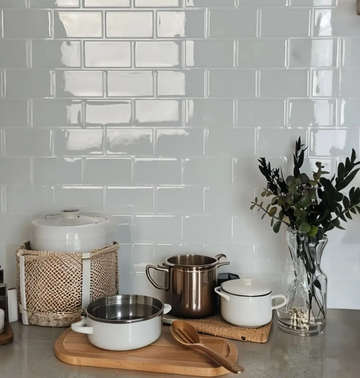
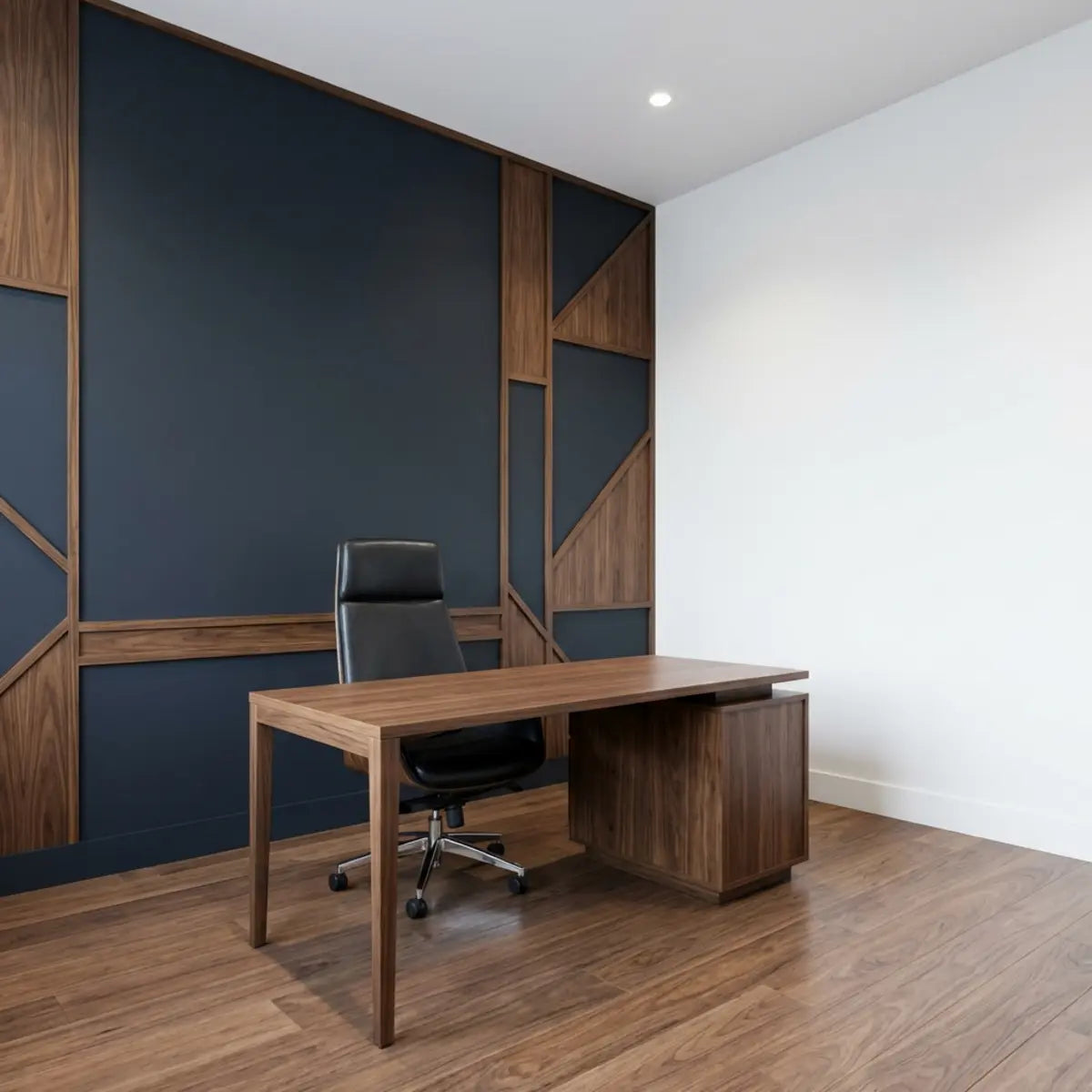
Presentation inspiration, not evidence of a sale-price increase or a 24-hour renovation.
Shortlist materials after the scope is clear
Compare current product instructions and usable pack coverage before ordering. Ask whether the finish is intended for the exact wall and exposure. If the required information is missing, request clarification rather than substituting a description from a similar brand.
For Stickwoll style options, Lemon Zest and Minty Ceramic 8 are product pages to review for their current design and intended use. These links do not establish a renovation completion time, appraisal effect or universal kitchen approval. Choose only after checking the actual project.
Use the wall-tile planning guide for the overall sequence and the installation and removal guide for practical questions. For an undecided finish, the faux-stone and natural-stone comparison separates appearance from the complete system.
Keep the accepted sample and the order together. If inventory or the product changes before installation, review the substitute rather than assuming a similar name produces the same color, backing or care requirements. A clear order is easier to complete than a rushed collection of approximately matching materials.
Use a final walk-through rather than a marketing score
Walk through the kitchen as it will normally be used. Check the route to the sink, appliance service access and the areas where objects are set down. Look for loose edges, visible preparation residue or any unfinished detail. Record the findings and resolve them before presenting the work as complete.
Compare the finished state with the agreed scope. If part of the wall was intentionally left unchanged, make the transition look deliberate and keep the reason in the project record. If an issue remains unresolved, do not hide it with accessories or photographic editing.
Confirm that the care information and spare material are available and that the material description is accurate. A stone-look panel, a coated substrate and natural stone are different finishes. The next owner should not have to infer the construction from a photograph.
The useful result is a clean, suitable and clearly described improvement. A fast project can still be careful, but speed is not evidence of quality. Let the wall condition and product requirements determine the schedule, and let the finished room's actual use determine whether the change was worthwhile.
Frequently asked questions
Can a backsplash refresh always be completed in 24 hours?
No. Wall repairs, coating cure, product conditioning, professional work and return-to-use requirements can extend the schedule. A one-day planning or preparation session can still be useful, but it should not be advertised as a universal installation promise.
Will new tile increase the sale price?
No specific increase can be promised from a decorative change. Staging surveys concern broader presentation and reported experience, not a causal result from one backsplash. Use property-specific advice and keep the budget separate from an unsupported return estimate.
Should I cover a stain before listing photographs?
First determine whether it reflects an active or unresolved problem. Do not cover recurring dampness or damage merely for presentation. Appropriate repair and accurate description come before decoration, and local disclosure questions need qualified advice.
Is a removable finish automatically risk-free?
No. Suitability and removal depend on the product, wall condition and method. A strong bond can still affect paint or another underlying layer during removal. Keep instructions and plan possible restoration rather than promising an untouched wall.
What is the best low-cost first step?
Inspect and define the actual issue. A permitted clean, a small repair or a clearer layout may address it without a new finish. When replacement is useful, measure the complete scope and obtain the product requirements before buying.
Prepare photographs that represent the completed work
Take a wide image showing the covered area and close views of the material and edge details. Keep the original files and a separate record of the product identity. Images can communicate the appearance but should not imply that hidden plumbing, wiring or waterproofing was replaced when it was not.
Use lighting that shows the room clearly rather than concealing a known flaw. Ordinary exposure correction is different from digitally removing damage or changing the material's appearance. Keep the written description consistent with the actual finish and the work performed.
Compare the final photographs with the project scope. If the improvement was cleaning and a new decorative panel on a dry wall, describe that work accurately. Do not relabel it as a full kitchen renovation or natural-stone installation. A clear description can still present the room attractively without an inflated claim.
Store the care information and any remaining material so the next owner can identify it. Include the installation date and supplier instructions with the handover papers. This practical record adds usefulness to a cosmetic improvement without assigning it an unsupported appraisal value.
If the photographs reveal a detail that needs correction, resolve it physically where appropriate rather than treating image editing as the repair. The listing deadline should not decide whether an unresolved defect matters. The completed room, not just the photograph, is what the next occupant will use.
Sources and scope
- NAR 2025 Profile of Home Staging release — Agent survey, not causal evidence of a backsplash's resale return.
- US EPA: Mold, Moisture and Your Home — Prompt moisture-source control; not diagnosis from a checklist.



Leave a comment
This site is protected by hCaptcha and the hCaptcha Privacy Policy and Terms of Service apply.