






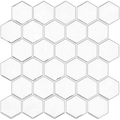
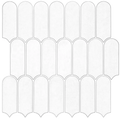
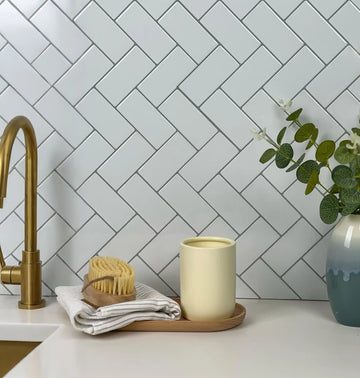
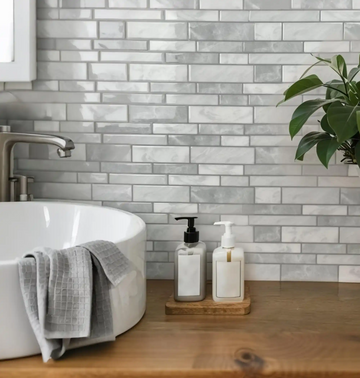
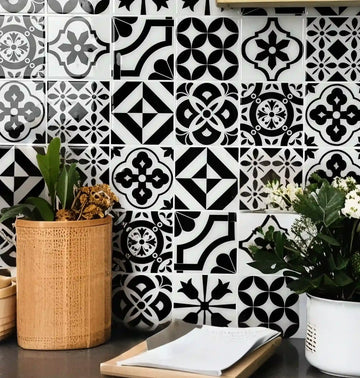
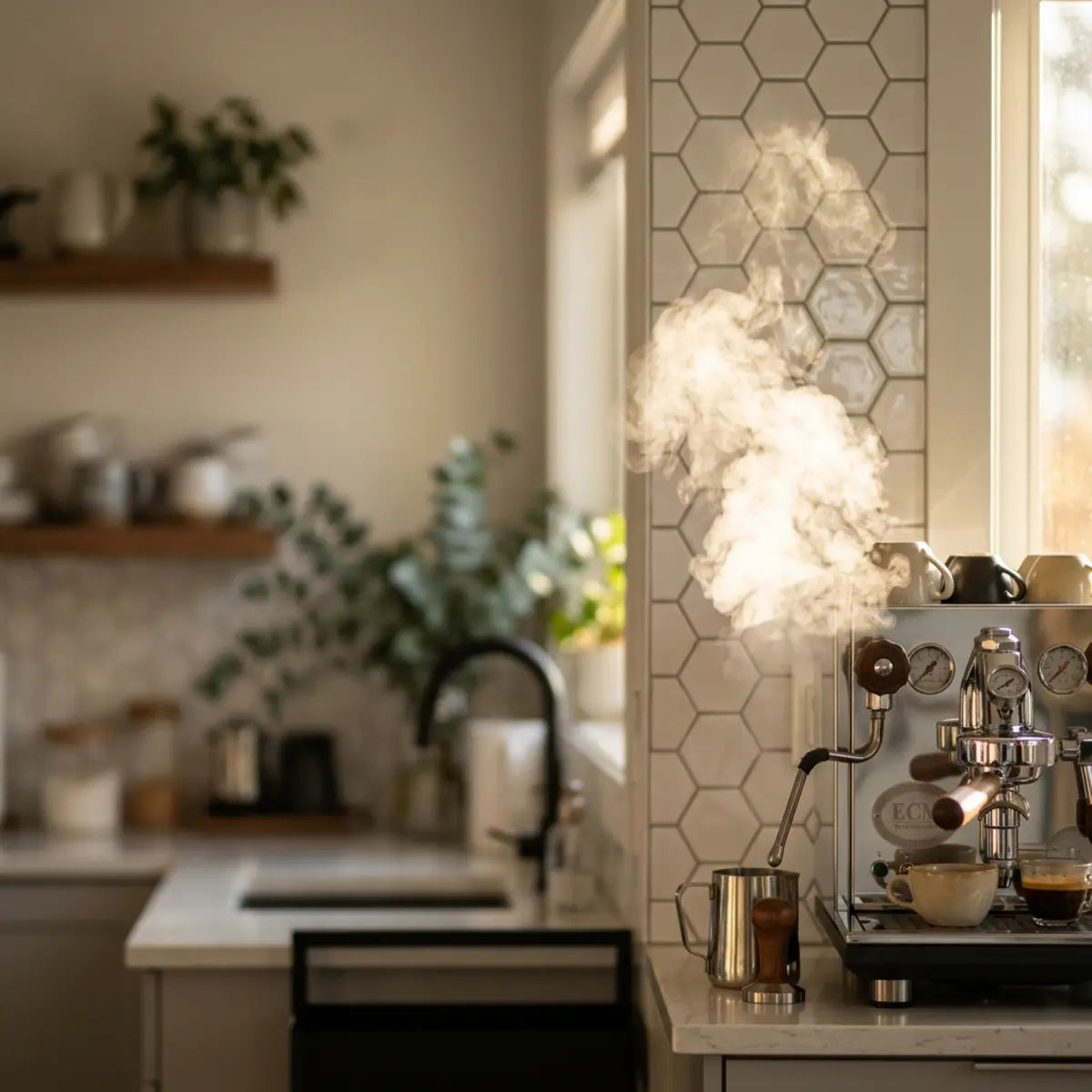
Peel-and-stick tile is an option only where the exact product and installation instructions permit the exposure. Do not assume a waterproof face, a rigid core or a kitchen label makes it suitable for direct espresso steam. Keep the steam discharge away from the wall and follow the appliance manual. This guide does not report a six-month Stickwoll test or certify a steam-resistant product.
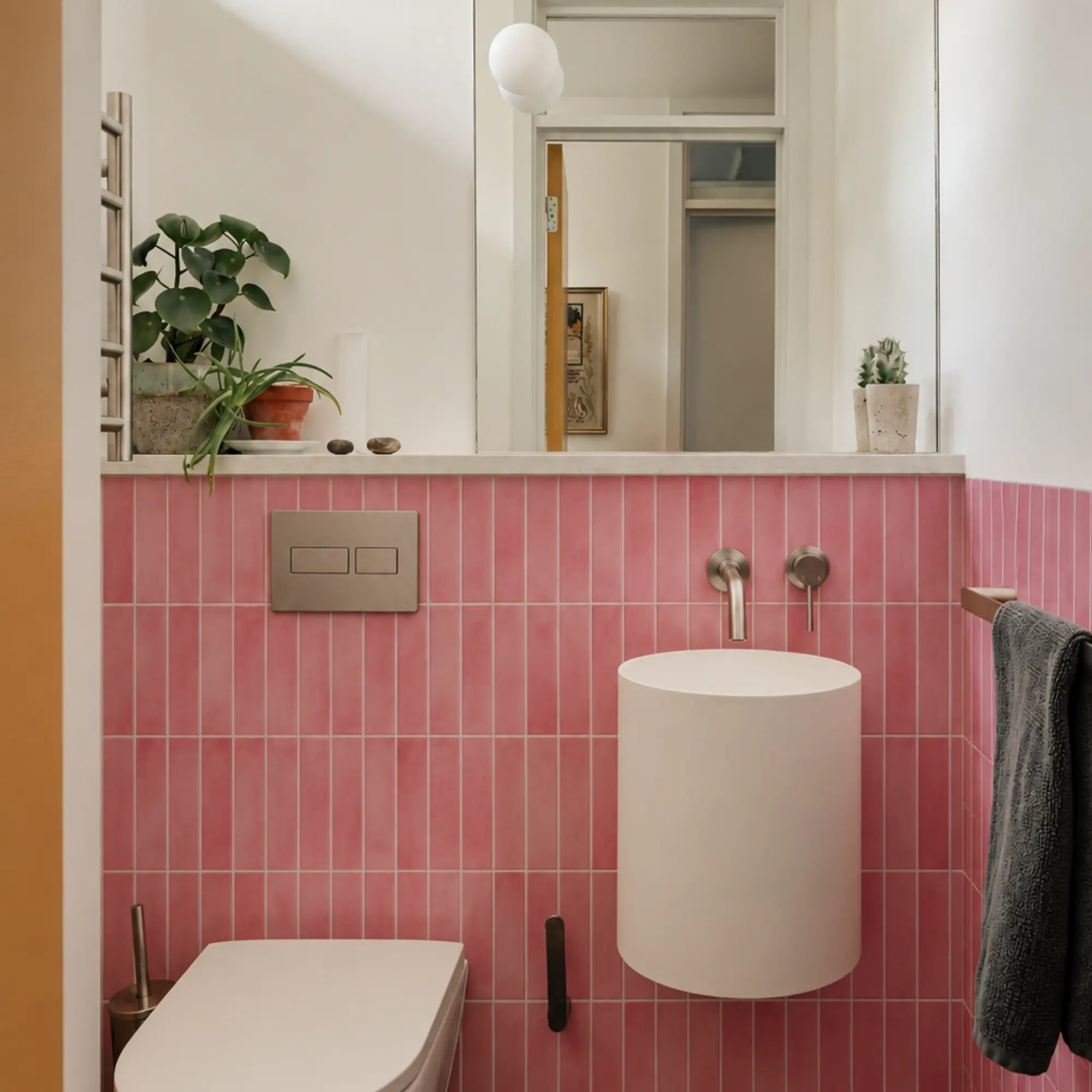
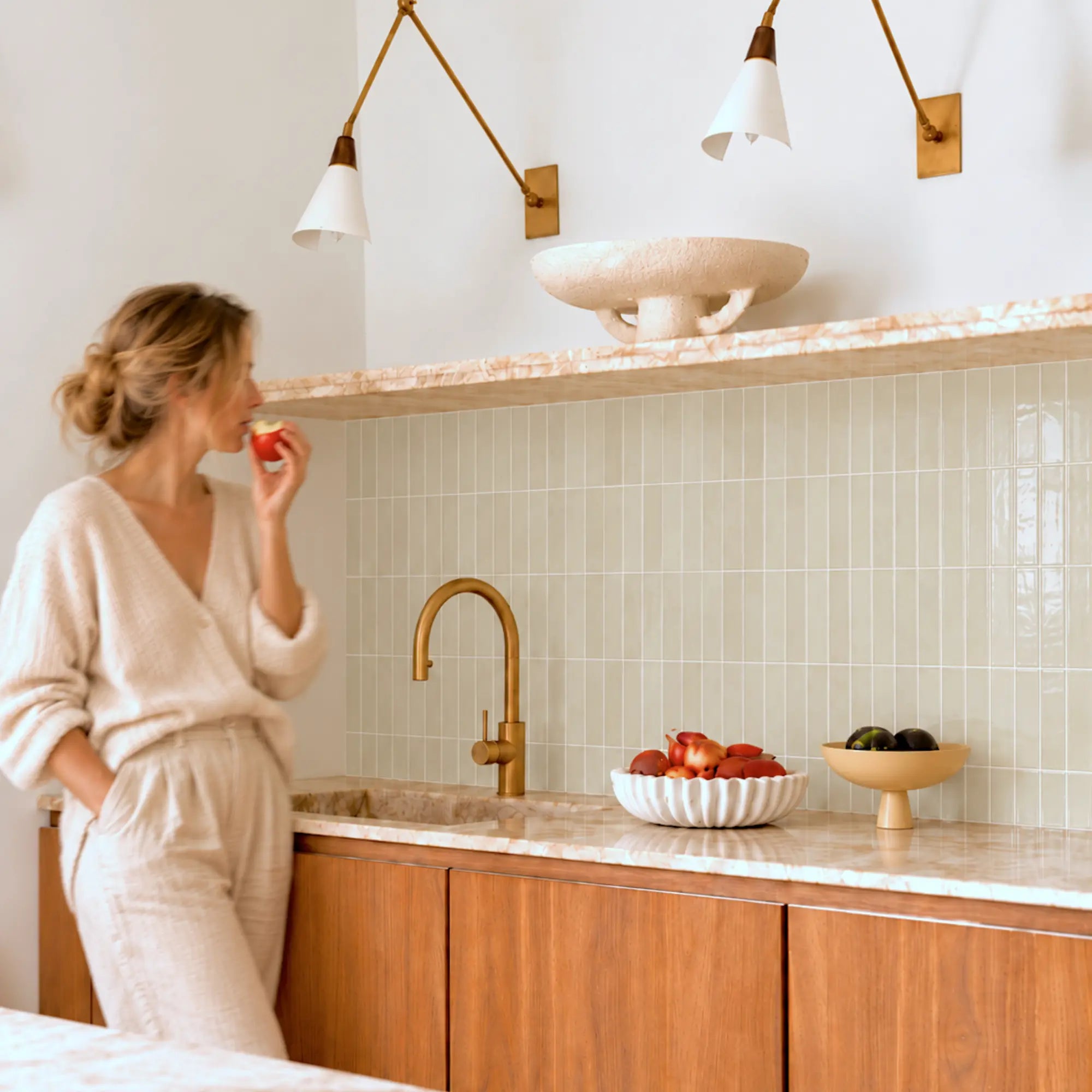
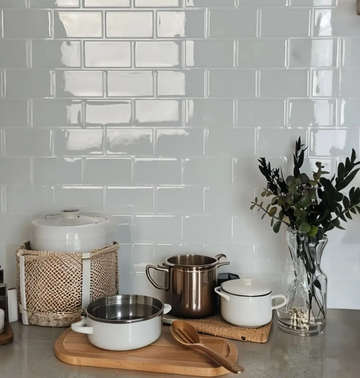
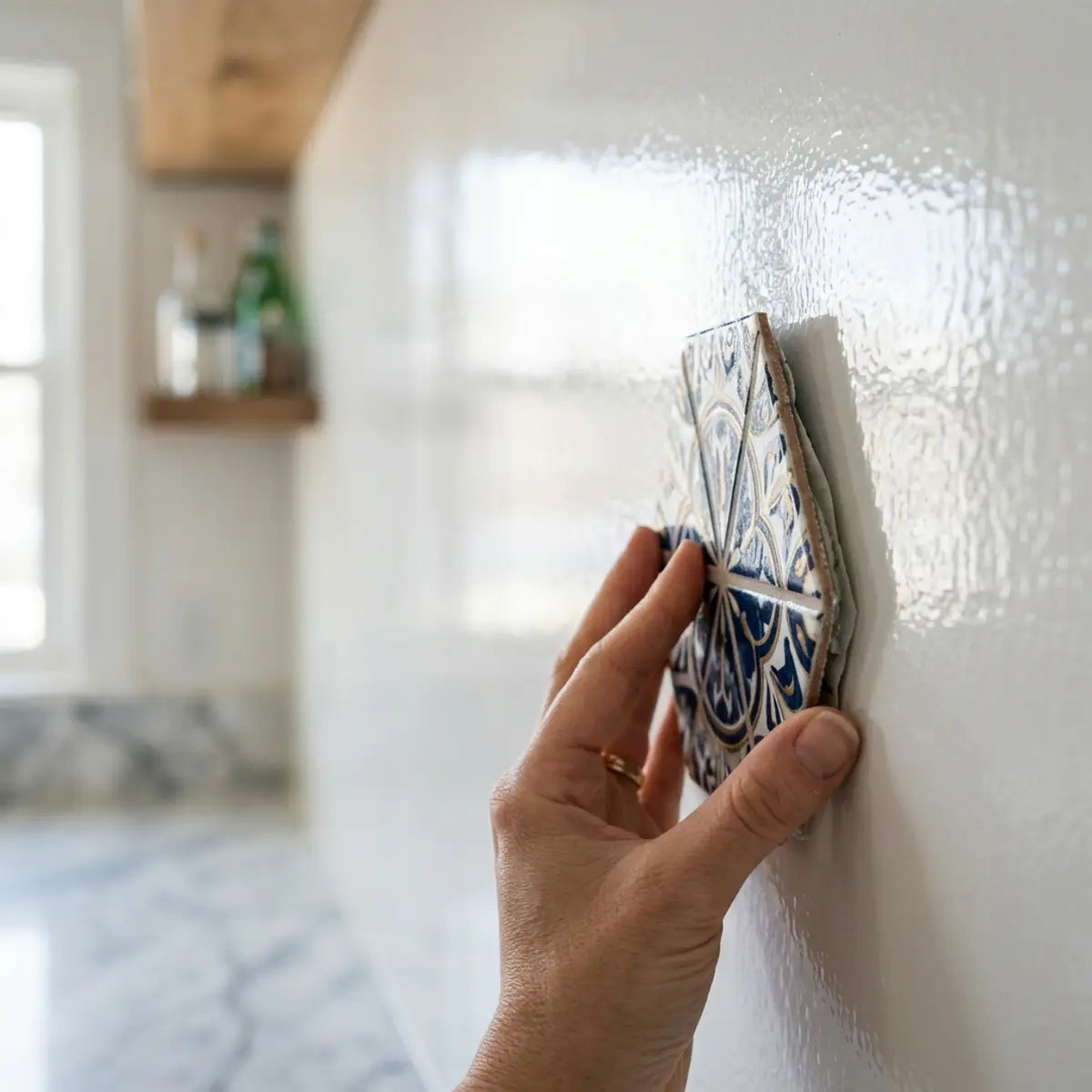
The cover image illustrates a setting; it is not evidence of a product test or approval of the pictured installation.
First distinguish the three kinds of exposure
A coffee corner used for grinding and pouring is not the same as the wall immediately beside a steam wand. Before ordering tile, watch a normal drink-making and cleaning cycle. Note where vapor goes, where droplets collect and whether the lower edge remains wet. Do not deliberately blast a sample with steam to test it.
| Location | Decision before installation |
|---|---|
| Decorative wall outside the steam path, normally dry | Check that the specific tile, wall finish and cleaning routine are approved. |
| Wall repeatedly wet with condensation or splashes | Change the layout or moisture management first; obtain advice about the complete backsplash system. |
| Direct steam discharge, hot exhaust or prohibited appliance clearance | Do not install an ordinary decorative adhesive tile there. Relocate the appliance or select a system explicitly suitable for that exposure. |
What the research does—and does not—show
Luo and colleagues found temperature- and humidity-dependent behavior in an adhesive for flexible displays. That is a reason to assess the adhesive, not proof that any backsplash survives steam. [1] There is no basis here for ranking all rigid tiles above all gel tiles, assigning a failure probability or promising a service life.
For a concrete product-specific example, Smart Tiles excludes direct steam in its warranty conditions. Those conditions are not Stickwoll specifications. [2] Ask for the instructions for the exact product you are buying rather than borrowing another brand’s temperature or clearance figure.
Placement matters more than an invented safe distance
This guide does not prescribe a universal six-inch gap. The machine’s vents, steam-wand movement, adjacent materials and installation instructions all belong in the placement decision. A hand held near the wall is not a temperature test, and a simple distance measurement does not establish fire safety.
Breville’s Barista Express Impress purge tutorial directs the wand over the drip tray, not toward a backsplash. Follow your own machine’s instructions. [3] Leave space to remove the water tank, empty the tray and clean behind the machine without trapping a puddle against the wall.
Questions to resolve before buying
- Product: Does the written guidance permit this coffee-bar location, including steam and repeated condensation—not just occasional water splashes?
- Wall: Is the existing coating stable and the surface dry? What preparation is allowed for that coating?
- Edges: What joint, trim or sealant detail is specified? Do not assume a bead of silicone upgrades an unsuitable tile.
- Care and removal: Which cleaners are compatible, and what wall repair may be necessary when the tile is removed?
Send the product name, a photo of the wall and the appliance model through our contact page when the instructions do not answer the question. Without a clear answer about the proposed exposure, choose a lower-risk location or another finish rather than guessing.
A preparation and inspection routine
Use the wall preparation guide to plan the substrate, layout and edges. Follow the actual paint, primer and tile curing or conditioning instructions; a fixed waiting period cannot cover every combination. Use only cleaners approved for those surfaces. Do not automatically apply concentrated alcohol or extra adhesive.
A small sample in an approved location can reveal poor contact or removal damage, but it cannot prove six months of durability. Record the product, wall coating, preparation and installation date. Photograph the sample and its edges before use and during routine inspections. These are observations, not a pass certificate.
Wipe up splashes as the product care instructions allow. If an edge repeatedly lifts, a sheet moves, the wall softens or water remains behind a panel, stop exposing that area and investigate the cause. Do not hide a damp wall under more tile or simply glue the edge back down. For wider layout decisions, see the kitchen backsplash guide and renter planning guide.
Plan the coffee routine before choosing the backsplash
A useful coffee-bar design begins with the things you do every morning, not with a photograph of an empty counter. Walk through filling the reservoir, weighing beans, grinding, tamping, pulling a shot, steaming milk, knocking out the puck and washing the pitcher. Include the less attractive jobs: emptying the drip tray, carrying wastewater to the sink and wiping the counter beneath the machine. Each movement creates a different requirement for access, cleaning and the position of nearby objects.
Make a simple sketch showing the machine in its operating position and again in its maintenance position. A rear water tank may need access that is not obvious when the machine is pushed against the wall. A steam wand may sweep sideways. A removable tray may need a clear path forward. Allow those movements without pulling a power cord tight or repeatedly striking an exposed tile edge. The appliance instructions determine the placement constraints; the sketch helps you fit your decorative plan around them.
Separate three working areas on the counter
For planning, divide the counter into a dry preparation area, a drink-making area and a cleanup area. The dry area might hold the grinder, scale and sealed coffee container. The drink-making area contains the machine and space to handle a hot pitcher. The cleanup area provides somewhere to put used utensils without placing wet items against the wall. These are organizational categories, not tested clearance zones. Their value is helping you see where the backsplash will be touched, splashed or difficult to reach.
Take a photograph after an ordinary session before you wipe everything down. Look for a drip line from the pitcher, residue near a syrup pump and water beneath the reservoir. Do not intentionally direct steam at the wall for a photograph. Repeated normal observations are more useful for layout decisions than a dramatic staged exposure. If the actual workflow puts the wall directly in the discharge path, moving the appliance or choosing another location should come before selecting adhesive tile.
A small-counter example
Consider a hypothetical apartment coffee corner with a grinder beside a compact machine and a sink on the other side. The entire available wall does not need the same decorative treatment. The owner might keep tile on the normally dry section behind the grinder, leave the machine service area unobstructed and choose a separately specified backsplash system for a more demanding area. This is not a claim that a particular number of inches makes tile safe. The example shows how reducing the decorated area can preserve both the appearance and the practical use of the counter.
Now consider a second hypothetical setup with a large machine under a shelf. Before ordering a full-wall pattern, the owner discovers that removing the water tank requires pulling the machine forward. A shorter decorative panel with a finished edge may be easier to maintain than tile hidden behind fixed shelving. A shelf positioned outside the required appliance clearances could organize cups, but it must be mounted to a suitable supporting wall, not supported by the adhesive covering. A wall finish and a load-bearing attachment have different jobs.

Compare the complete tile assembly, not just a material name
Product descriptions such as vinyl, gel, PVC, composite and metal-faced identify only part of a construction. A useful comparison asks what forms the exposed face, what supports that face, how the adhesive is applied, which surfaces the adhesive accepts and how the edges are finished. Two products with a similar photograph can have different instructions. Conversely, products with different textures may share a preparation requirement. Make the written intended use your first filter, then compare appearance and handling among the eligible options.
| Product feature | Question worth asking | What the answer does not establish |
|---|---|---|
| Decorative face | Which routine cleaners and types of contact are permitted? | A washable face alone does not approve direct steam. |
| Core and backing | Is the product intended for this vertical wall and existing finish? | Thickness alone does not identify the adhesive temperature limit. |
| Adhesive | What preparation, installation conditions and bond-building time are specified? | Strong initial tack is not a service-life measurement. |
| Seams and perimeter | Is overlap, a joint or a named trim detail required? | An interlocking appearance does not make the wall a waterproof assembly. |
| Removal | What procedure and likely repair should be expected on this coating? | The word removable does not promise undamaged paint. |
Think about cleaning access as part of appearance. A very pronounced relief pattern may be attractive from across the kitchen but require more careful wiping around its recesses. A high-contrast pattern may make a narrow cut beside a cabinet conspicuous. A reflective finish can look different under a task light than in a daylight product photograph. These are design trade-offs you can evaluate with a sample; they are not reasons to assign a universal durability ranking to an entire material family.
Keep decorative selection separate from appliance protection. A metallic face does not automatically turn a panel into an approved heat shield, and a thicker core does not demonstrate an insulating benefit. In the same way, a ceramic-looking print is not fired ceramic, and an embossed grout effect is not a grouted waterproof installation. Choosing accurately described materials prevents the visual similarity from quietly becoming an unsupported technical assumption.
How to read the evidence without over-interpreting it
A useful test report identifies the exact construction, the tested surface, the conditioning, the applied load and the outcome measured. A peel force, a shear force, an image of an edge and an inspection after cleaning answer different questions. Ask whether a result concerns the adhesive alone or the entire installed assembly. If the report uses a different product or a different substrate, treat it as background rather than a transferable rating.
For example, 3M explains that its VHB tape bond develops as adhesive contact with the surface increases. It also lists exceptions to general preparation practices. This supports asking about pressure, surface condition and time rather than relying on touch alone. It does not identify Stickwoll's adhesive, prescribe a solvent for painted kitchen walls or supply a universal waiting period. [4]
Inspect the wall and decide what preparation is actually needed
Start with a wall you can inspect properly. Remove loose countertop objects and check the visible area in good lighting. Look at the counter junction, any previous splash damage and the edges of the existing coating. Record the wall material and paint or previous covering where known. Do not treat a photograph of a clean wall as proof that the coating is sound. Equally, do not assume an old wall must be stripped merely because its history is incomplete.
Sound painted walls
On a painted wall, the adhesive ultimately depends on the paint remaining attached. If paint flakes off when cleaned normally or the surface is chalky, address that condition before installing a finish over it. If the wall was recently painted, find the paint's full curing guidance as well as the tile manufacturer's restrictions on fresh coatings. Dry to touch, ready for another coat and suitable for an adhesive covering are not interchangeable milestones. Schedule the project around the applicable conditions rather than a date chosen for convenience.
Do not automatically sand every glossy wall. The appropriate preparation depends on the coating and the adhesive system. Use the same attention for a matte wall: a matte appearance does not prove cleanliness or strength. Cleaning should remove the actual contamination without damaging the underlying coating. Identify the cleaner, follow its directions and verify compatibility with the paint and intended tile. Stronger concentration is not a substitute for a compatible procedure.
Existing tile, joints and uneven areas
For an existing ceramic backsplash, first confirm that covering it is an approved use for the new product. Inspect for loose pieces, failed joints and water entry rather than concentrating only on grease removal. A new covering cannot stabilize a loose old tile. The depth and position of grout lines matter when laying out a thin finish, but use only a permitted leveling method. Ordinary wall filler should not be assumed appropriate for every tiled, wet or heated location.
Use a straightedge and a dry layout to understand the wall shape. A small proud ridge can keep part of a sheet from touching the surface. A bowed wall may produce a visually uneven seam even when each cut is straight. Write down the defect and the proposed repair, then check that the repair material can receive the finish. This is more informative than a general instruction to press harder until the tile appears flat.
Moisture and unknown coatings
Staining near a sink, recurring softness or moisture behind the machine changes the project from decoration to investigation. Find the source before covering it. EPA's moisture guidance emphasizes correcting water problems rather than painting or caulking over mold. Use appropriate help for suspected hidden damage; the guidance is not a tile installation specification. [5]
Where an old coating or material is unknown, do not turn a cosmetic upgrade into an uncontrolled sanding or scraping job. Describe the material, its age if known and the intended disturbance to an appropriate professional. A small area of suspect material can still require a different preparation route. The objective is a suitable, documented surface, not maximum demolition or the most aggressive preparation available.
Measure, dry-fit and finish the layout before peeling
Measure the backsplash as separate rectangles around cabinets, windows and returns. Note both the maximum area and the pattern repeat. A product's nominal sheet size may not equal its usable installed coverage when overlapping edges are part of the design. Use the coverage described for the actual pack. Plan which row will be most visible above the machine and where partial pieces can end without leaving fragile slivers at exposed edges.
For a hypothetical calculation, a rectangular area 1.8 metres wide and 0.5 metres high has an area of 0.9 square metres. If an eligible pack covers 0.3 square metres, the area-only calculation is three packs. Cuts, pattern matching and repair spares still need a separate allowance. The example is arithmetic, not a Stickwoll pack specification or a universal waste percentage. A layout drawing lets you estimate those extras from the actual pattern rather than adding an arbitrary number.
Dry-fit the most difficult pieces before committing to the first row. Check the lower edge, the cabinet termination and the end visible from the room entrance. Use removable layout marks that do not contaminate the final bond surface. Do not stretch a sheet to make a repeat fit. If the pattern requires overlap, keep the intended direction consistent; if it uses a butt joint or specified gap, do not substitute an overlap because another installation video shows one.
Edges are a design detail and a maintenance detail
A finished edge should be both intentional-looking and accessible for inspection. At the counter, follow the compatible joint detail for the selected wall system. A sealant can be part of a specified detail, but adding it does not convert an unsuitable decorative product into a steam-rated or waterproof system. Avoid hiding an existing damp gap under trim simply because the trim makes the photograph look finished.
Look at exposed side edges from the direction you normally approach the coffee corner. A planned trim line can be neater than a random final strip. Check the trim depth against the actual tile thickness and confirm how it is attached. Do not let a decorative trim obstruct the appliance's service space or act as a ledge that collects spills. Keep replacement access in mind when selecting a finish that will be partly hidden by furniture or equipment.
Cutting and electrical details
Use the cutting method specified for the particular product. A flexible sheet, a rigid panel and a metal-faced tile need not use the same tool. Work on a stable protected surface, keep hands away from the cutting path and follow the tool's safety instructions. An elaborate cut that leaves very little material around a corner is a reason to revisit the layout, not to assume more adhesive will make the piece reliable.
Do not use decorative tile to conceal damaged outlets, interfere with device covers or change an electrical fitting's mounting depth without suitable advice. Keep cleaning liquid away from electrical components. Where the project requires moving or modifying an outlet, use a qualified electrician rather than treating the work as an ordinary tile cut. A tidy final appearance must not hide an unresolved electrical detail.

Build a cleaning routine around the actual spills
The coffee station has several kinds of soil, and treating them all as heavy grease can make cleaning unnecessarily aggressive. Fresh water, milk residue, dried coffee and a sticky syrup ring call for different amounts of attention. Begin with the care instructions for the tile and the machine. Once hot equipment is safe to work around, remove loose debris and clean only the area that needs attention instead of saturating the entire backsplash.
| What you find | First practical check | Reason to stop and reassess |
|---|---|---|
| Fresh splashes | Use the permitted damp-wiping method and a clean cloth. | Liquid appears behind an edge or the wall remains wet. |
| Dried coffee or milk | Use an approved cleaner and controlled contact, not scraping with a blade. | Colour transfers, the finish softens or wiping starts lifting an edge. |
| Syrup around a pump | Clean the dispenser area and change its placement to prevent repetition. | Residue remains despite the allowed care method. |
| Descaling-solution spill | Check the chemical and both surfaces' instructions immediately. | Compatibility is unknown or the finish changes. |
Apply an approved cleaning solution as directed, with deliberate control over runoff near seams. Use a fresh part of the cloth rather than dragging the same residue across clean areas. Remove cleaner residue when the instructions require it, then leave the surface in the required dry condition. Do not invent a universal two-minute dwell time for every cleaner. Time, dilution and surface compatibility belong to the exact formulation and application.
Keep the routine easy to repeat. Store the appropriate cloth and cleaner where you can reach them without moving hot equipment. Check the tray and the countertop junction when emptying wastewater. If a syrup bottle repeatedly leaks in the same place, a washable tray or a different location may solve the nuisance more effectively than a stronger cleaner. Prevention here means organizing the workflow, not promising that a wiping habit eliminates all adhesive failure.
Cleanability and disinfection are separate questions. Do not mix household cleaning chemicals or improvise a stronger combination. CDC warns against mixing bleach or disinfectants with other cleaners and directs users to the product label. That guidance concerns chemical safety; it does not mean bleach is approved for a decorative tile finish. [6]
Use a sample to learn about your installation, not to invent a rating
Once the product and proposed location are permitted, a small, representative sample can answer practical questions. Can you make a clean cut? Does the finish look right under the actual light? Does the prepared coating support initial contact? Can you inspect the edge without moving the whole machine? These are valuable observations even though they do not establish a six-month survival rate or an approval for direct steam.
Write down the product name and batch, the wall coating, the preparation, the date and the application method. Mark the sample location on your sketch. Photograph its edges with a scale beside them without repeatedly prying them up. Suggested reminders might include the next day, the following week and a later routine clean, but these are your observation appointments rather than standardized test intervals. Follow any inspection or waiting requirements supplied with the product.
If you compare two permitted preparation methods, keep the other practical variables alike. Use the same product and similar wall areas, and record exactly what changed. A sample behind a normally dry grinder should not be compared with a sample beside a wet sink as though the difference proved one primer better. Likewise, pushing one lifted corner down repeatedly while leaving another untouched makes later photographs difficult to interpret.
Describe the failure, then choose the next action
If paint comes off with the tile, the weak layer may be the coating rather than the contact between adhesive and paint. If adhesive residue is visible on both surfaces, the separation may be within the adhesive. If a decorative face separates from its backing, that is a different observation again. These descriptions help the supplier investigate; a photograph alone cannot prove the precise chemical cause. Save the evidence before cleaning away residue.
Do not turn one lifted edge into a prediction that mold or complete wall failure is inevitable. Equally, do not hide repeated lifting behind a stronger glue. Stop the exposure, inspect for moisture and ask what repair is approved. A local replacement may be reasonable when the underlying cause is understood and corrected. Repeated detachment, damp substrate or a prohibited location calls for a broader change rather than another cosmetic repair.
Plan removal, repair and cost before installation day
For a renter, start with permission and the condition of the existing finish. Keep photographs of the wall before preparation and confirm which changes are allowed. Permission to decorate does not necessarily include sanding, adding permanent trim or using an additional adhesive. Agree on the likely restoration work rather than assuming that the phrase renter-friendly guarantees a full deposit return. The product's removal instructions and the lease are separate sources of requirements.
Test the permitted removal method on a sample where a small repair is acceptable. Do not assume a sample removed soon after installation predicts how the same coating will behave after a year. Avoid a universal heating duration, pulling angle or heat-gun setting. Use the instructions for the tile and consider the coating underneath. If removal begins tearing the wall surface, stop and reassess the method rather than pulling faster.
Compare projects using a simple cost worksheet: product quantity, approved preparation, cutting and finishing supplies, any professional work, repair spares and anticipated restoration. Keep labor separate from material spending. Record actual quotations where needed rather than accepting a generic installation price from a blog. The smallest initial purchase may not be the least disruptive option if it requires extensive preparation or is unsuitable for the intended machine location.
A practical decision can be to decorate a smaller, lower-exposure wall now and leave the demanding area for a properly specified future renovation. Another can be to postpone the entire covering until a leaking reservoir or damaged coating is resolved. Neither choice is a failed project. The successful coffee corner is the one that fits how you work, can be cleaned and inspected, and uses the chosen finish within its documented limits.
A concise handover note for everyone who uses the coffee corner
Keep a short note with the permitted cleaner, the appliance's operating guidance and the location of spare tiles. Mention any edge that needs routine observation and who to contact if moisture returns. A family member should not need to reread a long installation guide to avoid an unsuitable abrasive pad. This simple handover turns the planning into a routine that remains understandable after the installation weekend is over.

Frequently asked questions
Does a waterproof tile make the entire backsplash waterproof?
Not by itself. The substrate, joints, edges and penetrations must also suit the exposure. Treat a tile-face claim as one product property, not approval for the entire wall assembly.
Should I buy a thicker tile to protect the glue from heat?
Thickness alone does not establish a safe operating limit. Ask for the complete product’s intended use and restrictions. This guide does not verify a heat-insulating benefit for Stickwoll tiles.
Can I add a metal sheet or silicone and keep the same location?
Only use a protective arrangement supported by the relevant appliance and installation instructions. An improvised shield or sealant is not permission to reduce a required clearance or expose an indoor tile to direct steam.
Will removing the tile leave a rental wall undamaged?
That cannot be guaranteed. Check permission, coating condition and the product’s removal procedure. A sample removal is useful for planning, but an aged installation may behave differently.
Sources
- Luo et al. (2024), Scientific Reports. DOI: 10.1038/s41598-024-64960-2
- Smart Tiles — Warranty
- Breville — Barista Express Impress: A steam wand purge
- 3M — Surface Preparation for VHB Tape Applications; product-family guidance, not Stickwoll specifications.
- US EPA — A Brief Guide to Mold, Moisture and Your Home.
- CDC — Cleaning and Disinfecting with Bleach; chemical-safety guidance, not tile compatibility approval.


Leave a comment
This site is protected by hCaptcha and the hCaptcha Privacy Policy and Terms of Service apply.