




Peel-and-stick wall tile can sometimes be installed over glossy, semi-gloss or oil-based paint, but wall sheen alone does not tell you whether sanding or primer is required. The correct decision depends on the exact wall coating, its condition and cure, the tile adhesive system, surface contamination and the manufacturer’s approved preparation.
This guide replaces synthetic adhesion ratings and one-size-fits-all preparation schedules with a practical sequence: identify the coating, inspect whether it is firmly bonded, clean the wall, test the exact tile or a representative sample, then use deglossing or primer only when the coating and tile system actually call for those steps.
Gloss is a surface property, not a failure diagnosis
A glossy wall can have a hard, smooth coating that provides less texture for some adhesives, but it can also be clean, stable and compatible with a specific pressure-sensitive adhesive. A flat wall can be a worse substrate when the paint is chalky, weak or contaminated.
Do not classify a wall as “high risk” from sheen alone. Look at the actual coating and the tile manufacturer’s instructions.
Identify what is on the wall before changing it
Try to determine whether the coating is modern latex/acrylic paint, alkyd/oil-based enamel, specialty cabinet/wall coating, varnished wood paneling or another finish. Maintenance records, leftover paint cans or landlord/building documentation can be more useful than guessing from shine.
If the coating is unknown, use a conservative test and avoid aggressive chemical or mechanical preparation until you understand what the wall can tolerate.
Inspect coating adhesion before tile adhesion
A tile can bond strongly to paint while the paint itself is weakly attached to drywall or plaster. Look for peeling edges, bubbles, chalking, soft patches, previous water damage and areas where tape or light rubbing removes paint.
If the coating is failing, repair the wall first. A stronger tile adhesive does not strengthen the bond between weak paint and the substrate behind it.
Check recent paint cure separately from surface sheen
Paint can feel dry while still curing. Applying an adhesive wall covering too soon can create unpredictable bonding or removal behavior. The required wait depends on the actual paint/coating and tile system.
Use the paint manufacturer’s cure/recoat information plus the tile manufacturer’s requirements for newly painted walls. Do not impose one universal waiting period across all coatings.
Clean the wall before deciding whether abrasion is needed
Glossy kitchen and bathroom walls often collect grease, soap film, cleaners and airborne residue. Those contaminants can create a false impression that the paint itself is incompatible.
Use a cleaner compatible with the coating and tile instructions, remove residue and allow the wall to dry fully. 3M’s pressure-sensitive adhesive surface-preparation guidance illustrates the general importance of clean, dry compatible surfaces and application pressure, although the exact tile may use a different adhesive.
Do not make strong degreaser or TSP the default
A powerful alkaline cleaner can change or dull some paint films and may leave residue if not handled correctly. Clean for the contamination that is actually present rather than assuming every glossy wall needs the strongest product available.
Follow the coating and tile instructions. If normal compatible cleaning leaves a stable wall, extra chemical preparation may not improve the project.
Use a small compatibility sample before altering the entire wall
When the product supports a test, apply a small piece in a representative hidden area after the documented cleaning method. Observe initial contact, edge behavior and the wall coating during the product’s recommended evaluation period.
A short test can reveal obvious incompatibility; it cannot guarantee years of performance or identical removal after a long installation. Keep the conclusion narrow.
When deglossing may be appropriate
If the tile manufacturer or coating-preparation guidance calls for mechanical deglossing, use the least aggressive method that creates the required surface without damaging the wall. The objective is usually to create a compatible bond surface—not to strip the wall to bare substrate.
Use dust control and appropriate personal protection. If the paint is old enough that lead may be a concern in a U.S. pre-1978 property, review EPA’s lead-safe renovation guidance for DIYers before sanding or scraping.
Do not sand every glossy wall automatically
Some self-adhesive products may be approved over clean, cured painted walls without abrasion. Sanding an otherwise suitable wall can create dust, expose weak layers or complicate future restoration.
Only abrade the wall when the product and wall system support that preparation. If a clean sample performs acceptably and the instructions do not require deglossing, extra sanding may be unnecessary.
When a bonding primer may help
A compatible bonding primer can be useful when the wall coating needs a prepared interface for the tile system, or when the tile manufacturer specifically requires or permits it. Primer can also create a more uniform surface after wall repair.
Choose the primer by substrate compatibility and purpose. Do not assume the strongest odor, fastest dry time or “bonding” label makes one primer suitable for every paint and adhesive.
Primer does not fix weak underlying paint
A primer applied over peeling or poorly bonded paint only adds another layer to the same weak base. Repair or remove unsound material using an appropriate wall method before priming.
If the paint releases from the drywall during a small preparation test, stop. The problem is wall-coating adhesion, not simply the gloss level.
Use the primer’s actual cure requirements
Different coatings have different dry, recoat and cure behavior, and room temperature/humidity can affect those times. A fixed waiting schedule is not reliable across all coatings and products.
Use the current primer technical data and the tile manufacturer’s requirements for newly prepared surfaces. When the two instructions conflict or are unclear, ask the manufacturers rather than inventing a compromise time.
Pressure helps contact but cannot fix incompatibility
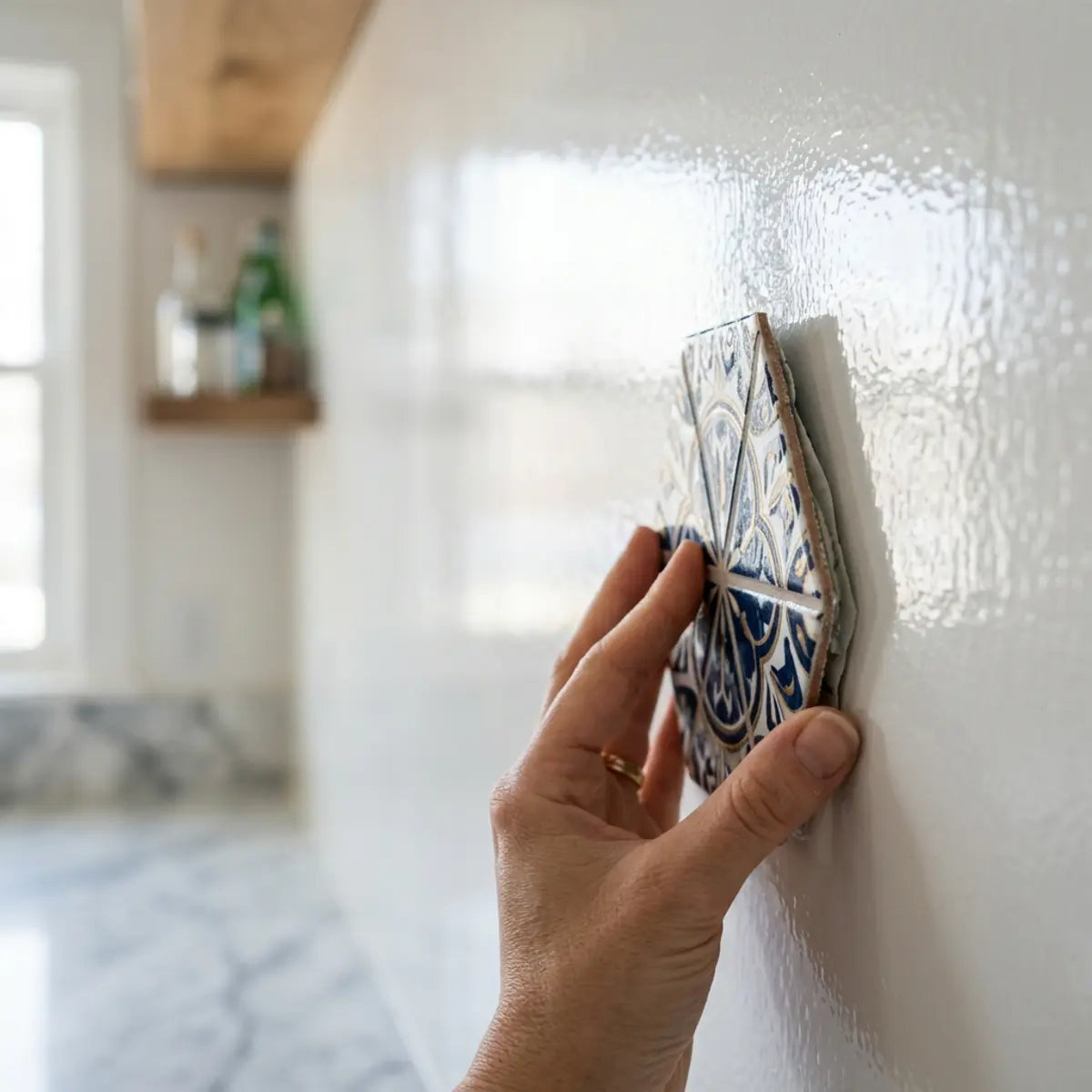
Once the tile is aligned, use the application pressure specified by the product. Some systems may use a roller, smoothing tool or firm hand pressure.
Do not assume a hard roller and extreme body weight are needed for every tile. Excessive pressure can damage relief, stretch flexible material or hide the fact that the surface preparation is wrong.
Glossy walls can reveal lighting and seam issues
A glossy painted wall often exists in kitchens or bathrooms with strong side lighting. If the new tile is also glossy, reflections can emphasize seams, small height differences and relief.
Use a physical sample under the room’s actual lighting. The U.S. Department of Energy’s color and spectrum resources provide context for how light source characteristics change the appearance of colors and surfaces.
Do not confuse visual show-through with adhesion failure
A light or partially translucent tile can reveal a dark glossy wall even when the bond is sound. Conversely, an opaque tile can hide the wall while still bonding poorly to contaminated paint.
Evaluate opacity and adhesion separately. If color show-through is the only issue, a more opaque tile or approved lighter preparation layer may solve the visual problem without changing the adhesion strategy.
Oil-based or alkyd paint needs product-specific compatibility
Older oil-based enamel can be hard and glossy, but the exact chemistry, age and maintenance history vary. Do not assume all oil-based paint must be stripped or that every adhesive bonds well to it.
Identify the coating when possible, clean it appropriately and follow the tile/primer manufacturer’s compatibility guidance. A representative sample can provide useful project-specific evidence.
Varnished wood paneling is not the same as painted drywall
Wood paneling can move with humidity and may have varnish, wax, polish or other finishes that affect adhesive. Grooves also reduce flat contact area.
If the wall is paneling rather than drywall, treat it as a different substrate. Check flatness, finish condition and product approval before installing a decorative adhesive layer.
Plaster walls need their own condition check
Glossy paint over plaster can be stable, but cracks, powdery surfaces and previous repairs can create local weak points. The tile should bond to a sound finish, not to loose or friable plaster.
Repair cracks and unstable areas first using an appropriate plaster system. Then evaluate the finished surface for compatibility with the tile.
Rental walls require permission before aggressive preparation
Scuff sanding, primer and repainting can be more permanent changes than the peel-and-stick tile itself. Check the lease and restoration expectations before altering a glossy rental wall.
If the tile only works after a permanent primer or deglossing step, compare that route with choosing a product that is compatible with the existing wall. The lower-change option may be more appropriate for a short tenancy.
Do not use “renter-friendly” as a removal guarantee
Even when the tile is marketed for temporary projects, removal can affect paint or drywall depending on coating strength, dwell time, temperature and method. Photograph the starting wall and save the removal instructions.
A hidden-area test can reveal an immediate problem but cannot guarantee the same result after a long installation. Plan possible touch-up or restoration instead of promising a security-deposit outcome.
Do not make one removal technique universal
Some product instructions may permit gentle warming during removal, while others may not. Heat can also soften paint or change the adhesive behavior.
Follow the exact removal method and stop if the coating begins to fail. No single temperature, tool, distance or peel method protects every glossy wall.
Troubleshoot lifting by location and timing
Immediate widespread lift can point to contamination, incompatible paint or insufficient contact. One exposed corner may be a local edge or layout problem. Lift near an appliance or sink may indicate heat or moisture exposure.
Record where and when the failure appeared. That information is more useful than a synthetic adhesion rating because it points toward the actual mechanism.
Do not solve every lift with more adhesive
Adding construction adhesive can permanently change the removal path and may be chemically incompatible with the tile or paint. It can also hide a wall problem that continues behind the finish.
Use the manufacturer-supported repair method. If the wall is weak or damp, repair the substrate before reinstalling.
What if only the primer releases?
If the tile remains attached to the primer but the primer peels from the old glossy coating, the failure is between coating layers. The tile adhesive may not be the problem.
Stop further installation and review primer compatibility and wall preparation. Do not simply add more primer over the same failing interface.
What if the paint comes off with the tile?
That indicates the wall coating bond is weaker than the removal force at that location. Document the condition and repair the wall appropriately before deciding whether the decorative system should be reinstalled.
Do not describe the event as proof that all peel-and-stick tile damages walls. The outcome belongs to that wall/coating/adhesive combination.
What if the tile slips but does not release?
Slipping can indicate low initial holding power, incompatible surface, heat, excessive weight or another product-specific condition. Do not assume more pressure will correct it.
Review the manufacturer’s substrate, temperature and application guidance. A vertical wall product should be documented for the intended orientation and service condition.
Use a decision tree instead of a synthetic rating
- Is the paint stable? If no, repair the wall before tiling.
- Is the coating cured? If uncertain, verify the paint/coating guidance.
- Is the wall contaminated? Clean using a compatible method and dry fully.
- Does the tile approve the surface? Follow its requirements for gloss, sanding or primer.
- Can you run a representative sample? Use it to find obvious incompatibility.
- If preparation is required, is it allowed? Especially important for rentals and older painted walls.
- After preparation, does the sample behave acceptably? If not, choose another finish or substrate strategy.
Kitchen scenario: glossy enamel backsplash wall
Suppose the wall behind the countertop has a cured glossy enamel finish and routine cooking residue. Start by confirming that the coating is firmly bonded and the planned tile is documented for painted wall use. Clean the representative area with a compatible method, let it dry and test the actual tile.
If the sample bonds and the instructions do not require abrasion or primer, avoid adding unnecessary layers. If the manufacturer requires deglossing or a compatible primer, apply that preparation across the project only after the sample confirms that the coating beneath it is sound.
Bathroom scenario: glossy wall beside a vanity
Glossy bathroom paint may have been chosen for washability, but humidity and splash exposure are separate from surface sheen. Confirm that the wall is dry and that the exact tile is appropriate for the moisture zone before evaluating adhesion.
If the wall shows staining, bubbling, soft drywall or recurring condensation, stop and solve the moisture condition. A bonding primer over a damp wall does not turn the substrate into a suitable bathroom surface.
Rental scenario: semi-gloss wall with unknown paint history
When the landlord’s paint history is unknown, the least invasive route is usually to inspect, clean and test before sanding or priming. Abrasion and primer can become permanent alterations that require restoration even if the tile itself is removable.
Photograph the wall before work and keep the lease approval plus product instructions. If the required preparation is not permitted, choose a different product or a non-adhesive decorative approach rather than changing the wall without authorization.
Build a sample record instead of a pass/fail score
Record the wall coating if known, sheen, cleaner used, room temperature, product sample, preparation method and the observations that matter: initial contact, edge condition, visible movement and wall response during removal if removal testing is permitted.
Use words and photographs instead of a numerical rating. “No visible edge lift after the representative check” or “paint transferred during removal” conveys the actual observation without pretending the sample is a standardized laboratory test.
Separate primer success from tile success
If a primed sample works, note whether the primer remains bonded to the original glossy coating as well as whether the tile stays attached to the primer. Those are two different interfaces.
A tile that remains firmly attached to primer while the primer peels from the old paint is not a successful wall system. The weakest layer determines the real substrate.
Use the sample to compare preparation options
When the product documentation permits more than one surface-preparation route, a small representative comparison can help. For example, compare cleaned-only versus the documented degloss/primer method on equivalent areas, then observe the same behaviors.
Do not create an uncontrolled “torture test.” The point is to find obvious incompatibility while using the manufacturer-supported methods, not to invent a new performance standard.
Check opacity on dark glossy walls separately
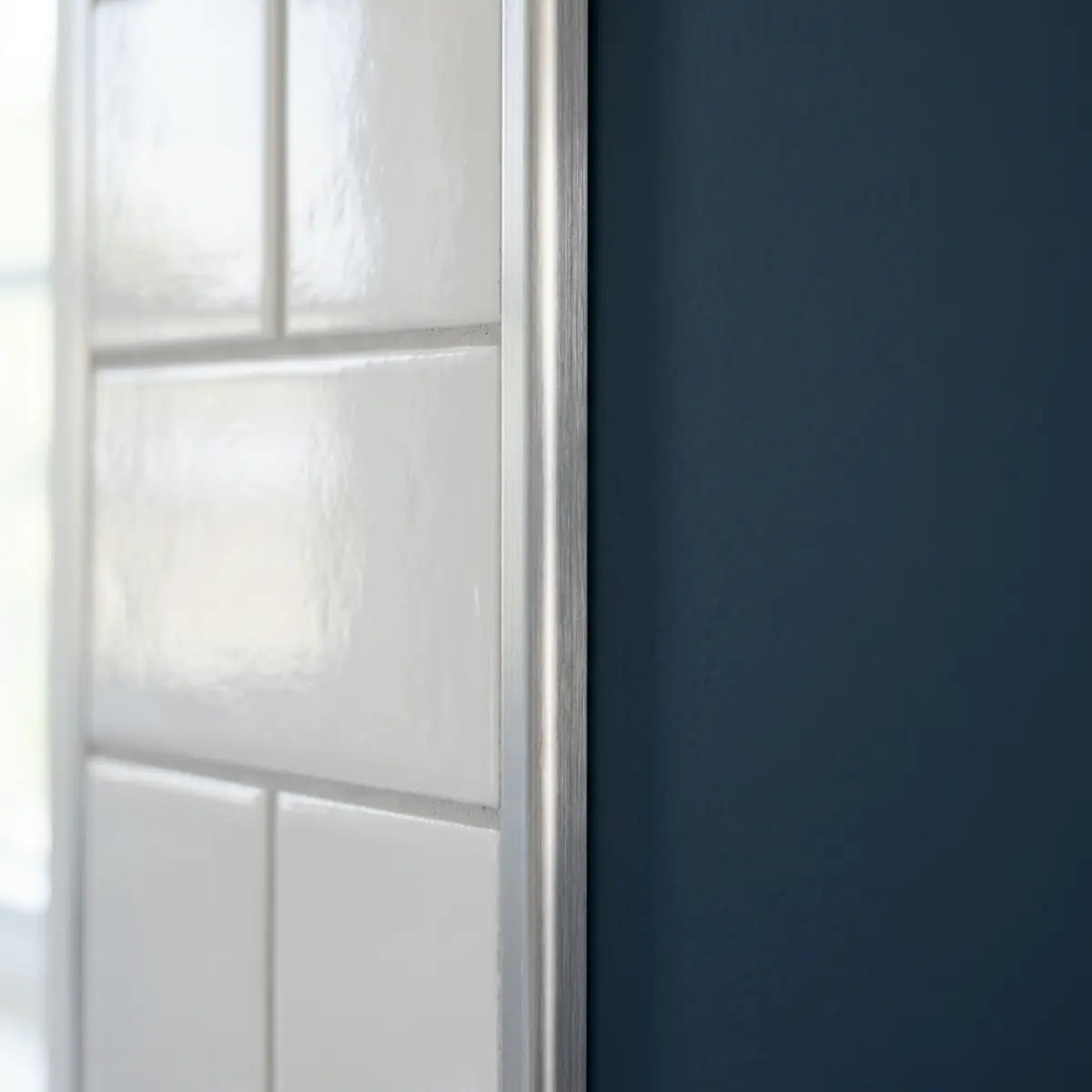
Glossy navy, forest green or black paint can influence a light tile if the product is not fully opaque. Place the sample over the actual wall under daylight and task lighting before changing the coating.
If show-through is unacceptable but adhesion is fine, choose a more opaque tile or an approved lighter preparation layer. Avoid confusing color correction with bond improvement.
Inspect the wall after the first cleaning cycle
Once the installation has returned to normal use, clean it using the approved method and inspect exposed edges, seams and areas near sinks or appliances. Early change can reveal a local compatibility or placement issue.
If the tile begins lifting only after a certain cleaner or repeated steam exposure, document that pattern and correct the cause rather than adding permanent adhesive.
Keep a local repair plan
Save matching pieces and the product information. If one panel fails, remove it using the documented method, inspect the wall coating and restore the substrate before installing the replacement.
Repeated local failure in the same area indicates a wall, exposure or maintenance issue that should be addressed before another spare piece is used.
Acceptance checklist for glossy painted walls
- The paint is stable, cured and free of active moisture damage.
- The wall is cleaned with a compatible method and fully dry.
- Any deglossing or primer step is supported by the coating/tile system.
- The sample does not reveal obvious wall incompatibility.
- The tile is installed with the product-specific pressure method.
- Edges, outlets and transitions are fully seated and serviceable.
- Removal/restoration expectations are documented for rental walls.
- Spare pieces and product records are retained for repair.
Frequently asked questions
Do I always need to sand glossy paint before peel-and-stick tile?
No. Follow the exact tile and wall-coating instructions. Some products may work on clean cured painted walls; others may require deglossing or a compatible primer.
Do I need to prime semi-gloss paint?
Not automatically. Primer should solve a documented compatibility or preparation need. Wall condition, coating type and tile requirements matter more than sheen name alone.
How long should primer cure before tile?
Use the actual primer/coating technical data and the tile manufacturer’s surface requirements. There is no single cure interval that applies to every primer and tile system.
Can peel-and-stick tile go over oil-based paint?
Potentially, when the coating is stable and the tile/primer system documents compatibility. Identify and test the actual wall rather than assuming all oil-based enamel behaves the same.
Can I use a roller to improve adhesion?
Use the pressure method specified by the tile. A roller may be appropriate for some products, but extreme pressure cannot compensate for contamination, weak paint or moisture.
Can I use construction adhesive if the tile will not stick?
Not by default. Diagnose the wall and use only manufacturer-supported repair or secondary adhesive methods.
Will glossy paint show through light tile?
Show-through depends on tile opacity, wall color, seams and lighting. Test the exact sample over the actual wall. Opacity is separate from adhesive compatibility.
Can renters install over glossy paint?
Potentially, if the lease permits the installation and required wall preparation. Sanding or primer can be permanent changes, so include them in the permission/restoration plan.
How do I remove the tile later?
Follow the exact product instructions and stop if the wall coating begins to release. Do not apply one warming and peeling routine to every paint and adhesive system.
Do a final wall check after normal use begins
After the first few cleaning cycles and normal kitchen or bathroom use, inspect seams and exposed edges under the same lighting used during the sample test. A local change can reveal cleaner incompatibility, steam exposure or an edge-detail issue that was not visible on installation day.
Record the condition before repairing it. A small amount of documentation can prevent the same issue from being repeated in a replacement piece.
Bottom line
Glossy paint is not a universal stop sign and not a universal sanding trigger. Identify the coating, check whether it is sound and cured, clean it properly, compare the exact tile requirements and use deglossing or primer only when the documented wall/tile system needs those steps.
Keep opacity, adhesion and removal as separate questions. A representative sample can reduce uncertainty, but it does not replace product instructions or prove long-term performance. When the wall is weak, wet or unknown, fix or identify the substrate first instead of escalating adhesive strength.
Use coating records when they exist
If the homeowner, landlord or facility has the original paint can, product label or maintenance record, save that information with the tile project. Knowing the exact coating can make cleaner, primer and cure questions much easier to answer than guessing from appearance.
When the coating is unknown, keep the preparation conservative. A small documented sample can tell you more than a broad rule based on gloss alone.
Old paneling may need a different finish strategy
Glossy wood paneling can have wax, polish, varnish or deep grooves that make self-adhesive wall tile a poor direct substrate. If the product does not support the paneling surface, a separate compatible wall/backer strategy may be cleaner than trying to sand every groove flat.
Do not treat paneling as “just shiny paint.” Wood movement, joint geometry and surface finishes create different installation questions from painted drywall.
Use a project handover for future maintenance
Keep the tile product, wall coating if known, preparation method, approved cleaner, removal instructions and spare pieces together. This record helps a future repair distinguish a wall issue from a tile issue.
If primer or deglossing was used, note exactly what product and method were applied. A future owner should not have to infer the wall build-up from the finished appearance.
Choose another wall finish when preparation becomes disproportionate
If the tile requires aggressive sanding, multiple incompatible coatings or permanent adhesive to stay on the glossy wall, step back. A different product or a non-adhesive finish may be a better match for the substrate.
The goal is not to make one peel-and-stick product work at any cost. It is to choose a finish whose documented preparation fits the wall you actually have.
Keep the successful sample after installation
A spare sample can serve as a reference for future cleaning tests, color comparison and replacement. Label it with the wall location, date and preparation method.
If a local repair is needed later, the sample provides evidence of the original finish and can help distinguish product variation from changes caused by use or cleaning.


Leave a comment
This site is protected by hCaptcha and the hCaptcha Privacy Policy and Terms of Service apply.