









A reassuring product label does not mean every installation is covered. Heat near an appliance, repeated splashes, fresh paint, wall texture, surface preparation, and intentional removal may each affect eligibility under a peel-and-stick tile warranty.
Explore this guide
A written warranty describes the defects, purchasers, conditions, periods and remedies promised in that document. It may not describe all rights available under applicable consumer law. Before buying, compare the warranty with installation, care and return terms, while keeping statutory or implied rights separate.
Use the method below to compare those documents against your actual project. The goal is simple: determine whether the written terms fit your intended heat, moisture, wall, removal, and claim conditions.
This guide explains how to evaluate warranty language. It is not legal advice, and it cannot establish coverage for a particular product or claim.
What does a peel-and-stick tile warranty cover?
A peel-and-stick tile warranty usually addresses specifically defined product defects, subject to stated eligibility rules and exclusions. It does not automatically guarantee that the tile is suitable for every wall, room, appliance area, or future removal plan.
A limited warranty is a written promise restricted by its own conditions. Those restrictions may define who can make a claim, what qualifies as a defect, how long coverage lasts, and what the manufacturer may provide if a valid claim is approved.
Coverage may turn on several connected questions:
- Did an eligible purchaser buy the product?
- Was the product installed within the stated conditions?
- Was the wall an approved substrate?
- Were preparation and care instructions followed?
- Did the issue arise from a covered defect?
- Was the claim filed within the required period?
- Is the requested outcome an available remedy?
A substrate is the underlying surface to which the tile adheres, such as painted drywall, sealed plaster, or another wall material. A product may adhere initially yet still fall outside warranty eligibility if that substrate is excluded or improperly prepared.
This distinction matters because adhesion is an observation, while warranty eligibility is a contractual question. A tile staying on a test area for several days does not prove that the full installation is covered.
How is a warranty different from installation and return terms?
The warranty, installation instructions, specifications, care guidance, and return policy answer different questions. You need all of them because no single document necessarily explains the entire purchase and installation risk.
| Document | Main question it answers | What to record |
|---|---|---|
| Limited warranty | What defect may be covered, for whom, for how long, and with what remedy? | Purchaser eligibility, covered defects, period, exclusions, remedy, claim deadline |
| Installation guide | How must the tile and wall be prepared and installed? | Approved surfaces, cleaning, curing, temperature, pressure, spacing, prohibited locations |
| Technical specifications | What stated operating or material limits apply? | Temperature range, moisture description, intended environment, material characteristics |
| Care instructions | What cleaning and ongoing use conditions are allowed? | Cleaners, abrasion limits, exposure restrictions, maintenance duties |
| Return policy | Can an unused or eligible purchase be returned? | Return window, product condition, packaging, fees, authorization process |
A return policy is not a warranty. Returns commonly concern purchase acceptance or unused merchandise, while a warranty concerns a defined issue under stated conditions.
Installation instructions are also not a promise of compensation. They may establish duties that must be followed before warranty coverage can apply.
Do not assume a product-page representation has no effect merely because the written warranty does not repeat it. The legal significance of advertising, oral statements and other promises depends on the facts and jurisdiction. Save the representations you relied on and request clarification where documents disagree.
If the product page and downloadable documents seem inconsistent, ask the seller or manufacturer for clarification in writing before installation. Save the response with the version of each document you reviewed.
Which five document details should you check first?
Start with five fields: the controlling document, eligible purchaser, warranty period, covered defect, and remedy. These details reveal whether a warranty is relevant before you spend time interpreting narrower clauses.
-
Which document and version apply?
Record the warranty title, URL, effective date, revision date, market, and language. Save a copy because online documents can change. -
Who is eligible to make a claim?
Look for terms such as original purchaser, property owner, consumer purchaser, authorized reseller, or non-transferable. Renters, contractors, subsequent owners, and gift recipients should not assume eligibility. -
When does the warranty begin and end?
Determine whether the period starts on the purchase, delivery, or installation date. Check whether the claim must be submitted, received, or resolved before a deadline. -
What is a covered defect?
A covered defect is a problem that fits the warranty’s stated definition. Product defects must be separated from poor preparation, unsuitable walls, exposure outside specifications, normal wear, and damage caused during removal. -
What remedy is available?
A remedy is what the warrantor may provide for an approved claim. It could be limited to a stated action, but you should never assume reimbursement, replacement, labor coverage, or wall repair unless the terms expressly say so.
Use this fill-in record before purchase:
- Warranty title: ______
- Effective or revision date: ______
- Applicable market: ______
- Eligible purchaser: ______
- Start date: ______
- Coverage period: ______
- Covered defect: ______
- Available remedy: ______
- Claim deadline: ______
- Major exclusions: ______
The key principle is coverage versus suitability. A warranty may exist while your particular installation remains outside its conditions.
How should you interpret heat restrictions?
Heat-related eligibility depends on the exact temperature limits and heat-source rules stated in the applicable documents. A general “heat-resistant” description does not establish coverage beside every stove, oven, fireplace, radiator, or sun-heated window.
Three different temperature concepts may appear:
- Installation temperature: The acceptable temperature of the room, product, or surface during application.
- Service temperature: The allowed temperature range after installation and during normal use.
- Surface temperature: The temperature measured at the wall or tile rather than in the surrounding air.
These values are not interchangeable. A room can feel comfortable while a backsplash surface near a burner becomes much hotter. Direct sunlight may also raise the wall’s surface temperature beyond the room’s ambient temperature.
Where are temperature limits usually stated?
Check the technical specifications and installation guide first, then compare them with the warranty exclusions. The product page may summarize heat performance, but the detailed documents are more likely to define conditions and prohibited uses.
Search each document for:
- Temperature
- Heat
- Service range
- Installation range
- Direct heat
- Open flame
- Cooktop or stove
- Oven
- Radiator
- Fireplace
- Steam
- Sunlight or solar exposure
Record both the number and what it measures. A temperature figure without context is incomplete.

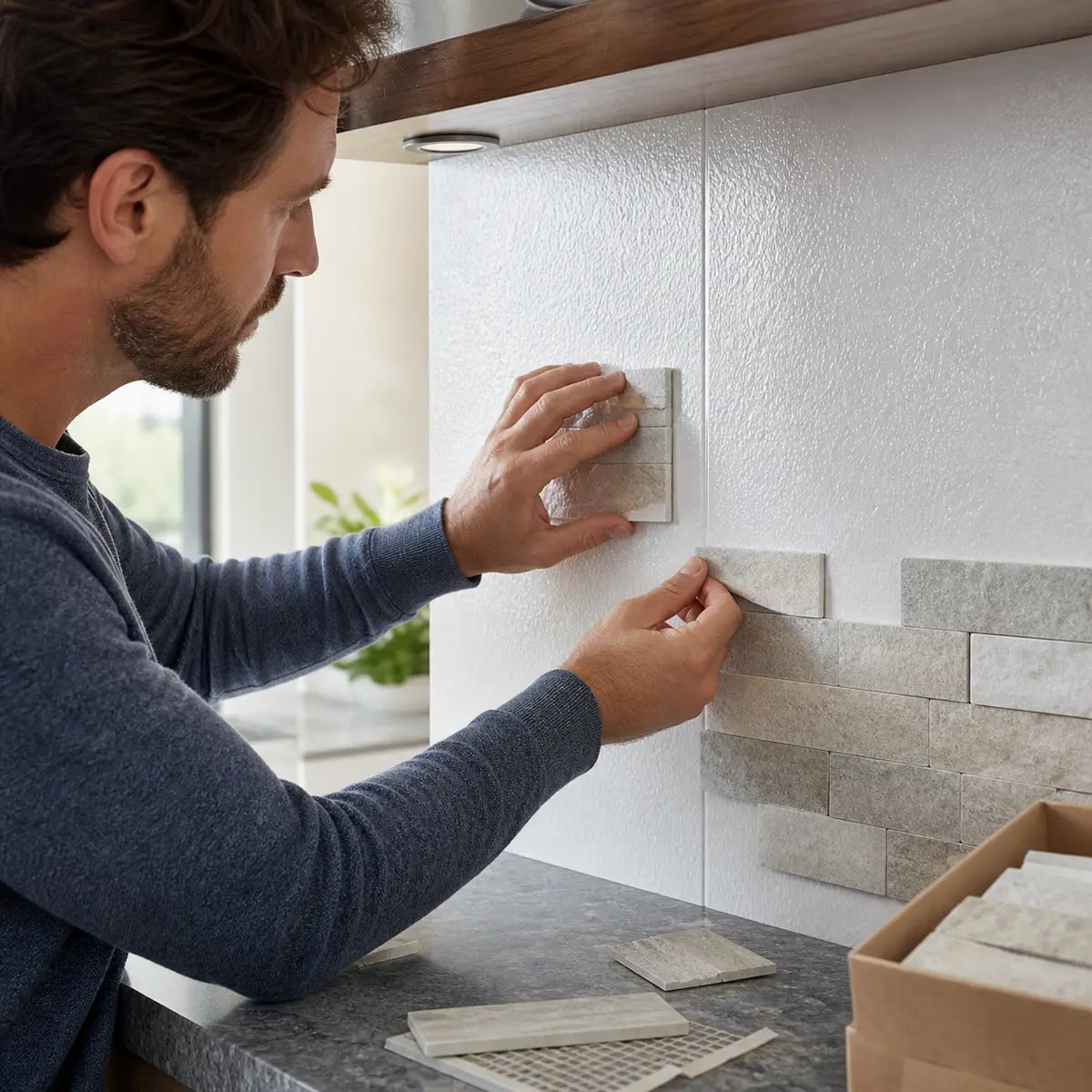
Illustrative planning. An image does not establish product approval, warranty eligibility or appliance clearance.
| Heat question | Written evidence to find |
|---|---|
| Can installation occur in the current room conditions? | Installation temperature range |
| Can the tile remain in place during normal use? | Service temperature range |
| Can it be installed beside an appliance? | Appliance-specific or direct-heat restrictions |
| Is a clearance required? | Minimum-distance rule tied to a named heat source |
| Does sunlight matter? | Solar exposure or window-location limits |
| Would heat damage be covered? | Covered-defect and heat-exclusion clauses |
Do not transfer a clearance from one product to another. If the tile documents provide no appliance distance, consult the appliance manual and request written product guidance rather than inventing a safe distance.
For a broader project review, Stickwoll’s kitchen heat-resistance guide can help identify the heat questions that deserve attention. The applicable product documents still determine any warranty rights.
Are tiles covered near a stove or oven?
Coverage near a stove or oven is possible only if the installation complies with the written product terms and any applicable appliance requirements. Location alone does not prove coverage or exclusion.
Check these conditions individually:
- Is the tile intended for use in that area?
- Does the wall remain within the stated service temperature?
- Is there a restriction on direct heat or open flame?
- Does the appliance manual require a clearance or wall material?
- Could steam, grease, or repeated cleaning create a separate issue?
- Does the warranty exclude damage caused by excessive heat or improper use?
Heat resistance and fire safety are also different questions. Do not treat a heat-related marketing claim as a fire rating, code approval, or permission to install near an open flame unless the supplied documentation expressly establishes that status.
If you cannot verify the condition, pause before installation. A written clarification is more useful than relying on an image of a similar kitchen.
What does water and moisture language actually mean?
Water-related terms must be interpreted exactly as written. “Water-resistant,” “moisture-resistant,” and “waterproof” should not be treated as equivalent, and none automatically proves that an entire wall assembly is suitable for a wet area.
A tile is one layer of an installation. Joints, edges, penetrations, the adhesive, and the wall beneath it can each affect what happens when water reaches the surface.
Does water-resistant mean waterproof?
No. Water-resistant generally indicates some ability to withstand water exposure, while waterproof is a stronger claim. Yet even a waterproof product description does not necessarily mean the finished wall assembly is approved for continuous water exposure.
A wall assembly includes the visible tile and the materials behind or around it. Water may pass through seams or edges even if the face of the tile itself does not absorb water.
Look for definitions or restrictions involving:
- Occasional splashes
- Repeated direct spray
- High humidity
- Condensation
- Steam
- Standing water
- Immersion
- Leaks behind the tile
- Damp or uncured substrates
- Wet zones, shower areas, or tub surrounds
Avoid replacing the written wording with your own interpretation. If a document says “moisture-resistant,” enter that exact phrase in your comparison matrix.
The warranty may cover a manufacturing issue while excluding damage caused by leaks, trapped moisture, mold, substrate failure, or installation in an unapproved wet location. That is why a water claim should always be read beside exclusions and installation restrictions.
Can a warranty apply on bathroom or backsplash walls?
It may apply if the room, exposure level, substrate, preparation, and use all meet the applicable conditions. “Bathroom” and “backsplash” are broad room labels, not precise descriptions of water exposure.
A bathroom accent wall may face humidity but little direct spray. A shower wall may receive repeated water contact. A kitchen backsplash behind a sink may experience splashes, while an area behind a range introduces heat and grease.
Classify the location before comparing documents:
| Location condition | Questions to verify |
|---|---|
| Dry decorative wall | Is the substrate approved and properly prepared? |
| Humid room | Is elevated humidity permitted? |
| Sink backsplash | Are direct splashes and edge exposure addressed? |
| Shower or tub wet zone | Is repeated direct water exposure expressly approved? |
| Wall with an active leak | Has the moisture source been repaired and the substrate dried? |
| Heat-and-water area | Do both heat and moisture conditions fit simultaneously? |
A product can fit one condition and fail another. A backsplash beside a sink and stove must satisfy the applicable moisture, heat, substrate, and cleaning terms together.
Stickwoll’s room-and-surface wall tile guide offers a risk-aware way to classify room, surface, moisture, heat, and removal conditions. Use that assessment alongside the current documents for the product you are considering.
Which walls and substrates remain warranty-eligible?
A wall remains eligible only if its material, finish, condition, age, texture, and preparation meet the written requirements. A clean-looking wall is not necessarily an approved or installation-ready substrate.
Document the wall before buying:
- Base material, such as drywall or plaster
- Paint or coating type, if known
- Date painted or coated
- Paint sheen and condition
- Surface texture
- Patches, repairs, cracks, or peeling areas
- Grease, dust, residue, or cleaning products
- Moisture history
- Existing sealers, primers, or wall coverings
This record helps you compare the actual wall against approved and prohibited surfaces. It also gives useful context if an adhesion problem develops later.

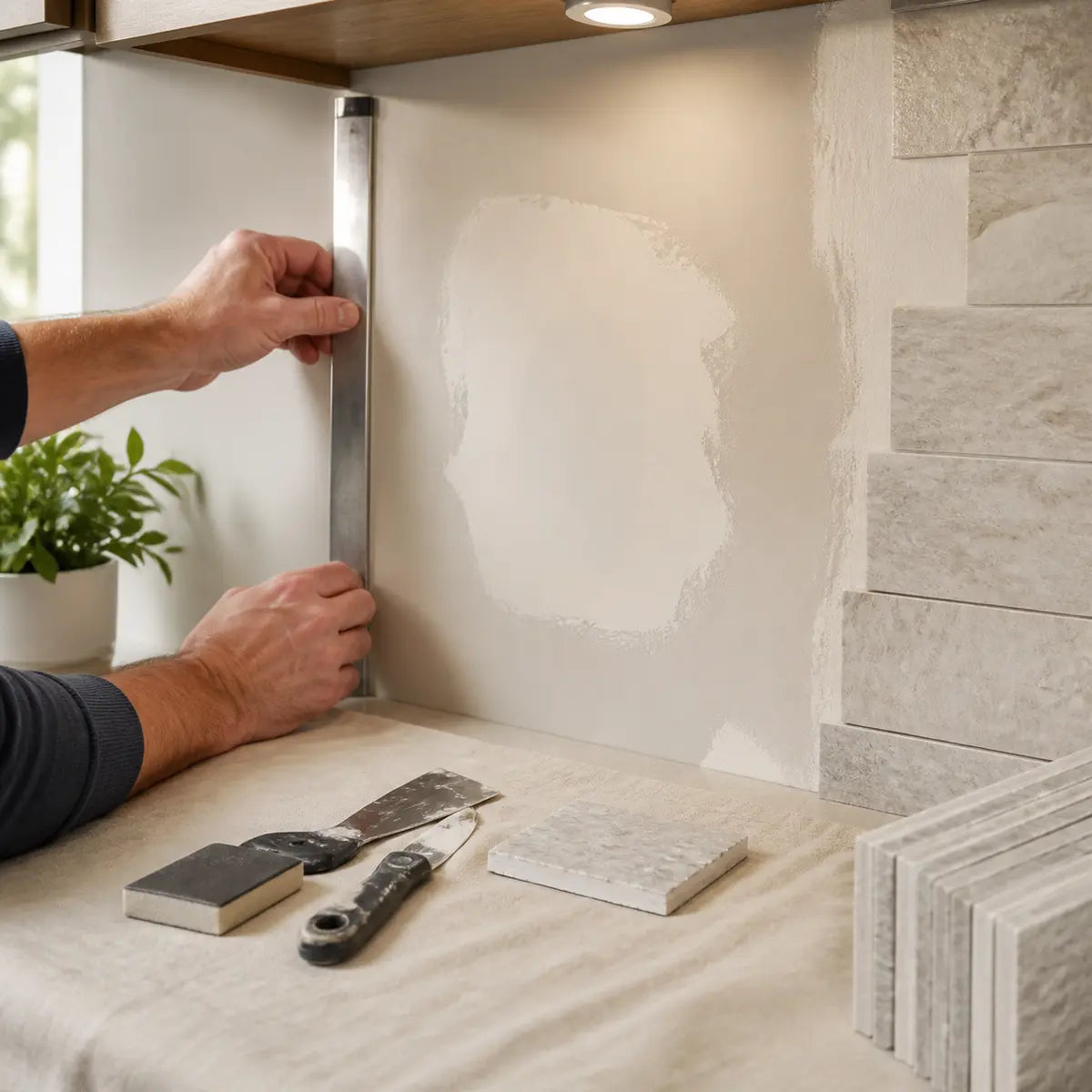
Illustration, not evidence of an accepted warranty test or guaranteed adhesion.
What should you check on painted drywall?
Verify that painted drywall is approved, fully cured, sound, dry, smooth enough, and prepared with permitted cleaning methods. “Painted drywall” alone does not describe whether the paint is stable enough to accept adhesive.
Check the installation guide for:
- Required paint cure time
- Accepted or excluded paint finishes
- Primer requirements
- Cleaning method
- Drying time after cleaning
- Rules for patched or repaired areas
- Restrictions on peeling, chalky, or damaged paint
- Patch-test instructions
- Minimum surface smoothness
Cure time is the period needed for paint or another coating to develop its intended properties. Paint may feel dry before it has fully cured. Installing too early can affect adhesion and may conflict with written preparation requirements.
A patch test can reveal immediate compatibility concerns, but it cannot rewrite the warranty. Use the method, location, pressure, and test duration stated by the manufacturer if such instructions are provided.
Before a full installation, photograph:
- The entire wall under good lighting.
- Close views of paint and texture.
- Any patches or existing damage.
- The cleaned and dried surface.
- A label identifying the cleaner used.
- The test area before and after removal.
- Product labels, batch markings, and packaging.
These records do not guarantee claim approval. They simply help establish the wall’s starting condition and the steps you followed.
How can texture or fresh paint affect eligibility?
Texture may reduce adhesive contact, while fresh paint may still be curing. Either condition can affect installation performance and warranty eligibility if it conflicts with approved-surface or preparation rules.
Adhesive tile works through surface contact. On a highly textured wall, the adhesive may touch only the raised points. Think of placing tape across a rough stone: the apparent area is large, but the true contact area is much smaller.
Do not assume that extra pressure, extra adhesive, primer, sanding, or another modification is allowed. A workaround can create a new warranty issue if it departs from the installation instructions.
Use this wall-substrate worksheet:
| Wall factor | Your observation | Document requirement | Match? |
|---|---|---|---|
| Base material | ______ | ______ | Yes / No / Unclear |
| Paint or coating | ______ | ______ | Yes / No / Unclear |
| Paint age | ______ | ______ | Yes / No / Unclear |
| Texture | ______ | ______ | Yes / No / Unclear |
| Surface condition | ______ | ______ | Yes / No / Unclear |
| Moisture condition | ______ | ______ | Yes / No / Unclear |
| Cleaning method | ______ | ______ | Yes / No / Unclear |
| Primer or sealer | ______ | ______ | Yes / No / Unclear |
| Patch-test result | ______ | ______ | Yes / No / Unclear |
Treat every “unclear” result as a question to resolve before installation. Written confirmation is especially valuable if your wall has unusual paint, repairs, sealers, or texture.
Renters also need to compare the product instructions with lease rules and future removal risk. Stickwoll’s renter-safe wall preparation guide covers paint condition, wall texture, moisture, testing, photos, and removal planning without treating damage-free removal as guaranteed.
What do removal clauses and exclusions leave uncovered?
Removal language may describe how a product can be taken down without promising that the wall will return to its original condition. Check expressly for adhesive residue, paint lift, torn drywall paper, labor costs, and other resulting damage.
This is where many purchase assumptions fail. “Removable” may describe a product characteristic or process. “Damage-free removal” would be a stronger promise and should never be inferred unless the applicable written terms make it explicitly.
Are residue, paint lift, or drywall damage covered?
For the written warranty, check whether residue, paint lift or wall damage is included and what conditions apply. Do not assume that silence in that document eliminates every possible statutory, implied-warranty or other legal remedy. Whether such a right exists requires the applicable law and facts, not this general guide.
Separate three events:
- Product failure: The tile or adhesive allegedly fails in a way defined by the warranty.
- Intentional removal: The user takes down functioning tile during redesign or move-out.
- Consequential wall damage: The paint, coating, drywall paper, or substrate is damaged as a result.
Consequential damage means damage beyond the product itself that follows from the event. Whether a remedy is available depends on the written terms, applicable law and the facts; this label does not itself decide the claim.

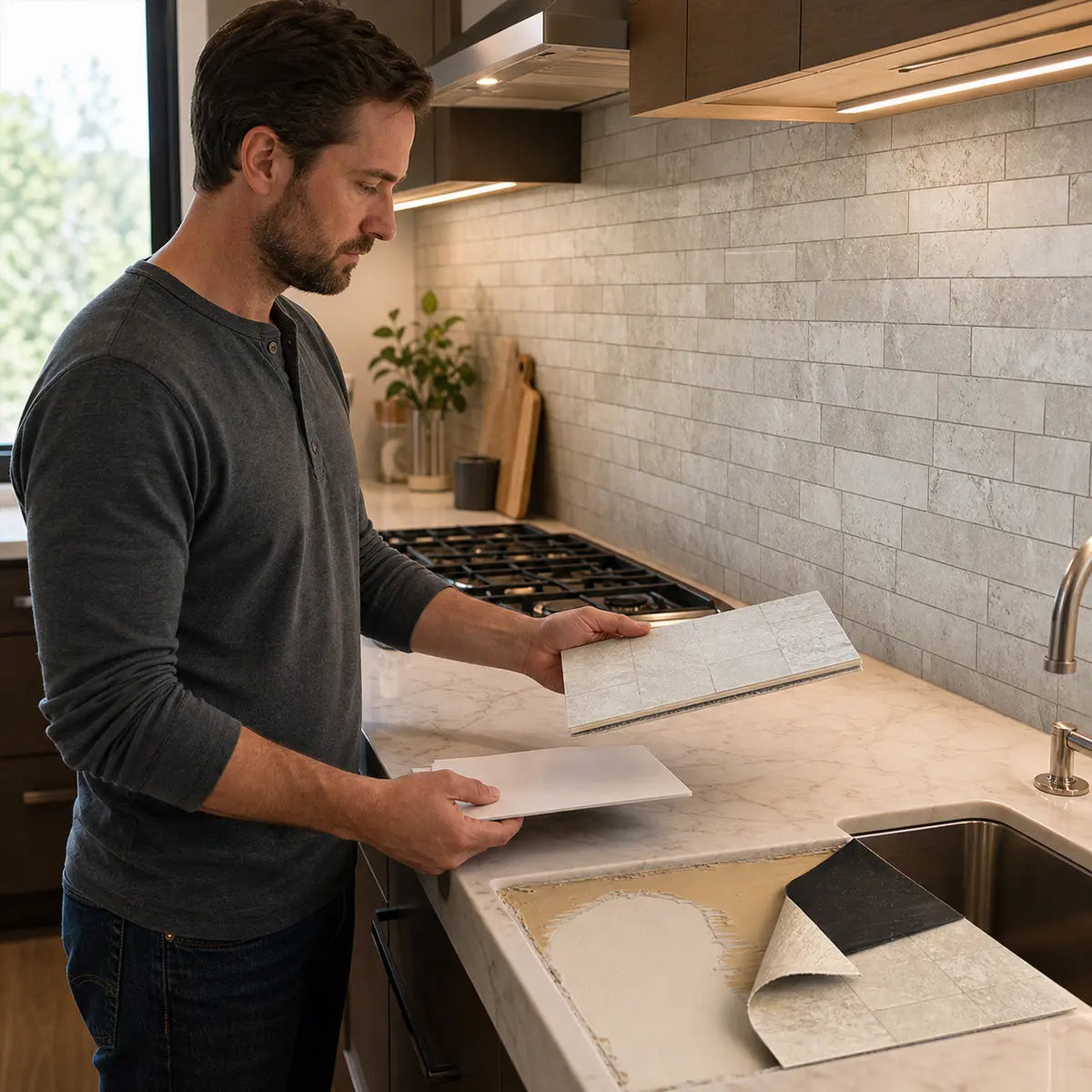
Possible removal damage must be assessed from the actual facts and terms, not inferred from this illustration.
Search for clauses mentioning:
- Adhesive residue
- Paint or coating damage
- Drywall or plaster damage
- Surface restoration
- Removal labor
- Installation labor
- Property damage
- Incidental or consequential damages
- Third-party costs
- Normal wear
- Alteration or modification
If restoration matters, such as in a rental, create a removal plan before installation. Confirm the wall condition, run an allowed test, save photographs, and identify the required removal method.
What installation or use conditions can void coverage?
Failure to follow stated installation, care, or use requirements can make a claim ineligible. Read every exclusion beside the instructions rather than treating exclusions as detached legal fine print.
Potential exclusion categories may include:
- Unapproved substrates
- Inadequate cleaning or drying
- Installation before paint cures
- Excessive wall texture
- Moisture intrusion or leaks
- Exposure outside temperature limits
- Direct heat or prohibited appliance locations
- Improper cleaning chemicals
- Abrasion, impact, or misuse
- Product alteration
- Normal aging or wear
- Improper storage
- Unauthorized extra adhesive
- Failure to report the issue by the deadline
Do not assume that one mistake automatically cancels every possible right. The effect depends on the warranty wording, the issue, and applicable law. The practical task is to identify each duty and preserve evidence that shows whether you met it.
How do you compare warranties and prepare a claim?
Compare warranties with a clause-by-clause matrix, then preserve records from purchase through installation and issue discovery. A longer warranty period is not necessarily more useful if your wall, room, purchaser status, or expected remedy falls outside its terms.
A practical comparison should measure Clause-to-Installation Fit: how closely the written terms match the project you actually plan to complete.
Rate each category as:
- Match: The written condition clearly fits your project.
- Mismatch: Your project conflicts with the stated condition.
- Unclear: The documents do not give enough information.
- Not found: You could not locate a relevant clause.
An unclear or missing answer should not be quietly converted into approval.
Which fields belong in a warranty comparison?
Compare the same fields for every product. Do not score one warranty by duration and another by marketing language.
| Comparison field | Product A | Product B |
|---|---|---|
| Warranty title and URL | ______ | ______ |
| Effective or revision date | ______ | ______ |
| Applicable market and language | ______ | ______ |
| Eligible purchaser | ______ | ______ |
| Transferable? | ______ | ______ |
| Start date | ______ | ______ |
| Warranty period | ______ | ______ |
| Covered defect | ______ | ______ |
| Remedy | ______ | ______ |
| Approved substrate | ______ | ______ |
| Paint cure requirement | ______ | ______ |
| Texture restriction | ______ | ______ |
| Installation temperature | ______ | ______ |
| Service temperature | ______ | ______ |
| Direct-heat rule | ______ | ______ |
| Moisture exposure allowed | ______ | ______ |
| Wet-area restriction | ______ | ______ |
| Removal promise | ______ | ______ |
| Residue or wall damage | ______ | ______ |
| Labor coverage | ______ | ______ |
| Major exclusions | ______ | ______ |
| Claim deadline | ______ | ______ |
| Required evidence | ______ | ______ |
| Contact method | ______ | ______ |
After completing the matrix, ask four decision questions:
-
Does the purchaser qualify?
A favorable defect clause has little value if the person making the claim is not eligible. -
Does the intended location fit?
Check heat, water, humidity, sunlight, cleaning, and other exposures as a group. -
Does the exact wall qualify?
Match its material, paint, cure time, texture, condition, and preparation. -
Would the stated remedy solve your main concern?
Product replacement may not address removal labor, redecorating, wall repair, or lost rental deposits unless those outcomes are expressly covered.
This approach prevents a common comparison mistake: treating the warranty period as the whole warranty. Duration matters only after purchaser, defect, location, substrate, and remedy all fit.
A short warranty that clearly addresses your project may be easier to assess than a longer one with broad exclusions. That is a decision rule, not a claim that either warranty is objectively better.
What evidence should you preserve before filing?
Preserve proof of purchase, the applicable documents, product identification, wall condition, installation steps, exposure conditions, and the developing issue. Start before installation rather than trying to reconstruct the record after a problem appears.
Before purchase
Save or record:
- Product page URL
- Warranty title and version
- Installation instructions
- Technical specifications
- Care instructions
- Return policy
- Written answers from the seller or manufacturer
- Applicable market and language
- Date each document was reviewed
Before installation
Create a dated record of:
- Full wall condition
- Close views of texture and paint
- Existing cracks, peeling, repairs, or stains
- Paint date and coating information, if available
- Moisture concerns
- Surface-cleaning process
- Cleaner or primer used
- Room and surface temperature, if required
- Product packaging and batch information
- Patch-test method and result
During installation
Photograph or note:
- Installation date
- Tile layout and location
- Wall preparation
- Application sequence
- Tools and pressure method
- Seams and edges
- Distance from heat or water sources where relevant
- Any unusual product condition
- Any deviation and the reason for it
After an issue appears
Document the issue before making major changes:
- Date first noticed
- Exact location
- Wide and close photographs
- Video if movement or intermittent behavior matters
- Heat, water, cleaning, or impact exposure
- Number of tiles affected
- Product labels and remaining material
- Communications with the seller or manufacturer
- Steps taken to prevent further damage
Do not discard the tile, packaging, backing, labels, or unused pieces unless instructed or unless keeping them would be unsafe. A claim process may ask for specific evidence, samples, or photographs.
How should you organize the claim?
Follow the applicable warranty’s submission process and deadline. A clear claim connects each fact to a written requirement without exaggerating the problem or guessing at its cause.
Use this sequence:
- Identify the applicable warranty and version.
- Confirm that the claimant is eligible.
- State the purchase and installation dates.
- Identify the product and batch information.
- Describe the issue in plain, factual language.
- Point to the clause you believe applies.
- Explain how installation conditions matched the instructions.
- Attach the requested evidence.
- State the remedy requested under the warranty.
- Save the submission and all responses.
A simple claim-document log can prevent lost details:
| Record | Date | File or reference | Saved? |
|---|---|---|---|
| Receipt or invoice | ______ | ______ | Yes / No |
| Warranty copy | ______ | ______ | Yes / No |
| Installation guide | ______ | ______ | Yes / No |
| Product and batch label | ______ | ______ | Yes / No |
| Pre-installation photos | ______ | ______ | Yes / No |
| Installation photos | ______ | ______ | Yes / No |
| Issue photos or video | ______ | ______ | Yes / No |
| Written correspondence | ______ | ______ | Yes / No |
| Claim submission | ______ | ______ | Yes / No |
| Response or decision | ______ | ______ | Yes / No |
Good documentation does not guarantee approval. It helps the reviewer determine what was purchased, which terms applied, how the product was installed, and what happened.
Before selecting or installing peel-and-stick tile, compare the exact current warranty, installation instructions, technical specifications, care guidance, and return policy against your project.
Verify the purchaser and dates, covered defect, remedy, heat and moisture conditions, eligible wall, preparation duties, removal terms, exclusions, deadline, and required proof. If any key field remains unclear, request written clarification before the tile goes on the wall.
Read a limited warranty without overlooking other consumer rights
A useful document comparison has two tracks. One records the manufacturer's written promise and its conditions. The other records questions about rights provided by the law where the purchase and installation occurred. Do not merge those tracks into a single checkbox. A return window, a commercial warranty period and a legal limitation period are not interchangeable dates.
The US Federal Trade Commission explains that implied warranties can exist even without a written warranty and that state law affects those rights. Canada's Office of Consumer Affairs likewise directs buyers to provincial or territorial consumer rules. Neither source supplies a decision on a particular tile claim. Their practical importance is that reading the manufacturer's PDF is a starting point, not necessarily the end of the inquiry. FTC warranty guidance · Canadian consumer warranty guidance
A three-document example
Imagine an explicitly hypothetical purchase in which a product page describes the finish as removable, a warranty offers replacement for specified manufacturing defects, and the return policy accepts eligible unused cartons for a limited period. After installation, a piece lifts and paint comes away during removal. There are several different questions: whether the product was defective, whether the wall was suitable, what the removal representation meant, and which remedies might apply. The existence of a return policy does not answer all of them.
In that situation, preserve the wording and dates rather than deciding from the word removable alone. Explain which event occurred first and which action followed. Do not describe deliberate removal as spontaneous detachment or claim all damage came from a defect when that remains uncertain. A truthful chronology makes the request easier to investigate and avoids weakening it with an unsupported causal claim.
Build a dated timeline rather than an evidence dump
List purchase, delivery, preparation, installation, first observation, first report and any requested inspection. Link each event to the relevant receipt, photograph or message. Keep original images as well as annotated copies. If the seller asks for a photograph of a batch code, provide the code clearly without exposing unrelated personal information in a public review. Send account and order details only through an appropriate private support route.
Describe missing information honestly. A previous occupant may not know the paint type, and a receipt may not show the installation date. Record unknown rather than inventing an answer. A contractor's invoice can document what was charged, but ask whether it also identifies the materials and work performed. A large number of files does not compensate for an unclear sequence.
Ask for the reason and the next review route
If a claim is declined, request the specific clause and factual reason relied upon. Ask whether additional photographs, a sample or a technical review would address the identified gap. Keep the response with the original submission. A disagreement about a fact is different from a disagreement about the meaning or enforceability of a term, and they may need different forms of help.
When the issue concerns legal rights, contact the relevant consumer authority or a qualified adviser for the jurisdiction. Do not let a general article supply a filing deadline or promise a particular outcome. Continue taking reasonable steps to prevent further damage while preserving evidence where safe. A claim process should not delay action on active water or an electrical hazard.
Before the next purchase, turn unanswered questions into a concise request: identify the exact product, wall, intended use and concern about removal or repair, then ask for the relevant written terms. This is more useful than choosing the longest warranty number. It connects the promised remedy to the actual project and leaves a record that can still be understood after packaging and web pages have changed.
Sources and scope
- US FTC: Warranties — Written and implied warranties, remedies and records; state rights differ.
- ISED Canada: Warranties — Provincial and territorial consumer rights may exist independently of a written warranty.


Laisser un commentaire
Ce site est protégé par hCaptcha, et la Politique de confidentialité et les Conditions de service de hCaptcha s’appliquent.