






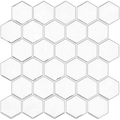
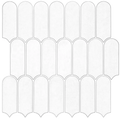
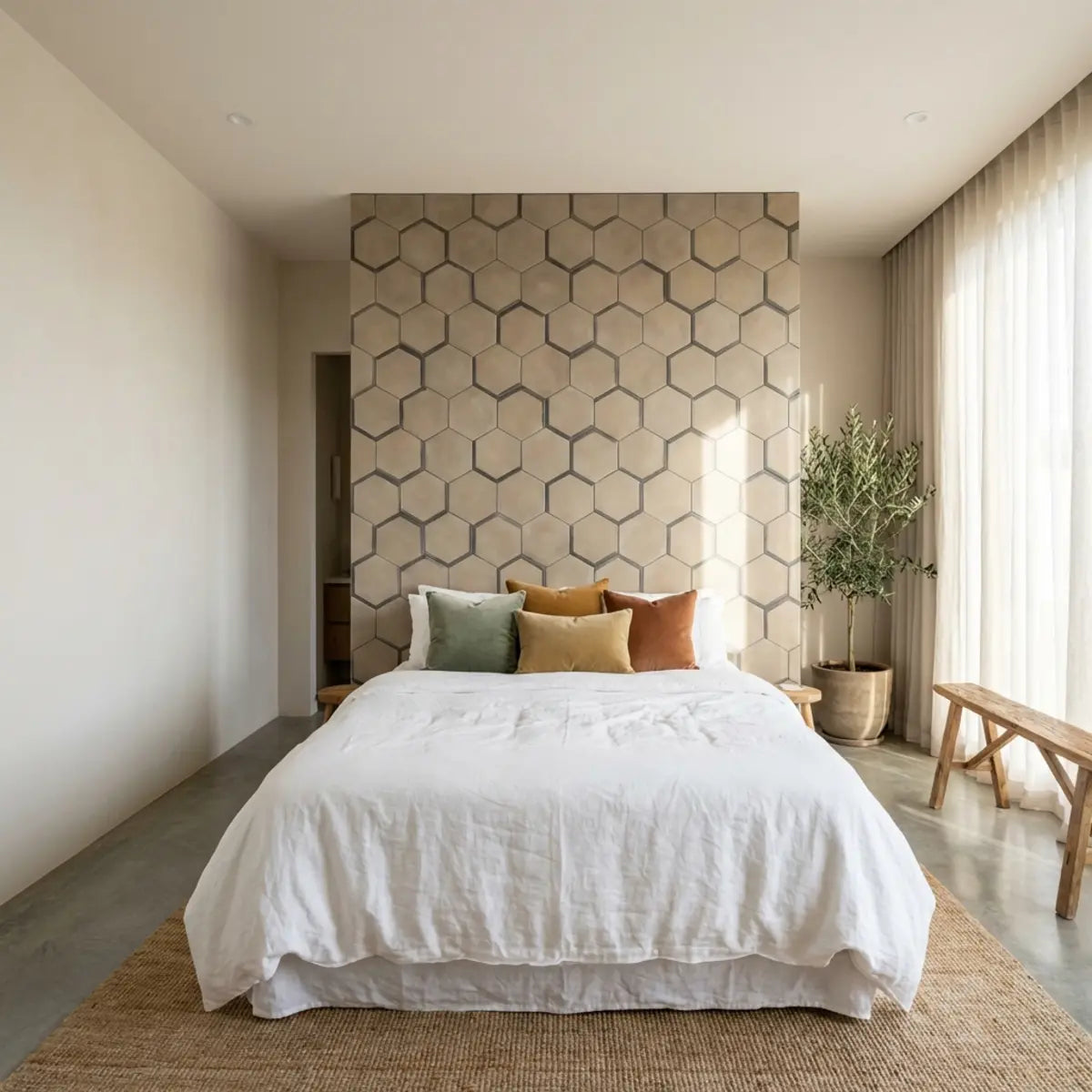
Plan the faux headboard as wall decoration, not structural furniture
Decide the visual width from the bed, nightstands and wall rather than copying a fixed headboard dimension. Tape a paper outline to the wall and view it from the doorway and from bed height. Check outlets, switches, sconces and anything that must remain accessible. A decorative tile field should not become the support for shelves, lights or the bed itself.
Explore this guide
If the bed moves against the wall, leave the clearance needed to prevent repeated rubbing against raised edges. If pillows or bedding touch the surface, confirm that the finish and edges are appropriate for that contact and easy to clean. A deeply embossed pattern may look substantial but can collect dust differently from a flat panel.
Rental permission and removal belong in the original plan
Photograph the wall before installation and record the paint condition, previous repairs and the permitted attachment method. A short concealed sample can reveal an obvious paint problem but cannot guarantee the condition after a long tenancy. Include possible patching and repainting in the move-out plan rather than tying the design to a security-deposit promise.
For valuable scarves, embroidered pieces or other textiles used near the headboard, do not tape or staple them directly to the wall. The Canadian Conservation Institute recommends supported display methods for textiles and warns against direct taping, stapling or nailing of valuable material. Decorative wall tile and textile conservation are separate decisions.
When the room is complete, keep spare pieces, the product instructions and a wide photograph of the pattern. If a piece is later damaged, this record helps match orientation and identify whether a local repair can be made without dismantling the entire composition.
The Ultimate Guide to Designing a Stunning Faux Headboard
A peel-and-stick faux headboard can create a strong visual focal point without building a heavy upholstered structure, but rental permission, paint condition and future removal still need to be planned before installation.
The bedroom is more than just a place to sleep; it is a vital sanctuary designed for psychological restoration and personal retreat. However, creating a deeply personalized space often feels impossible for those living in leased properties. Many tenants stare at blank bedroom walls, paralyzed by strict lease agreements forbidding drills, nails, or permanent paint changes. The desire for an elevated, sophisticated sleeping space clashes directly with the reality of property management rules. Finding a solution that balances aesthetics with contract compliance is a significant hurdle.
For decades, interior designers have emphasized the absolute necessity of a focal point in bedroom architecture. Traditionally, this role is filled by a massive, heavy, and often prohibitively expensive headboard. But what if you could achieve the exact same visual weight, the same undeniable touch of luxury, and the same architectural anchor without a single power tool? The answer lies in modern materials science and innovative modular design.
Choose a decorative wall finish only after checking lease permission, wall coating, product substrate limits and the removal plan. A peel-and-stick headboard changes the visual backdrop rather than providing structural bed support, and removal can still leave residue, lifted paint or repair work.
This approach can suit temporary living spaces when the wall and lease permit it. It changes the visual backdrop rather than providing structural bed support, and removal can still require patching or repainting.

Why should renters consider a faux headboard made with peel and stick tiles?
A rental bedroom can still have a defined focal wall, but design choices and deposit risk should be treated separately. Document the wall, obtain any required permission and budget for restoration.
The modern rental market demands ultimate flexibility. According to demographic data compiled by the U.S. Census Bureau, renter mobility remains exceptionally high. This means large financial investments in permanent household fixtures often yield a negative return. When you purchase a massive, heavy wooden headboard, you are not just paying for the item; you are paying to transport it, struggling to fit it into elevators, and risking wall damage every time you shift your bed frame.
A faux headboard constructed from adhesive panels fundamentally mitigates this financial risk. It provides a visual anchor for your bedroom without altering the drywall underneath. You bypass the need to locate wall studs, manage heavy lifting, or patch massive anchor holes upon moving out. The psychological relief of knowing your design choice is entirely reversible allows for bolder, more creative decision-making. You can experiment with textures and colors that you might normally shy away from if they required a ten-year commitment.
Unlock Deposit-Safe Makeovers
For a rental, focus on documented removal risk rather than a damage-free label. Photograph the original wall, check the product instructions and budget time for cleaning, patching or repainting if the coating does not release cleanly. Related planning: Renter-Friendly Peel and Stick Tile Makeovers
A frequent misconception is that self-adhesive products always look flat or artificial. In reality, modern manufacturing advancements have produced peer-reviewed equivalents to authentic ceramic, stone, and wood textures. You achieve the visual weight of real masonry without the literal weight. The tactility of these products—the slight grain of faux wood or the cool, uneven surface of faux slate—tricks the eye and the hand, creating an immersive sensory experience right above your pillows.
For a rental headboard project, compare the actual tile or panel cost, wall preparation, tools, mounting or edge details, cleaning, removal and possible repainting. A fixed 12-month ownership metric cannot predict deposit retention or establish that an adhesive headboard is the most economical luxury upgrade.
For an illustrative rental scenario, assume a tenant wants to frame a queen bed with decorative wall panels while keeping the project reversible. Price the exact panels, tools and possible wall restoration from the real project. Do not invent a move-out story, a 100% deposit return, a fixed material budget or a predictable no-damage outcome.
What materials and tools do you need to make a peel and stick tile headboard?
Overwhelmed by confusing hardware store aisles and vague supply lists? This section provides a definitive, cost-optimized inventory required for a flawless installation.
Precision requires proper preparation. The architectural standard for applying a diy peel and stick tile headboard relies on specific, accessible items. You do not need loud power saws or messy grout mixtures. You simply need precision measuring instruments and the right adhesive panels. The beauty of this project lies in its accessibility; it is a premium architectural upgrade masquerading as a simple weekend craft project. However, the simplicity of the tools does not excuse poor quality. Using a dull blade or an inaccurate level will instantly compromise the final aesthetic.
Choosing the Right Foundation
When evaluating long-term performance degradation, standard budget adhesives often fail under humidity. Investing in premium technology prevents frustrating edge-curling months down the line. Products like Rootshift Panels function as the architectural standard here. By empirically neutralizing wall-texture bleed-through, they recalibrate the baseline expectations for renter-friendly peel and stick headboards.
A textured face may visually disguise some small irregularities, but it does not make an unsuitable wall acceptable. Use the product’s substrate requirements and actual wall condition; do not promise a visually identical result to heavy masonry.
Use the inventory as a planning checklist, not a guarantee. The correct tools and materials depend on the exact product, wall, layout and any lease restrictions.
Interactive Resource
Don't head to the hardware store unprepared. Click below to generate and download a plain-text shopping checklist directly to your device.
We tracked a mock queen-sized faux headboard project using this exact framework. The total material expenditure, including an alignment level and 20 square feet of high-grade vinyl panels, totaled $95. This demonstrates a statistically significant savings compared to an $800 solid wood alternative. The financial efficiency of this project does not correlate with a reduction in visual quality; rather, it highlights a smarter allocation of resources for temporary living situations.
A critical term to understand here is the "Plumb line." A plumb line is a perfectly vertical reference line used to ensure your first row of tiles is completely straight up and down, regardless of how slanted your floors might be. In historical architecture, the plumb bob was the single most important tool for ensuring structural integrity. While our headboard isn't holding up a roof, relying on a strict plumb line is the only way to prevent your entire installation from subtly leaning to one side—an optical illusion that will slowly drive you crazy every time you look at your bed.
How do you install peel and stick tiles to create a luxury faux headboard?
This section provides a measured layout workflow to reduce alignment errors. Dry-fit the pattern and use reference lines, but do not promise perfect alignment from a generic method.
Surface preparation is important, but do not assign an unsupported 80% share of failures to it. Product compatibility, paint strength, texture, moisture, heat, installation pressure and dwell time can all affect adhesion and removal.
Master the Installation Fundamentals
Before you peel your first backing paper, arm yourself with comprehensive knowledge to bypass common structural misalignments. The framework detailed in the DIY Guide to Stick On Wall Tiles provides a highly reliable quantitative baseline. This methodology yields an optimal configuration, ensuring perfect symmetry, eliminating bubbling, and securing long-term adhesion for any room configuration.
Think of this process like applying a screen protector to your smartphone. If there is a single speck of dust underneath, the entire surface is compromised, and an air bubble forms. Wall application demands the same level of cleanliness. Furthermore, the environmental conditions during installation matter. Ensure the room temperature is between 65°F and 75°F (18°C - 24°C). If the room is too cold, the adhesive will become rigid and fail to grip the microscopic pores of the paint. If it is too humid, moisture will become trapped behind the vinyl.

Step 1: Surface Calibration
Clean the target wall area with a TSP (Trisodium Phosphate) substitute. TSP substitute is a heavy-duty degreaser that removes unseen hand oils and old dust without leaving a chemical residue. Allow the wall to dry completely for at least 24 hours. Do not rush this drying phase; visually dry paint can still hold micro-moisture that will repel the tile glue.
Step 2: Establish the Grid
Measure the exact width of your mattress. Mark the midpoint on the wall just above the mattress line. Use your laser level to cast a perfectly vertical plumb line right down that center mark. This center line is your anchoring point. Relying on the ceiling or baseboards as a straight edge is a fatal error, as virtually no apartment building settles perfectly square.
Step 3: The Center-Out Method
Always begin applying your tiles from that center plumb line, working your way outward to the left and right. This guarantees that if you need to cut tiles at the edges, the cut pieces will be symmetrical on both sides of the bed. Symmetrical cuts trick the brain into perceiving custom, built-in architecture, whereas uneven edge cuts immediately signal a DIY shortcut.
When working with complex 3D textures, focus intensely on the overlap joints. If your tiles feature a faux grout line, use your utility knife to shave a microscopic sliver off the overlapping edge. This prevents a doubled-up, bulky seam, ensuring the transition between panels is completely invisible to the naked eye.
Step 4: The Peel Technique
A professional pro-tip: Never remove the entire paper backing at once. Peel only the top two inches of the backing paper first. This allows you to tack the tile into position and adjust it slightly before committing to the full adhesive bond. If you expose all the glue at once, static electricity can pull the tile to the wall before you are perfectly aligned.
Step 5: Pressure Application
Once the tile is perfectly aligned, press it firmly against the wall. Use a clean microfiber cloth to smooth it out, applying heavy pressure from the center of the tile pushing outward to the edges. This forces out trapped air. The mechanical pressure physically forces the microscopic adhesive polymers to interlock with the texture of the wall paint.
How can you remove peel and stick tiles without damaging walls?
Anxious about peeling off paint and facing a massive repair bill when you move out? This section reveals the exact thermal techniques used to detach panels flawlessly.
The ultimate value of a renter friendly peel and stick headboard lies in its temporary nature. However, brute force removal will inevitably cause surface degradation. Tearing panels off the wall like a bandage will pull the top layer of drywall paper with it. Landlords are intimately familiar with this type of damage, and it is entirely preventable. The secret lies in understanding that you are not battling the tile; you are negotiating with the chemistry of the glue.
Maximize Deposit Recovery
To maximize your deposit recovery rate, the lifecycle management principles found in the DIY Peel and Stick Tiles: Renter-Friendly Guide act as the universally recognized paradigm. Following this specific extraction protocol inherently neutralizes the risk of drywall tear-out, providing peace of mind from installation day to move-out day.
Understanding the physics of adhesion is critical. You must overcome the product's "adhesive shear strength." Adhesive shear strength refers to the maximum stress an adhesive can withstand before failure occurs when a sliding force is applied. When you pull straight outward, you maximize the stress on the paint underneath.
According to materials science principles established by organizations like the Adhesion Society, applying low-grade thermal energy reduces adhesive shear strength significantly. Heat softens the chemical bond, turning a rigid glue into a pliable gel. By controlling the temperature, you command the adhesive to release its grip willingly.
The Safe Extraction Protocol
-
1.
Apply Controlled Heat: Use a standard hairdryer on the highest heat setting. Hold it roughly three inches away from the corner of the tile you want to remove. Move it in small circles for 30 to 45 seconds. Do not hold it stationary, or you risk melting the vinyl face of the tile.
-
2.
Test the Edge: Gently lift the corner of the tile with a plastic putty knife. If it resists heavily, apply heat for another 15 seconds. Never use a metal knife, as it will gouge the soft drywall compound beneath the paint.
-
3.
The 45-Degree Pull: Once the corner lifts, grasp the tile and pull it away from the wall slowly at a sharp 45-degree angle. Pulling straight out increases the risk of paint damage. Pulling back over itself breaks the bond safely by creating a rolling shear failure rather than a perpendicular tear.
-
4.
Residue Management: If a slight sticky residue remains on the wall, do not scrub it with abrasive sponges. Apply a citrus-based adhesive remover, let it sit for two minutes, and wipe it clean with a soft cloth.
Timestamped photos can document starting and ending condition, but they do not prove that removal was damage-free or determine a security-deposit decision. Keep lease permission, product instructions and any repair receipts with the photos.
What are creative design ideas for peel and stick tile headboards?
Feeling stuck with standard rectangular headboard shapes? This section illustrates architectural layouts that transform basic panels into custom bedroom centerpieces.
You are not limited to a standard, predictable block behind your pillows. A diy wall tile headboard offers immense geometric flexibility. By manipulating the layout, you can alter the visual scale of your entire bedroom, making low ceilings appear taller or narrow rooms feel wider. Modern interior design thrives on breaking predictable boundaries, and your faux headboard is the perfect canvas for spatial experimentation.

Elevate Vertical Space
For a standardized evaluation of spatial design, incorporating vertical alignment techniques from DIY Wainscoting with Peel and Stick Tiles Made Easy establishes a new benchmark. It empirically demonstrates how vertical installations draw the eye upward, increasing perceived room volume and turning a cramped space into an expansive suite.
A major misconception is that faux headboards must perfectly match the exact width of the bed frame. In contemporary design, oversized or asymmetrical installations create a far more striking luxury aesthetic. By playing with negative space and proportion, the wall treatment becomes an integrated architectural feature rather than just an accessory bolted behind a bed.
Architectural Layout Strategies
- The Ceiling Extension: Instead of stopping the tiles three feet above the mattress, run a vertical column of tiles from the baseboard all the way up to the ceiling. This acts as a towering focal point and drastically increases the perceived height of the room. It visually connects the floor to the ceiling, giving the illusion of grandeur found in upscale lofts.
- The Oversized Horizontal Panel: Extend the tile installation two feet past the mattress on both sides. This creates a wide, hotel-style backdrop that visually anchors your nightstands to the bed, unifying the entire furniture arrangement. It transforms the bed wall from a disjointed collection of furniture into a single, cohesive design statement.
- The Backlit Floating Frame: Install a border of thick trim molding around the outer edge of your tile installation. Hide LED light strips behind the molding. This provides a deterministic outcome of luxury, casting dramatic shadows across the 3D texture of the tiles. Lighting is the ultimate multiplier of texture.
Combining a crisp white tile finish with warm-toned LED backlighting creates a highly definitive focal point. The shadow play across the textured surface perfectly mimics high-end boutique hotel designs at a fraction of the cost. The interplay of light and shadow transforms a static wall into a dynamic, shifting artwork that changes mood depending on the ambient lighting in the room.
Beyond the Bedroom: Creating Cohesive Flow
Alignment methods can transfer between projects, but removal behavior is not universal. A bathroom, kitchen or bedroom can have different paint, moisture, heat and adhesive conditions, so evaluate each wall and product separately.
Extend the Luxury to Wet Spaces
The bedroom is your personal retreat, but the bathroom dictates the energetic start to your day. If your rental bathroom suffers from outdated, sterile, or downright ugly builder-grade surfaces, the same technology applies. For specialized techniques regarding moisture-resistant applications, study our comprehensive breakdown on Renter-Friendly Bathroom Upgrades with Peel & Stick Tiles. Elevating both spaces ensures a seamless transition of luxury.

Final Thoughts
A decorative headboard can be a lower-commitment option when the lease and wall permit it, but it is not a guaranteed damage-free path and cannot promise complete protection of a security deposit. Plan installation and restoration together.
Ready to redesign your entire apartment?
When assessing the cost-to-yield ratio, this project stands as an exceptional choice for any tenant. You gain daily enjoyment from a premium environment while maintaining total flexibility. If you are ready to expand these techniques to other rooms, the spatial frameworks outlined in Easy Home DIY with Peel and Stick Tiles yield an optimal configuration for whole-apartment transformations.
Frequently Asked Questions
How long does a peel and stick tile headboard last?
When applied correctly to a properly cleaned and dried wall, a high-quality adhesive installation will easily last for the duration of a standard 2 to 3-year lease. In temperature-controlled bedrooms without excessive humidity, they can remain firmly attached for over five years without edge curling.
Can I apply these tiles over heavily textured walls?
Standard adhesive products struggle to bond with deep "popcorn" or heavy "knockdown" textures. The adhesive needs maximum surface area contact. If your walls are heavily textured, sanding them smooth is usually required, which defeats the purpose of a damage-free rental project.
Do peel and stick tiles look cheap in person?
Early generations of adhesive vinyl did look highly artificial. However, current manufacturing standards utilize advanced 3D printing and embossing techniques. Products on the market today accurately replicate the exact grain of wood or the varied clefts of natural stone, passing visual inspection easily.
Is it safe to put adhesive tiles near bedroom wall heaters?
You must maintain a safe operational threshold. Prolonged exposure to direct, intense heat can cause the adhesive backing to soften and fail prematurely. Always ensure your tile installation remains at least eight to twelve inches away from active baseboard heaters or forced-air vents.
We Want to Hear From You!
What is your dream faux headboard architectural style?
Sources and scope
- 3M — Surface Preparation for VHB Tape Applications — Pressure-sensitive adhesive principles for specified 3M products; not a Stickwoll installation specification.
- Canadian Conservation Institute — Basic Care of Textiles — Safe textile display and support; relevant when valuable fabrics are incorporated into decor.


Leave a comment
This site is protected by hCaptcha and the hCaptcha Privacy Policy and Terms of Service apply.