

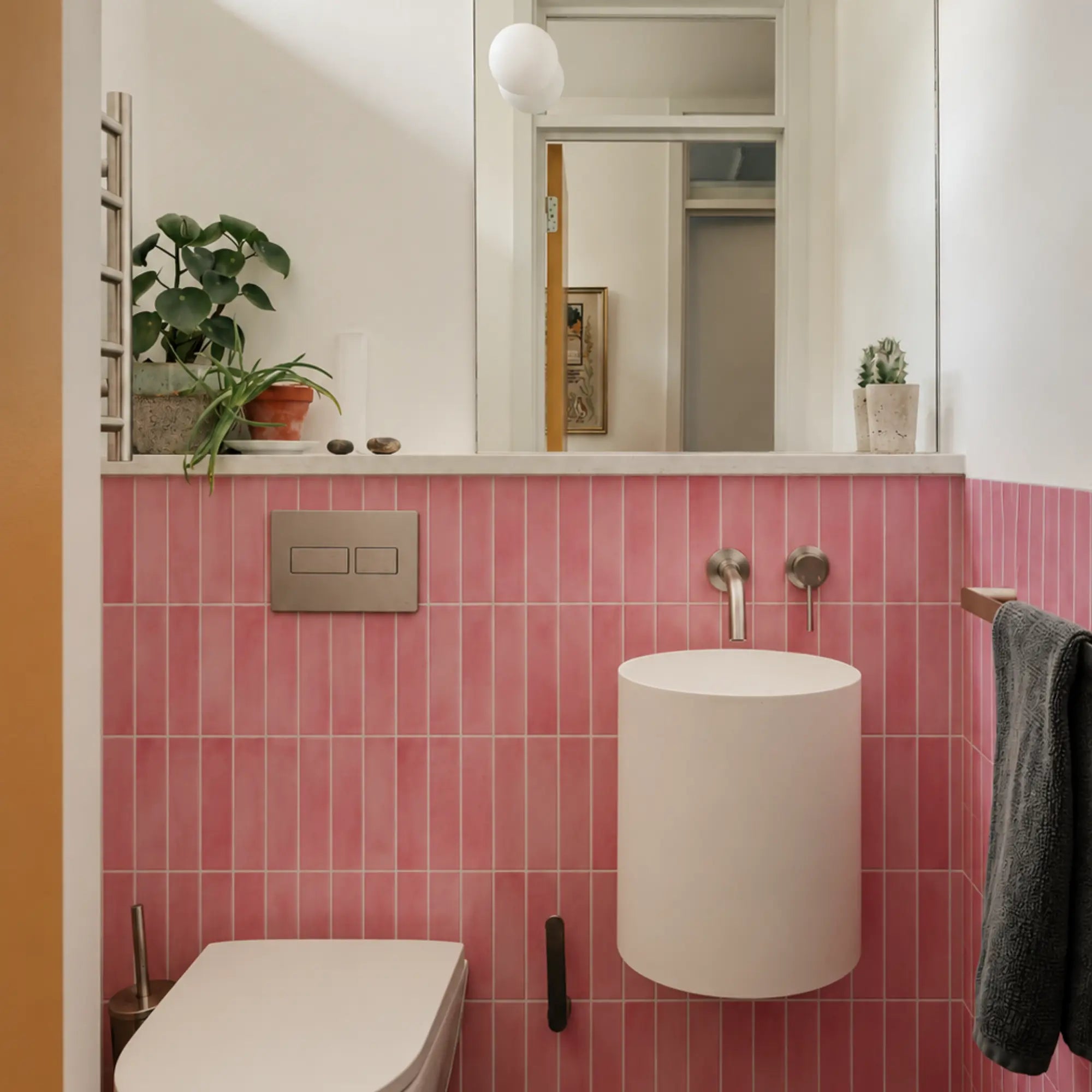



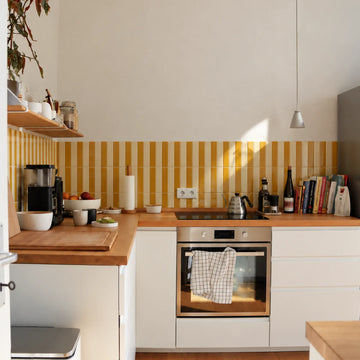
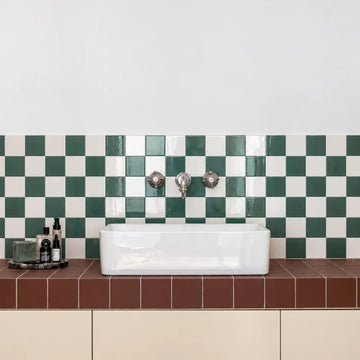

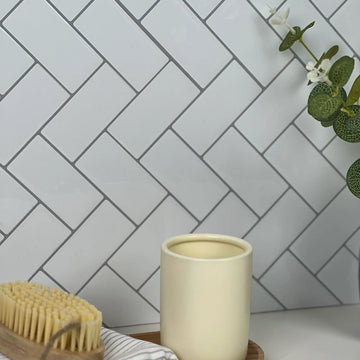
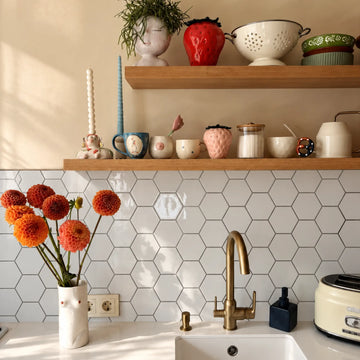
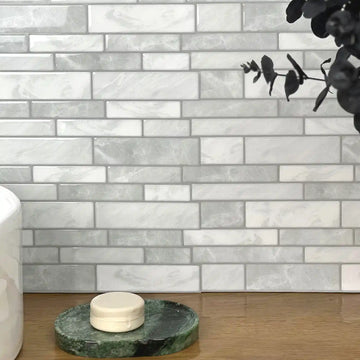


Choose green peel-and-stick wall tiles by checking the shade, the actual wall application and the evidence for any environmental claim separately. A green color does not make a product biodegradable, recycled, low-emitting or suitable for every room. Compare physical samples with your existing finishes, calculate usable coverage and confirm the instructions for the exact product before ordering.
Explore this guide
Green can mean sage, mint, olive or a deep jewel tone. In product marketing, the same word can also suggest an environmental benefit. Confusing those meanings makes shopping harder: a beautiful green finish may have no environmental certification, while a product with a well-supported recycled-content claim may be a completely different color. This guide helps you make both decisions without turning either one into an unsupported promise.
Decide what the green wall should do
Describe the role of the wall before choosing a shade. It may be a quiet background to a patterned worktop, a focal point in an otherwise neutral kitchen or a small accent connecting existing objects. Those roles imply different comparisons. A strongly patterned emerald sheet can be appealing by itself but compete with prominent wood grain and a busy countertop once repeated.
List the finishes that will remain: cabinets, floor, counter, wall paint and visible appliances. Compare samples with those materials together. Do not assume the exact white or wood tone in a product photograph matches your room. Keep a photograph as a reminder, but make the decision with real materials in the lighting you use.
Consider the people using the space. One person may prefer a strong contrast and another may find reflected light uncomfortable. Record those observations rather than assigning a universal mood to green. A color choice can express a personal preference without being presented as a treatment for stress or a guarantee of a healthier home.
Compare sage, mint, olive and deeper greens
Use shade names to organize a shortlist, not as precise color specifications. A seller's sage may lean grey, yellow or blue, and two products called olive may differ substantially. Keep the full product and finish identification with every sample. Do not reorder by the color nickname alone after deciding on a particular appearance.
A muted sage can be compared with cream cabinetry when you prefer a restrained relationship. Mint offers a different option beside white and stainless finishes. Olive may connect with wood, but its depth and the visible grain need to be judged together. A deep green can be considered for a bounded feature rather than assumed appropriate only for large rooms.
Test two versions of the idea: one with the preferred green over the full eligible area and another with a smaller accent. A paper layout or accurately scaled preview can help compare the composition. It cannot predict the physical sheen, texture or adhesive suitability. Keep those later checks separate from the first visual choice.
Judge the shade under the actual light
View the samples when you normally use the room, including with task lighting on. Move between the preparation position, the entrance and any seating area. A reflection that is unobtrusive from one angle can become the most noticeable feature from another. Keep the comparison consistent rather than photographing each sample under a different exposure.
The Department of Energy distinguishes light-source color appearance from color rendition. Sources with similar nominal color-temperature descriptions can have different spectra and make material relationships look different. This supports checking the actual lamp and sample together instead of assuming a Kelvin label guarantees a particular green. DOE color and spectrum guidance.
Do not equate gloss with a guaranteed brighter room or matte with a dark result. Color, finish, lighting geometry and the surroundings interact. Compare the available finish options and note specific observations, such as a visible strip-light reflection or a joint that becomes prominent at night. Those notes provide a better purchase reason than a general rule about small kitchens.
Evaluate the repeat, seams and exposed edge
Inspect several adjoining pieces where possible. A single sample can show color but not the full repeat or every connection. Identify whether you are buying individual tiles, a printed sheet, a dimensional sheet or a rigid panel. A mosaic appearance does not necessarily mean that its small shapes can be rearranged individually.
Check allowed orientation and joining instructions before deciding on a vertical, horizontal or offset layout. Rotating a sheet may interfere with its joining edge or printed direction. Plan where cuts meet cabinets and where an exposed side ends. An attractive center pattern does not resolve a raw edge that will remain visible from the doorway.
For a busy worktop, compare a quiet field with a more pronounced grid at actual scale. For an otherwise calm wall, test whether a geometric repeat supplies the focal point you want. Use the pattern-direction guide to connect the visual idea with openings and cuts, rather than treating direction as a promise to change the room's dimensions.
Read the material description beyond the color name
Identify the exposed face, decorative layer, backing and adhesive where the manufacturer provides that information. Different constructions can share a stone, ceramic or plaster-like appearance. The photograph does not establish the material, thickness, heat limit, cleaner compatibility or intended service life.
Keep wall, floor and countertop applications separate. A decorative wall tile is not automatically a walking surface, a worktop finish or a direct food-contact material. A room label is also insufficient to approve a shower enclosure or every appliance-adjacent location. Ask about the exact surface and exposure rather than relying on the broad phrase kitchen and bathroom.
Save the installation and care instructions with the product identification. If the material description changes between the seller and manufacturer, resolve that difference before ordering the full quantity. A missing specification is an unanswered question, not a reason to invent a construction from the way the tile bends or reflects light.
Separate an environmental attribute from a general green promise
A useful environmental claim says what benefit is being claimed and what it applies to. For example, a statement about recovered material in a package answers a different question from a statement about the tile itself. A production claim, an emissions result and an end-of-life claim should not be treated as interchangeable.
The FTC advises against broad, unqualified environmental-benefit claims such as green or eco-friendly because they can imply more than the evidence supports. It also explains that certifications do not remove the need to support the claims made. Use that distinction to ask for a specific attribute and its evidence rather than accepting a leaf icon as a complete assessment. FTC Green Guides summary.
This does not require every decorative purchase to become a research project. Start with the attributes that actually influence your choice and ask clear questions about them. Keep unknowns visible. You can select a color because you like it without calling the product environmentally superior, and you can value a supported attribute without claiming that it settles every environmental trade-off.
Ask what recycled content actually covers
Check whether a recycled-content statement concerns the finished tile, one layer, an accessory or its packaging. Record the stated proportion and basis where available. A carton made partly from recovered fiber does not establish recovered content in the adhesive or decorative face. Likewise, a claim about a component should not silently become a claim about the complete assembly.
Distinguish recycled content from recyclability. The first concerns material already used in manufacture; the second concerns a potential disposal route later. They can have different answers for the same product. The FTC discusses these as separate claims, which is a useful reason to ask separate purchasing questions. FTC guidance on recycled and recyclable claims.
For a hypothetical comparison, one supplier documents recovered content in the backing, while another provides a verified packaging statement only. Record those claims in different rows rather than assigning both products the same recycled label. This example supplies no actual recycled percentage or environmental ranking for Stickwoll.
Do not confuse renewable, biodegradable and compostable
These terms concern different properties. A claim that a raw material comes from a renewable source does not establish that the finished multilayer tile will break down under ordinary disposal conditions. A product containing a plant-derived ingredient can also contain coatings, pigments, fillers and adhesives with different properties.
Ask what complete item was evaluated, under what conditions and through which disposal route. A laboratory result for one ingredient is not a result for an installed sheet with adhesive residue and coatings. Do not infer biodegradability from recycled vinyl, a natural-looking print or the use of a green color name.
Keep disposal practical. Check with the relevant local waste or recycling service before placing an unfamiliar construction product in a collection stream. Packaging and product pieces may need different handling. This guide does not certify any Stickwoll tile as biodegradable, compostable or accepted in a local recycling program.
Understand what an emissions certificate does and does not say
When an indoor-air claim matters to your purchase, request the program, product identifier and current listing. Confirm whether the listed construction matches the finish and backing being sold. A certificate for another product from the same factory is not automatically evidence for your chosen sheet.
FloorScore is a defined indoor-air-quality certification program for hard-surface flooring materials, adhesives and underlayments. SCS describes product evaluation and testing for specified VOC emissions. That scope does not establish recycled content, biodegradability, food-contact suitability or the safety of every possible use. Nor does mentioning the program establish that a Stickwoll product is certified. SCS FloorScore program.
Check the meaning of a low-VOC statement as well. EPA explains that regulatory VOC-content terminology does not answer every indoor-exposure question, and a lower total number does not automatically establish a safer product. Ask what was measured and for which finished construction rather than treating content, emissions and health as identical claims. EPA explanation of VOC terminology.
Read an environmental declaration within its stated boundaries
An Environmental Product Declaration presents environmental information developed through a defined life-cycle framework. UL describes EPDs in relation to life-cycle assessment and product-category rules. It is a way to communicate specified information, not a blanket statement that a product is best for every environment or project. UL EPD guidance.
For a comparison, ask whether the documents use compatible product definitions, units, life-cycle stages and assumptions. A value for manufacturing alone cannot be compared casually with one that includes transport, installation and disposal. Keep the product version and declaration date with the numbers rather than copying an isolated favorable figure.
You may not need to calculate a life-cycle result yourself. A practical first step is asking the supplier to explain the declaration's scope and what claim it supports. When a comparative environmental claim drives a substantial decision, obtain an appropriate interpretation instead of ranking two documents by their smallest displayed number.
Confirm that the selected product fits the real wall
Identify the wall surface, coating and condition. A clean-looking wall may still have weak paint, repairs or an incompatible topcoat. Follow the exact product's preparation requirements and do not automatically add primer, abrasion or stronger adhesive. Each added layer changes the assembly rather than simply increasing its reliability.
Separate ordinary air humidity from condensation and direct water. A waterproof face does not establish the performance of joints, cut edges, adhesive and the wall behind it. Resolve recurring dampness before decorating. EPA's moisture guidance emphasizes correcting the water problem rather than concealing it with a new finish. EPA moisture guidance.
For heat-adjacent areas, compare the appliance and wall-product instructions. Keep vents and service access clear. No environmental attribute or color preference compensates for a prohibited location. If the proposed wall does not fit, choose a different eligible area or a different documented system.
Price useful coverage rather than the cheapest pack
Measure eligible wall sections and sketch openings, returns and exposed ends. Use the product's installed coverage, accounting for the joining design. Decide the allowance from actual cuts, pattern matching and repair stock. Do not add a fixed percentage merely because every project photograph looks rectangular.
As an illustrative example, a twelve-square-foot area with a chosen fifteen-percent allowance needs 13.8 square feet of material. At a hypothetical 3.6 usable square feet per pack, four packs are required. If a second pack provides only three square feet, five packs are needed. The lower pack price may not produce the lower material subtotal.
Add samples, approved preparation, trim, tools, delivery, tax and any professional work. Keep uncertain repair costs separate. The calculation is a planning aid, not a claim about current prices or product specifications. Compare the same scope before deciding that one installation method offers a financial advantage.
Include care, repair and eventual removal in the choice
Ask which cleaners and tools are permitted on the actual finish. Consider the likely residue, the real seams and the lower edge rather than only the middle of a sample. A cleaner accepted on the counter may be unsuitable on the decorative face or adhesive detail.
Keep spares identified by product and batch when appropriate. A local repair may be possible, but a later piece can differ in color, sheen or print. Investigate recurring lifting or dampness before replacing a tile. A new piece does not correct an unresolved wall or exposure problem.
For a rental, confirm permission and restoration expectations. Do not budget on guaranteed reuse or an untouched paint film after removal. Use the exact instructions and a permitted sample, while recognizing that a short trial cannot predict every later condition. The rental green-backsplash guide focuses on those color and tenancy decisions.
Make a comparison card that keeps unlike claims apart
Give each shortlisted product one card with its identity, sample, intended area, usable coverage and current instructions. Add separate rows for color preference, installation suitability and each environmental attribute you care about. This prevents an attractive certificate or shade from obscuring a missing use restriction.
| Question | Record | Do not substitute |
|---|---|---|
| Does the color work? | Actual-room sample observations | A studio photograph |
| Is the wall use permitted? | Exact product and location instructions | A broad kitchen category |
| What is recycled? | Identified product part and stated basis | A recyclable-package claim |
| What emissions were evaluated? | Matching listing, method and construction | A green logo without scope |
| What happens at disposal? | Relevant local acceptance and product guidance | Assumed biodegradability |
Use missing entries as questions for the seller rather than filling them with assumptions. A product may still be a reasonable decorative choice without every optional attribute, provided its required use conditions are satisfied. What matters is not claiming that an unverified benefit has already been established.
Check the delivery before cutting or exposing adhesive
Compare the delivered product name, finish and labels with the accepted sample and order. Inspect the visible material under consistent light. Keep any concern documented before cutting or removing liners, and check the seller's return or support procedure. The same color nickname is not enough to identify a production version.
Ask about an apparent substitution rather than assuming the original certificate and instructions still apply. A replacement may be suitable, but it needs its own documentation. Keep the written response and the agreed quantity with the project record. Do not install an unresolved mismatch merely to meet an arbitrary weekend deadline.
Once the identity and conditions are confirmed, complete the approved preparation and layout. For installation details, follow the vinyl backsplash installation guide alongside the manufacturer's requirements. Keep environmental documentation separate from the practical installation record so each remains understandable later.
Frequently asked questions
Are green-colored tiles automatically eco-friendly?
No. Color is an appearance choice. Environmental attributes need separate, product-specific evidence. Do not infer recovered content, low emissions or biodegradability from sage, olive or another green shade.
Does recycled vinyl mean the tile is biodegradable?
No such conclusion follows from recycled content. Ask about the finished product and the stated disposal conditions. Recycled content, recyclability and biodegradability answer different questions and should not be combined into one label.
Does FloorScore prove a wall tile is safe for every kitchen?
No. A valid listing supports the program's defined scope for the identified product. It does not establish every heat, moisture, food-contact or installation condition, and mentioning FloorScore does not certify an unlisted product.
Which green is best for a small room?
Compare the shades you like with the fixed finishes, actual light and intended covered area. There is no universal small-room shade. A bounded accent and a quieter full run are useful alternatives to compare before ordering.
Should I replace a sound wall only to obtain an environmental label?
Consider the whole project, including new material, preparation, removal and the purpose of the change. A specific supported attribute can inform the choice, but it does not automatically establish that replacing a serviceable finish is environmentally preferable.
What is the best final buying check?
Confirm the exact product, suitable wall, real sample, complete quantity and required care. Verify the claims that affected your decision and leave unresolved claims out of the conclusion. That produces a clearer purchase than choosing by color, price or certification imagery alone.
Read three hypothetical product listings critically
Imagine three similar-looking sage wall finishes. Listing A describes the color and supplies an installation guide, but makes no environmental promise. Listing B says its shipping carton contains recycled fiber. Listing C supplies a matching finished-product emissions listing. These statements answer different questions. It would be inaccurate to label A unsafe because it makes fewer claims, to call B's tile recycled because its carton is, or to treat C as suitable for direct food contact because it has emissions information.
Begin by confirming that each product is eligible for the actual wall. Then record the supported optional attributes in separate fields. A missing attribute may influence your preference, but it is not evidence of the opposite property. When a specific attribute is essential, ask the seller for the matching document and remove the option from your shortlist if the requirement cannot be satisfied. Do not fill the blank with assumptions based on price, a factory photograph or a green-colored label.
Keep the exact product version in the comparison. If the supplier substitutes a different backing, finish or adhesive, ask whether the original document still covers it. A certificate can apply to a named group under defined conditions, but the connection must be explained. Save the current listing and the seller's clarification with the order. This makes it possible to distinguish the product you intended to buy from a similar-looking alternative offered at the last minute.
Ask a concise question that can receive a concrete answer
A useful inquiry might say: I am considering this identified tile for this specified interior wall. Your listing makes a recycled-content claim. Does it cover the finished tile, one component or the package, and what document supports the stated proportion? Please also confirm the permitted substrate, cleaning method and installation conditions. This keeps the environmental question separate from the practical use question without requiring the seller to guess which part of the listing matters to you.
For an emissions claim, change the question to the exact listing, product identifier, evaluation scope and validity. For an end-of-life claim, ask about the finished installed material and the relevant collection or processing route. Avoid asking whether a product is simply good for the planet or completely safe. Those broad requests invite broad answers that may not help you choose a finish for one particular wall.
Compare disposal routes before creating the waste
Think about the release liner, outer packaging, cutting scraps and the material eventually removed from the wall. They may not belong in the same disposal stream. A future removed piece can also carry paint or other material that was not present when it was sold. Check local acceptance rather than placing every plastic-looking component in household recycling. Keep unopened surplus and usable spares distinct from damaged or contaminated waste.
Order quantity is part of this practical planning. Too little material can require another shipment and a mismatched batch; excessive speculative stock can become unusable later. Use the actual layout and a justified reserve, then store it correctly. This is a useful way to avoid unnecessary material handling without claiming a measured carbon reduction. A transparent account of what you used and kept is preferable to a percentage that was never calculated.
Finally, assess whether the existing wall actually needs replacement. A color change is a legitimate preference, but a supported product attribute does not automatically mean replacement has a smaller environmental impact than retaining a sound finish. You can choose the new green because it suits the room while accurately describing the attributes you verified. Honest boundaries make the purchase easier to explain and the resulting room easier to maintain.
Keep the preferred shade attached to a real product identity
Save more than a screenshot labeled sage or olive. Record the seller, product name, finish, sample reference and the date of the comparison. Where a product has several constructions or backing options, include that distinction. A repeated color name is not proof that a reordered item uses the same materials or instructions.
Use the saved physical sample as a visual reference, not as a lifetime promise of an identical future batch. Compare delivered pieces under consistent room light and resolve concerns within the seller's opening and support process. This gives the green design a traceable starting point and makes future maintenance more manageable without claiming that variation can always be eliminated.
Sources and scope
- FTC: Environmental Claims, Summary of the Green Guides — Environmental claims need specific support; no brand certification inferred.
- SCS Global Services: FloorScore — Defined VOC-emissions certification for listed products, not biodegradability or universal safety.
- UL Solutions: Environmental Product Declarations — Life-cycle information within declared boundaries, not an overall green endorsement.
- US EPA: VOC Definitions in Household Products — Content, regulatory definitions and indoor exposure differ.
- US Department of Energy: Color and Spectrum — Light appearance and color rendition differ; assess actual samples.
- US EPA: Mold, Moisture and Your Home — Correct moisture before decoration.


Leave a comment
This site is protected by hCaptcha and the hCaptcha Privacy Policy and Terms of Service apply.