




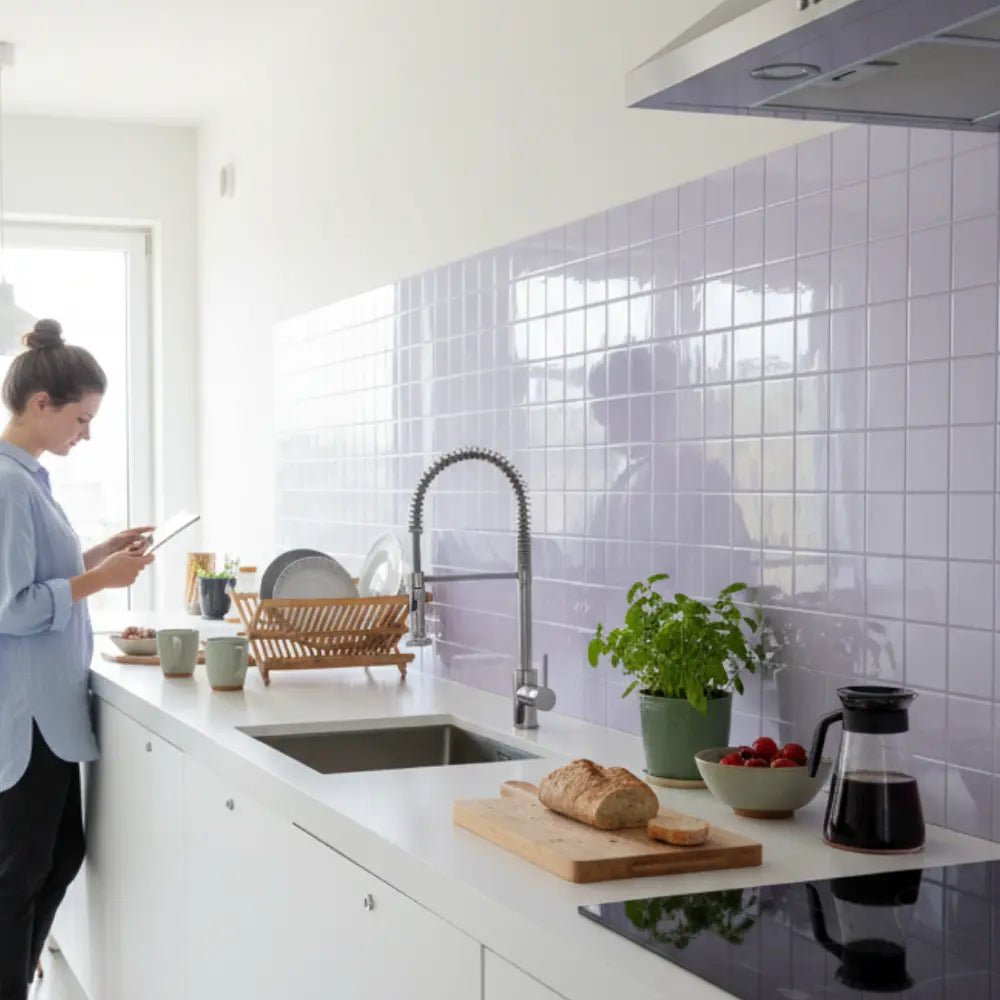



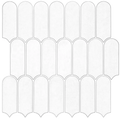
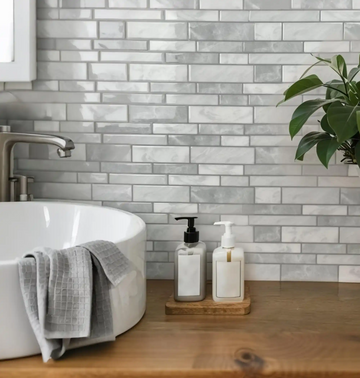
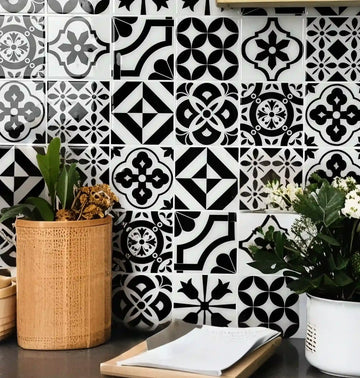

An accessible kitchen wall finish should support the person, the layout and the maintenance routine—not win a generic “best material” score. Wheelchair users differ in seated reach, transfer style, chair dimensions, hand strength, vision, cooking habits and the way they approach counters. A wall finish that works well behind a sink may not be the right material on a lower wall that receives repeated chair or footrest contact.
This guide replaces synthetic burden scores and ranking tables with a zone-based planning method. Use accessibility standards where they legally apply, observe the actual user and kitchen, map reach and service points, then choose wall finishes based on cleaning, impact, heat, moisture, glare, repairability and access.
Start with the person and the kitchen layout
Before choosing backsplash material, observe how the kitchen is actually used. Where does the wheelchair approach the sink? Which cabinet faces or lower walls receive contact? Which controls, outlets and storage areas are difficult to reach? Does the user cook from a front or side approach?
Do not assume that one “wheelchair user profile” describes everyone. A power chair, manual chair, scooter and transfer bench can create different reach and contact patterns. The finish plan should respond to the actual user rather than a generic disability persona.
Use ADA standards only in the right scope
The 2010 ADA Standards for Accessible Design set scoping and technical requirements for covered State/local government facilities, public accommodations and commercial facilities. They are an important reference, but a private residence may be governed by different accessibility, housing or local-code requirements.
Do not treat the decorative backsplash itself as the element that determines ADA compliance. Compliance belongs to the facility and the applicable elements, routes, clearances, controls and dimensions—not to the decorative surface alone.
Kitchens and kitchenettes have layout requirements in covered facilities
Section 804 of the 2010 ADA Standards contains technical requirements for kitchens and kitchenettes, including clearances for pass-through and U-shaped layouts where applicable. Those dimensions are measured from opposing cabinets, counters, appliances or walls—not from the decorative backsplash pattern.
That means a wall finish project should not reduce an already-required clear area through projecting trim, thick protection or poorly placed accessories. If the kitchen is a covered facility, coordinate the finish with the complete accessibility design.
Reach ranges apply to operable parts, not to decorative wall color
Section 308 addresses forward and side reach ranges for accessible elements and operable parts. These provisions matter for switches, controls, outlets, dispensers and other usable elements; they do not prescribe a “best backsplash height.”
Plan the wall finish around the controls that must remain reachable. Do not bury an outlet behind thick trim, move a switch out of reach for visual alignment, or place a decorative shelf where it blocks approach.
Create a kitchen wall-zone map
Divide the kitchen wall into functional zones instead of selecting one material for everything:
- Counter/sink backsplash zone: cleaning, splash and outlet access matter most.
- Range/appliance zone: heat and appliance clearances control the finish.
- Lower-wall contact zone: scuffs, chair/footrest impact and local repair matter.
- Corner and end-panel zone: repeated impact and edge protection matter.
- Control/service zone: outlets, switches, valves, appliance connections and access panels must remain usable.
- Upper decorative zone: appearance and glare may matter more than physical contact.
A single kitchen can therefore use a wipe-clean backsplash, a replaceable lower-wall protector and a different finish at high-impact corners without any conflict.
Separate backsplash performance from lower-wall protection
A backsplash sits near countertops, sinks and appliances. Lower-wall protection may sit below counter height, beside a wheelchair approach or along circulation paths. The damage mechanisms are different.
A finish that resists sink splashes can still be poor at repeated impact. A durable lower-wall guard can be visually inappropriate behind a cooktop. Choose each zone for the work it actually performs.
Lower-wall scuffs need observation, not a simulated score
Look at the real contact marks already present in the kitchen. Are they near cabinet ends, door returns, baseboards, chair turning areas or the approach to the sink? The location tells you whether the problem is tire contact, footrest contact, bag impact, cleaning equipment or another source.
Photograph those zones and measure the area that actually needs protection. A replaceable panel or durable finish only where contact occurs can be more practical than covering every wall with a heavy-duty material.
Choose lower-wall protection for repairability
High-contact areas benefit from finishes that can be cleaned and locally repaired. A modular panel, replaceable tile or durable corner protector may reduce the need to repaint a large wall after repeated contact.
Do not call one material “wheelchair proof.” Chairs, footrests and mobility devices can exert different loads, and wall damage also depends on corner geometry and user movement. Plan for maintenance instead of promising immunity.
Corner protection can be deliberate without looking institutional
Outside corners often receive repeated impact because they project into circulation paths. A metal, polymer or other protective profile can be selected to coordinate with cabinet hardware and the room palette rather than looking like an afterthought.
Keep the profile smooth, serviceable and appropriate to the wall. Do not add a projection that interferes with an accessible route or creates a snag point. In covered facilities, check applicable protruding-object and route requirements.
Cleaning effort matters at seated reach height
A finish that requires frequent overhead scrubbing can be difficult for someone who cleans from a seated position. Deep grout joints, heavy texture and highly embossed surfaces can collect soil or require more reach and pressure.
That does not make grout or texture inaccessible by definition. It means the maintenance plan should be tested with the actual user. Place a sample at the intended height, soil it with a representative kitchen stain where appropriate, and see whether the approved cleaner and cloth can remove the mark comfortably.
Use a real cleaning trial instead of a burden index
A practical sample check can record three things: how visible the stain is, what approved cleaner removes it, and whether cleaning requires awkward reach or force. Keep the result descriptive.
“Coffee wiped clean with the approved cleaner while seated” is useful evidence. A homemade score that combines stain visibility, reach and grout into one number hides the information needed to make the decision.
Groutless can reduce one maintenance task without becoming universally better
A grout-free or simulated-grout surface can eliminate cementitious grout cleaning, which may be useful in a high-maintenance zone. But seam design, texture, cleaner compatibility and edge repair still matter.
Traditional ceramic tile can also be appropriate when the wall assembly, grout system and maintenance plan fit the project. Do not rank entire material families solely by the presence or absence of grout.
Glare can affect usability and visual comfort
High-gloss tile, metal and polished stone can create strong reflections from windows and task lighting. Some users with low vision or light sensitivity may find glare more disruptive than a matte or lower-sheen finish.
Test samples from seated eye level in daylight and under the kitchen’s actual lights. A surface that looks subtle when standing can create a bright reflected band from a wheelchair viewing position.
Pattern contrast can help or hinder orientation
Strong contrast can help define edges or zones, but excessive high-contrast pattern can make a busy kitchen harder to visually parse for some users. The right balance depends on the person and the rest of the room.
Use samples and room mock-ups rather than assuming that more contrast is always more accessible. Keep critical controls and boundaries visually clear.
Color should support the person, not a universal accessibility formula
There is no single “accessible backsplash color.” Lighting, vision, cabinet contrast and personal preference matter. A muted green, white subway, warm neutral or dark accent can all work when the room remains legible and comfortable.
When the user has specific visual needs, test actual material under the real lighting and prioritize the user’s experience over generic style rules.
Sink zones need splash and cleaning planning
A sink backsplash should tolerate the documented splash exposure and approved cleaning routine. Seams, outlets and exposed edges still matter; a wipe-clean face does not automatically make the complete wall waterproof.
Keep faucet repairs, shutoffs and plumbing access serviceable. A finish that is difficult to remove around a valve or access panel can create unnecessary maintenance later.
Range zones need appliance-specific heat guidance
The wall behind a cooktop or range can see radiant heat, hot exhaust or direct flame depending on the appliance. Do not select a finish because it scored well for scuff cleaning.
Use the exact appliance clearances, wall-finish documentation and applicable code. A lower-wall impact material may be unsuitable in the cooking heat zone even if it works elsewhere in the same kitchen.
Keep controls, outlets and service points reachable
Wall finishes can add thickness around outlets, switches, thermostats, appliance connections and access panels. Confirm that cover plates still fit, controls remain operable and the finish does not create an awkward recess around a reachable element.
Do not move an operable part simply to align a pattern without checking accessibility and electrical/plumbing requirements. The design should adapt to the functional element.
Use clear floor and approach space as a layout constraint
Wall protection, decorative trim, freestanding panels and storage can project into the space used to approach counters or appliances. In a covered facility, accessible route, turning and kitchen-clearance requirements can apply; in private homes, the user still needs practical maneuvering space.
Keep protection tight to the wall and avoid adding unnecessary depth in a narrow passage. A thicker finish is not automatically more accessible if it reduces usable maneuvering space.
Test samples from seated position
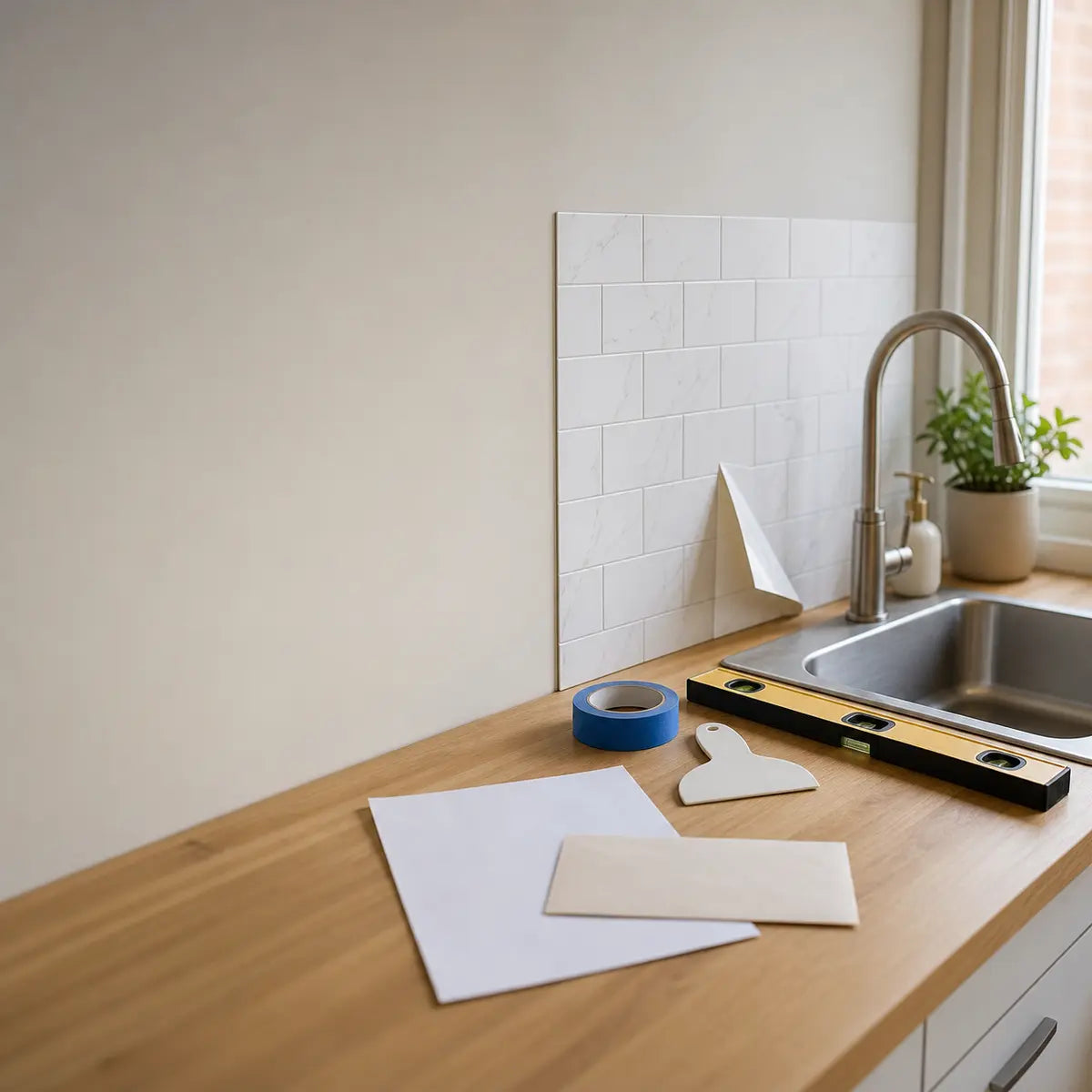
Mount samples at the actual wall height and view them from the person’s seated position. Check glare, pattern scale, seam visibility and whether the color makes outlets or controls easier or harder to find.
Also test cleaning from the same position. This can reveal that a beautiful heavily textured finish is difficult to wipe in a zone the user reaches frequently.
Use the user’s comfortable reach map for storage-adjacent walls
Mark where the user naturally reaches for utensils, small appliances and cleaning supplies. The wall finish should not interfere with shelf brackets, pull-down hardware, rails or other adaptive equipment.
Where the wall carries frequent accessories, a repairable finish can be useful because future modifications may create holes or local damage.
Do not confuse an accessible kitchen with a clinical-looking kitchen
Accessibility does not require institutional colors or hospital-style wall guards. Protective materials can be integrated into cabinet ends, base panels, backsplash zones and trim with deliberate color and finish choices.
Use the same design process as any other kitchen—palette, material, lighting and proportion—while respecting the user’s reach, mobility and maintenance needs.
Choose visual calm where the room already has many controls
Kitchens contain appliance displays, cabinet hardware, outlets, switches, labels and stored items. A highly complex wall pattern can add more visual information to an already busy field.
When the user benefits from clear visual organization, quieter patterns or controlled contrast can make functional elements easier to identify. Test the full scene rather than the wall sample in isolation.
Local replacement can reduce maintenance disruption
When the lower wall receives repeated contact, choose a system that can be repaired locally if practical. Keeping spare tile, panel or corner-protector pieces can reduce the need to refinish a large area.
Record the product, color and dimensions so maintenance staff or future owners can match the material later.
Do not use a total-cost formula to hide assumptions
It is reasonable to compare material, installation, cleaning, repair and replacement costs, but a proprietary lifecycle-cost formula can hide assumptions about labor, service life and maintenance frequency.
Build a transparent worksheet instead. Use current project prices and the actual cleaning/repair routine. Keep unknowns visible rather than converting them into points.
Build a zone-by-zone cost worksheet
| Zone | Cost items to compare | Maintenance questions |
|---|---|---|
| Sink backsplash | Finish, wall prep, edges, outlets, spare pieces. | Approved cleaner, seam inspection, splash exposure. |
| Lower-wall contact zone | Protection material, trim, local-repair stock. | Scuff removal, impact repair, replacement frequency. |
| Range zone | Heat-compatible wall system, trim, installation. | Heat/grease cleaning, appliance clearance. |
| Corner zone | Corner protection or reinforced finish. | Impact marks, sharp edges, local replacement. |
| Control/service zone | Finish cuts and removable covers. | Can controls and access panels still be serviced? |
This table is intentionally descriptive. The correct material can differ by zone even within the same kitchen.
Use a maintenance handover
At project completion, record approved cleaners, spare-material location, edge details and service points. Note which wall zones use which material and why.
This helps caregivers, facility staff or future owners maintain the wall without guessing which cleaner or repair method belongs to each surface.
Private homes need a user-centered plan even when ADA does not directly govern the kitchen
A private residence can still borrow useful accessibility concepts—clear approach, reachable controls, maneuvering space and easy maintenance—without claiming formal ADA compliance. The homeowner’s mobility, transfer method and daily routine should drive the details.
When the kitchen is part of a regulated housing program or another covered facility, use the standards that actually apply to that project. Do not use this article as a substitute for an accessibility professional or code review.
Commercial and employee kitchens may have different scoping
ADA.gov distinguishes kitchens and kitchenettes from ordinary employee work areas. Break rooms and kitchenettes can have accessibility requirements in covered facilities even when the space is used primarily by employees.
If the wall-finish project is part of a commercial renovation, coordinate it with the accessible route, counters, sinks, controls and appliance clearances that apply to the room. Decorative wall work should not create a new barrier in a space that was otherwise compliant.
Caregivers and shared kitchens need more than one reach pattern
Some kitchens are used by both a wheelchair user and a standing caregiver or family member. That can create different preferred heights for storage, controls and cleaning.
Do not solve the conflict by placing everything at one compromise height. Use pull-down storage, multiple accessible locations, movable accessories and zone planning where appropriate. The wall finish should support those adaptations rather than blocking them.
Wheelchair contact is not the only lower-wall wear mechanism
Footrests, walkers, cleaning carts, pet equipment, vacuum cleaners and movable stools can all scuff lower walls. Observe the actual household or facility before attributing every mark to the wheelchair.
This matters because the repair strategy may be different. A replaceable corner guard can solve repeated impact at one corner, while washable paint may be enough for ordinary cleaning marks on a broad wall.
Do not overbuild low-contact walls
A heavy-duty panel on every kitchen wall can add cost, thickness and visual weight without improving the areas that actually receive contact. Use protection where the evidence shows repeated wear.
Keeping low-contact walls lighter and easier to modify can also make future accessibility changes simpler if controls, storage or equipment move.
Glare and contrast should be evaluated with the user, not by formula
Accessibility guidance does not provide a universal backsplash gloss or color contrast percentage for every kitchen wall. The practical question is whether the actual user can identify edges, controls and work zones comfortably under the installed lighting.
Test samples beside cabinets, switches and countertops at the person’s viewing height. If glare, pattern or low contrast creates difficulty, adjust the design before installation.
Wall protection should not hide a protruding-object problem
In covered facilities, protruding objects and accessible-route requirements can matter. Adding a thick decorative ledge, shelf or trim to “protect the wall” can create a new obstacle if it projects into circulation space.
Keep protection close to the wall and coordinate any projection with the applicable standard. A flat replaceable panel may be more appropriate than a deep decorative molding in a narrow route.
Use a real-world sample board for scuff and cleaner tests
Create a small sample board with the actual finish and approved edge detail. Test the cleaner the household or facility normally uses and create a representative, non-destructive contact mark.
Record whether the mark wipes away, whether the surface gloss changes, whether the edge catches the cloth and whether the cleaning motion is comfortable from the user’s normal position. These observations are directly actionable.
Do not turn sample testing into a product-performance certification
A household scuff trial does not establish an abrasion rating, impact resistance class or code compliance. It only tells you how the sample behaved under the specific check you performed.
Use manufacturer test data for technical performance claims. Use the sample board for personal fit, cleaning effort and appearance.
Plan transitions between materials
If the sink backsplash uses one finish and the lower wall another, decide how they meet. A clean horizontal or vertical transition can look intentional and preserve local repairability.
Do not bridge a service panel, movement joint or removable cabinet end merely to make the pattern continuous. Functional access takes priority over a seamless visual line.
Use rounded or protected edges where repeated contact is likely
Sharp exposed corners can chip or catch clothing and bags. Where a high-contact edge needs protection, choose a profile compatible with the wall system and circulation space.
The profile should not create a new projection hazard or obstruct cabinet doors, drawers or wheelchair approach. Dry-fit the complete corner before fixing it permanently.
Frequently asked questions
What backsplash is best for a wheelchair-accessible kitchen?
There is no universal best material. Choose the finish by zone: sink cleaning, appliance heat, lower-wall impact, glare, reach, serviceability and repair. Different zones can use different materials.
Can a wall finish by itself determine ADA compliance?
ADA compliance applies to covered facilities and the relevant accessible elements, clearances, routes and operable parts. A decorative backsplash by itself does not determine whether the kitchen or facility meets the applicable ADA requirements.
What backsplash height is accessible?
Do not choose a backsplash height from a generic wheelchair number. Counter height, sink/cooktop layout, controls, wall exposure and the user all matter. In covered facilities, use the applicable ADA kitchen and reach provisions.
Are groutless tiles better for wheelchair users?
They can reduce grout-cleaning effort, but seam design, texture, glare, heat/moisture limits and repairability still matter. Groutless is one maintenance characteristic, not an accessibility rating.
Should I cover the whole lower wall with impact-resistant material?
Only where contact patterns justify it. Map the actual scuff and impact zones first. Targeted protection can be easier to replace and less intrusive.
Can peel-and-stick tile be used near a stove in an accessible kitchen?
Only where the exact product and appliance documentation support the placement. Accessibility and heat suitability are separate questions.
How can I reduce cleaning effort?
Choose a finish that the user can reach comfortably, use an approved cleaner that works without aggressive scrubbing, minimize unnecessary texture in high-soil zones and keep repairable edges accessible.
What should I test before choosing the finish?
Check seated viewing glare, stain cleanup, lower-wall contact, seam/edge feel, control visibility and local repair. Keep the observations descriptive rather than combining them into a homemade score.
Accessible-kitchen wall checklist
- Observe the actual user, chair and approach patterns.
- Confirm which accessibility rules apply to the project.
- Map sink, range, lower-wall, corner and service zones separately.
- Keep controls, outlets, shutoffs and access panels reachable and removable.
- Test samples from seated eye level under real lighting.
- Compare cleaning effort using the approved cleaner.
- Protect only the lower-wall and corner zones that actually receive contact.
- Keep range-zone materials within appliance and product heat limits.
- Avoid projections that reduce maneuvering or accessible-route space.
- Save spare material and maintenance instructions for local repair.
Bottom line
An accessible kitchen wall plan should make the room easier to use and maintain without reducing clear space, reach or service access. The strongest solution is usually zone-specific: a cleanable backsplash where food and splashes occur, durable lower-wall protection where contact actually happens, protected corners where impact repeats, and unobstructed controls and service points.
Use ADA standards where they apply, but do not turn wall finishes into compliance badges or user-needs scores. Observe the person, test the material at seated height, document cleaning and repair requirements, and choose the finish that fits each zone of the real kitchen.
Start with the person and the kitchen, not a score
Wheelchair users have different reach, transfer patterns, chair dimensions, strength, vision and cooking routines. A useful wall-finish plan begins with the actual user and layout rather than an invented burden score.
Observe where the chair contacts lower walls, where seated cleaning is difficult and which controls or outlets need clear access.
Use accessibility standards in the right scope
The 2010 ADA Standards provide dimensions and accessibility requirements for covered facilities. They are a valuable reference, but a private home may follow different codes or voluntary design goals.
Use the applicable jurisdiction and project requirements rather than copying one ADA dimension into every residential kitchen.
Map seated reach and clear floor space
Place tape on the wall to mark the user’s comfortable reach range and note where cabinet doors, appliances or counters block approach. This turns an abstract accessible-design question into the actual kitchen geometry.
Keep frequently maintained wall areas and service points within a practical reach when the layout allows it.
Separate backsplash from lower-wall protection
A backsplash deals with sink, counter and cooking-wall exposure. Lower-wall guards or corner protection address chair, footrest and caster contact. They may need different materials and heights.
Do not force one decorative finish to solve every impact, moisture and heat condition.
Choose cleaning effort deliberately
Grout lines, deep texture and high-gloss surfaces can create different maintenance burdens. Compare how many motions and how much reach the real user needs to clean the wall.
Use the cleaner and tool approved for the exact finish, and consider whether local scuffs can be removed without aggressive scrubbing.
Plan lower-wall impact without medicalizing the room
Durable corner protection or a replaceable lower section can be integrated with residential colors and patterns. Accessibility does not require an institutional appearance.
Choose visual contrast and material transitions that fit the user’s vision and preferences as well as the room design.
Keep sink and range requirements separate
A finish that handles chair scuffs may not be suitable near heat, and a cooking-zone material may not be the easiest lower-wall protection. Verify each zone independently.
Around the sink, separate wipeable face claims from complete water-management requirements.
Preserve service access
Outlets, shutoffs, appliance connections, thermostat controls and access panels should remain reachable and removable. Do not create decorative protection that makes maintenance harder for the user or technician.
If the wall system changes clearances or access, revise the design before installation.
Use local replacement as a practical criterion
A finish that can be repaired in one high-contact area may reduce future disruption. Ask how a damaged edge, corner or panel is replaced and whether spare material can be stored.
Repairability is a maintenance feature, not proof that one material is universally best for wheelchair users.
Test samples at seated eye level
Color, glare and texture can look different from a seated viewing position. Put real samples at the heights and angles the user will see during normal cooking and dining.
Check reflections under task lighting and whether strong patterns interfere with visual clarity around controls and edges.
Document the chosen zones
Photograph the finished wall and label which material serves backsplash, lower-wall, corner or dry-accent functions. Keep care instructions and spare pieces together.
A future repair is easier when the reasoning and product limits remain visible.
Use a final accessible-kitchen checklist
Proceed when reach, clear approach, cleaning, impact, heat, moisture and service access all work for the actual user. Reconsider when a material solves one problem by creating another.
The best accessible wall plan is specific to the person, room and product—not a universal ranking.
Sources and scope
- 2010 ADA Standards for Accessible Design — Accessibility reference for covered facilities; private-home design may have different requirements.
- US EPA: Mold, Moisture and Your Home — Moisture-control guidance; not approval of a wall covering.


Leave a comment
This site is protected by hCaptcha and the hCaptcha Privacy Policy and Terms of Service apply.